


















“Work is anything one is obliged to do. Play is anything one is not obliged to do.”
Mark Twain, The Adventures of Tom Sawyer, 1876.
In other words: why, in *Ghost in the Shell*, *Blade Runner*, *Evangelion* and *Star Trek*, do we stubbornly continue to do the same jobs we do today?
Random notes from a digital second-hand dealer
“Work is anything you are obliged to do. Play is anything you are not obliged to do.” Mark Twain, The Adventures of Tom Sawyer, 1876. In 150 years, we have not found a better definition. Everything that follows is simply a commentary on this sentence.
A salesman delivers a brand-new vacuum cleaner to the customer’s home. He shows it to the lady of the house with all the enthusiasm one would expect.
“Madam, this vacuum cleaner will cut your workload in half.”
The lady looks at him. She thinks for a second. She replies:
“Marvellous. I’ll have two, please.”
I’ve been thinking about this joke for days. Because in just thirty words, it sums up everything we’ve said in three articles. We produce more. We work more. Work doesn’t decrease: it multiplies. Technology doesn’t free up time. It fills it.
Perhaps this is the flaw of digital second-hand dealers. When they come across an old joke, they don’t just laugh at it. They pick it apart. Because every now and then, a joke hides an economic theory that’s better than many reports full of graphs.
But there is one question that has still not left me. If we cannot imagine a future with less work, can we at least imagine a future with a different kind of work? I did something simple. I went looking for it. The work of the future. In the places where humanity has already imagined it. In science fiction novels. In films. In anime. In TV series. And I discovered something extraordinarily intriguing.
The future is full of spaceships. Human beings are still working as lorry drivers
– Ghost in the Shell. Motoko Kusanagi is a policewoman.
– Blade Runner. Deckard is a detective.
– Minority Report. The police of the future.
– The Expanse. Military personnel, politicians, asteroid miners.
– Star Trek. Space sailors with stars on their shoulders.
– Evangelion. Teenage soldiers piloting giant robots.
– Alien. Space truck drivers in overalls.
*The Lawnmower Man*. A gardener with cognitive impairment who becomes a digital god — but it all starts there, with the lawnmower, because clearly even in the future someone has to mow the lawn. (Yes, *The Lawnmower Man*, the one with Pierce Brosnan.)
Science fiction imagines the future of technology with boundless creativity. Warp-drive spaceships. Sentient artificial intelligence. Cyborgs with digital souls. Colonies on Mars. Time travel. Yet, in almost all science fiction, human beings stubbornly continue to do the same jobs they do today. Police officers. Soldiers. Pilots. Scientists. Detectives. Mercenaries.
It is easier to imagine a new car than a new society. Machines are learning to do jobs. We must learn to nurture relationships.
Perhaps this is the most honest thing that can be said about the future of work. It is not a criticism of science fiction. It is an X-ray of our collective imagination. We can design spaceships, but we struggle to devise new ways of living together.
We can design spaceships. We struggle to build relationships. We can imagine technological advances centuries into the future. We struggle to imagine how we will organise work and value ten years from now.
William Ogburn would have called it ‘cultural lag’: technology races ahead, whilst institutions lag behind. Science fiction, perhaps unwittingly, depicts precisely this. There is one exception. The Mos Eisley Cantina in Star Wars is the only place in science fiction where you can’t tell what people are actually doing. But even there, the answer is the same: they’re either outlaws, bounty hunters, or involved in some sort of trafficking. The role in between — the support network, the carer, the educator — does not exist. Giufà would fit right in at the Mos Eisley Cantina. And no one would ask him what he does for a living. But there is something that science fiction fails to include: try finding a nurse as the protagonist in a science fiction film. A carer. A primary school teacher. A community facilitator. Someone who builds networks of trust between strangers. An educator. Someone who looks after an elderly person in a world of spaceships. You won’t find them. Or hardly ever.
Science fiction imagines the future of power. Of technology. Of control. Of conflict. It does not imagine the future of care. And yet, in previous articles, we had said exactly this: the jobs set to grow – those untouched by automation, those that keep ageing societies afloat – are precisely these. Caregivers. Educators. Community builders. The support network.
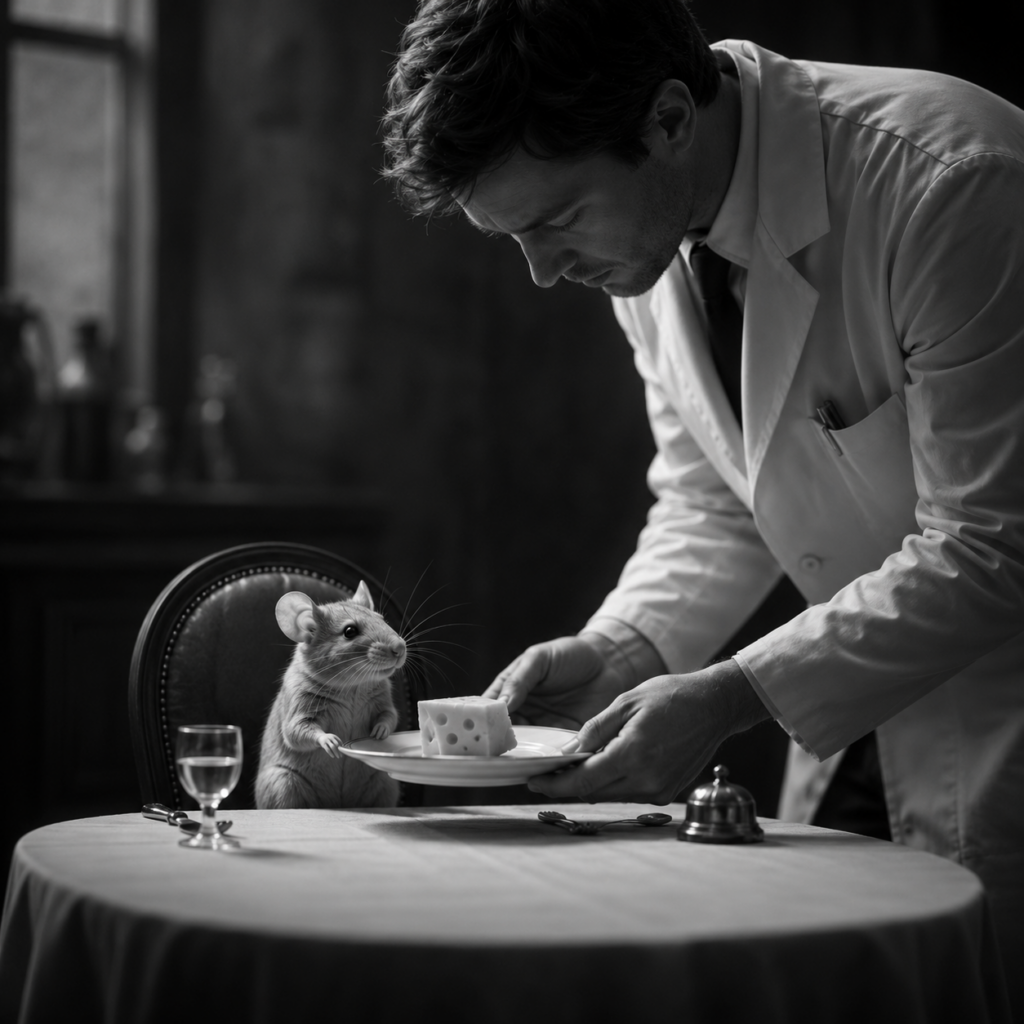
Mice, in short. Science fiction doesn’t feature them. Just like elephants.
Three people who had already figured it all out
But there is a genre of literature that has tackled the issue of work head-on. Not science fiction. Popular fiction. The sort of stories that don’t take themselves too seriously.
Pinocchio doesn’t want to work. He makes this clear to the Talking Cricket, without beating about the bush:
“Of all the occupations in the world, there is only one that truly suits me — that of eating, drinking, sleeping, enjoying myself and living the life of a vagabond from morning till night.”
Pinocchio refuses to work. That is why he is frightening. Not because he is wicked, but because he challenges the moral foundation of the nineteenth century: one becomes a man through work. When he finally agrees, the story ends.
Giufà doesn’t fight the system. He gets round it. He survives. He laughs at its rules without having the power to change them.
The Russian Pilgrim works just enough to keep going on his journey. His occupation does not define his identity.
Three strategies, not three characters. The second-hand dealer looks at all three of them with warmth. Not because they are right, but because none of them confuses their profession with who they are as a person. Perhaps the future of work begins precisely when we stop identifying ourselves with our job title.
Pinocchio refuses. Giufà gets round it. The Pilgrim transcends it. Science fiction would have turned them into policemen. The question that science fiction doesn’t ask: if machines are doing more and more things, what will be the last job left for human beings?
Caring? Educating? Creating meaning? Being there for someone who is suffering? Asking the right questions? Laughing at a joke about a vacuum cleaner?
The Russian Pilgrim would say: pray.
Giufà would say: make do.
Pinocchio, having finally become a real boy, would probably say nothing. He’d be working.
And perhaps that is precisely the problem. Where, then, does it lie? Perhaps the future of work is not where we are looking.
Not in McKinsey’s reports. Not in economists’ forecasts. Not in the spaceships of *Star Trek* or the cyborgs of *Ghost in the Shell*. It is to be found in the places that science fiction overlooks. Perhaps because care is difficult to portray. A duel makes for a spectacle. One person listening to another fosters civilisation. But cinema almost always prefers the former.
In the nurse who works the night shift. In the neighbour who brings over the shopping. In the teacher who stays behind after hours. In those who build trust without anyone noticing.
Pinocchio refuses. Giufà gets round it. The Pilgrim transcends it. None of the three becomes a space policeman. Perhaps because they had already realised what the job that really mattered was. Perhaps the future of work does not really exist. There are people who stubbornly continue to find new ways to be of service to others. Technology changes the tools. It does not change this stubbornness.
P.S. A mouse says of its experimenter: “I’ve trained that man so that every time I press this lever, he feeds me.” With AI, we’re doing exactly the same thing. The only question is who’s pressing the lever.
P.P.S. On the day he came up with that theory, Tom Sawyer was about to whitewash a fence. He couldn’t be bothered. So he convinced his friends that whitewashing a fence was a rare privilege. One after the other, they paid to do it for him. Tom spent the afternoon watching. The fence was whitewashed three times. The theory worked. It took McKinsey a hundred years to reach the same conclusion. With far more charts.