

















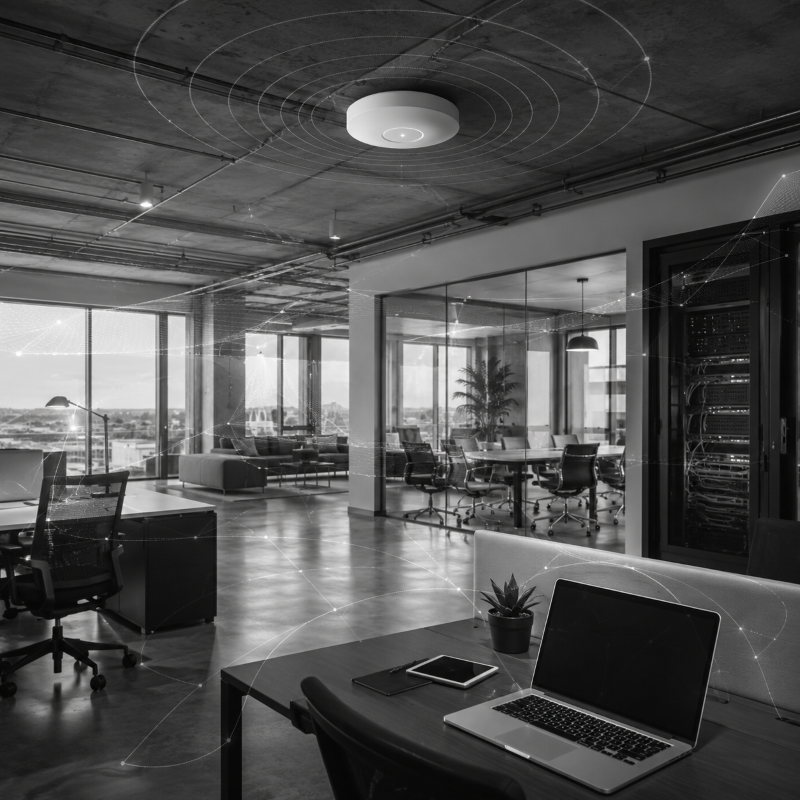

Digital sustainability is not just about large data centres or solar panels on a company’s roof. It also depends on less visible, yet crucial, elements: the network, connectivity, Wi-Fi coverage, equipment, configurations, hidden energy consumption and signal quality. Every digital process, from video conferencing to warehouse management, from the IoT to VoIP telephony, depends on a network infrastructure that must be stable, secure and efficient. When this foundation is poorly designed, the company wastes not only time but also energy, equipment, maintenance resources and productivity.
This is why a Wi-Fi site survey service for businesses can serve as the starting point for a broader assessment. Analysing the wireless network is not just about checking whether “the Wi-Fi works”. It means understanding how the signal propagates, where interference occurs, how many access points are actually needed, which areas are over-provisioned, where coverage is insufficient, and how to design a connectivity solution that aligns with the actual use of the spaces.
The network as an invisible environmental infrastructure
In the office, the network is often only noticed when it isn’t working. A video call that cuts out, a workstation that loses connection, a sluggish business management system, a printer that can’t be accessed or an unstable IoT device all become immediate operational problems. But behind these incidents lies a question of efficiency. A network designed without proper analysis can lead to an excessive number of devices, increased transmission power, the inclusion of redundant equipment or trial-and-error interventions, all of which have an impact on energy consumption and maintenance costs.
Sustainable efficiency, on the other hand, stems from well-thought-out design. It is not always a question of ‘more network’; it is a question of having the right network. The right number of access points, positioned correctly and configured to take account of actual obstacles, improves coverage and stability without adding unnecessary hardware. This approach also reduces the need for subsequent corrective measures, which often result in costs, technical interventions and unplanned replacements.
Wi-Fi, the Internet of Things and the digital workplace
The proliferation of sensors, mobile devices, room booking systems, VoIP phones, access badges, connected printers and collaboration tools has increased the strain on corporate networks. Wi-Fi is no longer just an ancillary service for browsing the internet, but a key component of productivity. If the network is not scaled to accommodate the number of users, the density of the premises and the applications actually in use, the digital experience deteriorates and the company tends to compensate with makeshift solutions.
A professional site survey enables you to assess the environment before taking any action. Walls, materials, glass, shelving, machinery, open-plan offices, meeting rooms and production areas all affect signal propagation. Neighbouring networks, legacy equipment and user distribution can also cause interference. Measuring these factors enables the design of a more stable network and, indirectly, a more sustainable one, as it is less reliant on trial-and-error adjustments.
Energy efficiency and the life cycle of equipment
IT sustainability is not just about instantaneous consumption. It also concerns the life cycle of equipment: how many devices are purchased, how long they last, when they are replaced, and how much work is required to maintain them. An oversized network may seem prudent, but it often creates unnecessary complexity. An undersized network, on the other hand, requires constant upgrades and emergency repairs.
Proper design helps to strike a balance. If you know the coverage, density and expected traffic, you can select suitable equipment, distribute loads more effectively, optimise channels and power levels, plan upgrades and reduce waste. At a time when even data centres and transmission networks are being scrutinised for their energy impact, paying attention to the local corporate network is a concrete step towards more responsible digital management.
Sustainability also means continuity
An efficient network is sustainable partly because it reduces disruptions, wasted time and duplication of effort. If an employee has to repeat a video call, move to another room to get a signal or rely on personal hotspots, the problem is not just technical. It is organisational. The quality of connectivity affects the way people work, collaborate and use digital tools.
This is particularly true in hybrid working environments, where the office must offer a seamless experience to those who alternate between working on-site and remotely. Meeting rooms, shared areas and flexible spaces require coverage designed around actual usage patterns, not a theoretical floor plan. A well-designed network makes more efficient use of space and reduces the need for alternative solutions.
From diagnosis to design
The value of a Wi-Fi site survey lies in its ability to turn perceptions into data. ‘The signal is weak’ becomes a coverage map. ‘The network often drops out’ becomes an analysis of interference. ‘We need more access points’ can sometimes be resolved simply by rearranging the existing equipment. This shift from gut feeling to diagnosis is essential to avoid making the wrong investments.
Corporate networks and sustainability are therefore more closely linked than they might seem. Carefully planned connectivity supports digital working, reduces waste, improves security and extends the useful life of the infrastructure. It is not the aspect most people are aware of, but it is often one of the factors that enables all the others. Because any company that wants to become more digital, efficient and responsible must also start with what is not visible: the quality of the network that brings people, data and processes together.
