







For a long time, we have pursued precision, efficiency and perfection. We have come to believe that this was the yardstick by which our worth was measured. Then came artificial intelligence, which is, by its very nature, more precise and more efficient. And this has given rise to fears and debates, centred on the future of work: will we all become replaceable? But there is another perspective worth considering: in an age where AI works to make everything run smoothly and perfectly, value is shifting elsewhere. And perhaps now more than ever, our unpredictability, our imperfection – in a word, our humanity – becomes a strength worth protecting: a choice we can all make today, and one that may be the key to making us truly irreplaceable.
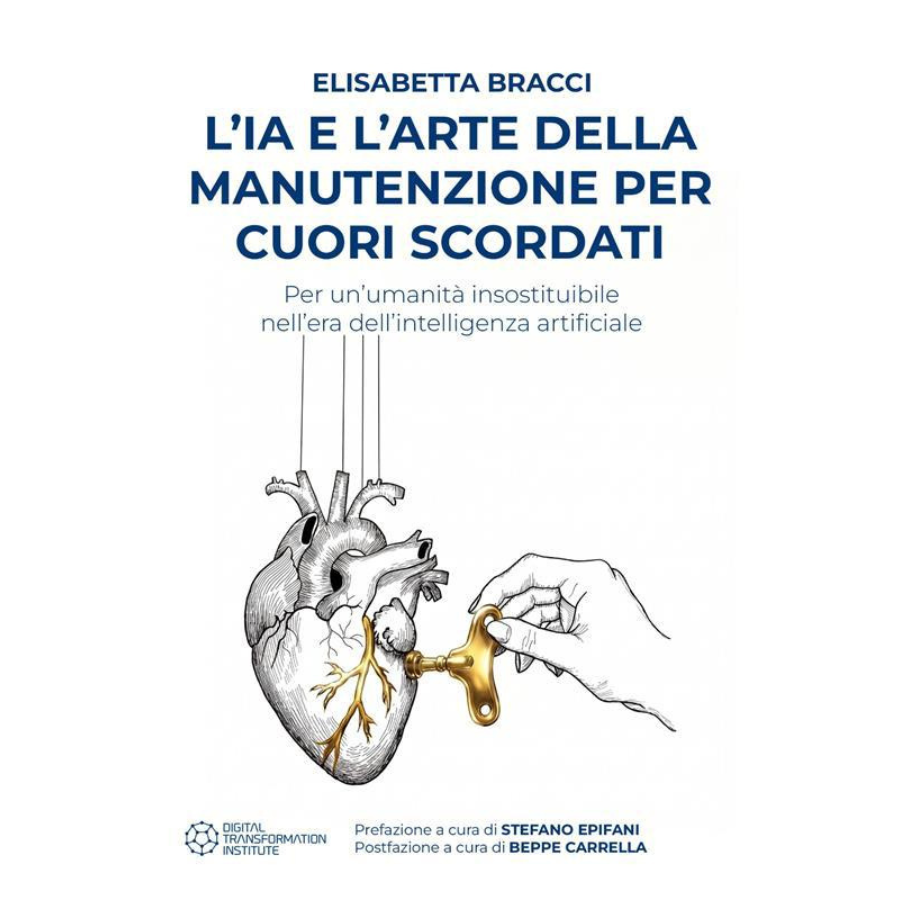
These reflections form the core of Elisabetta Bracci’s new book, entitled *AI and the Art of Maintaining Forgotten Hearts*– published by the Digital Transformation Institute. In this interview with the author herself, we explored the book’s contents in depth, from how it came about to what it aims to offer readers.
Let’s start with the title: a call to remain ‘human’ in the age of AI. What inspired it?
It all began with a poem. There is a line by Montale, in *Corno Inglese* (1925), from the collection *Ossi di Seppia*, in which the heart is described as a ‘forgotten instrument’: it longs to resonate in harmony with nature, with the wind, but remains out of tune. That line has never left me. And the more I reread it, the more I realised it held a dizzying insight: in the heart, unlike a violin, the musician and the instrument are one and the same. We are the ones who play ourselves. We cannot hand the instrument over to a luthier and come back to collect it in tune. It would be easier, but that’s not how it works. That’s where the title came from, and with it the idea of maintenance. Because an out-of-tune heart doesn’t need fixing; it needs tending. Montale, in his day, feared the mechanisation brought about by the Great War. I believe that today we are experiencing a more subtle and perhaps more insidious form of mechanisation: that of cultivating original thought. Remaining human, then, does not mean rejecting machines. It means tending to one’s own discord as the very last thing that is truly, irreducibly our own. It is an act of tending to the heart in an age that would like to tune us all to the same note.
In the book, he introduces the concept of ‘scordatura’. Where does it come from, and why is it so strategically important today?
‘Scordatura’ arose from a very personal question. Whilst training as an EQ Practitioner, I was asked to define my ‘noble goal’: a profound purpose, something that would guide my choices beyond material success. I spent a long time working on this, and the answer that emerged was to cultivate ecosystems in which technology generates ethical and inclusive prosperity — but starting with a specific act: focusing on my own “scordatura” and embracing that of others as a source of richness, not as a flaw to be corrected.
From an intimate concept, however, ‘detuning’ has proved to be a strategic key. Because Artificial Intelligence, given the way we are using it, is a sort of ‘universal tuner’: it works to eliminate all friction, to make everything fluid, smooth and average. And when you try to verify this with the figures, the picture is striking. I refer to the 2023 Harvard study, ‘Which Humans?’, in which researchers compared GPT with data from the World Values Survey, based on nearly 95,000 people across 65 countries. The result? GPT aligns almost exclusively with WEIRD (Western, Educated, Industrialised, Rich, Democratic) psychology – an analytical and individualistic style of thinking that ignores holistic and relational cultures. For the machine, diversity is simply statistical ‘noise’ to be reduced. Put simply, if we were to work in a multi-ethnic team, the machine would replicate the semantic constructs of around 12 per cent of the world’s population, leaving everyone else out. Yet it is precisely multi-ethnic teams that generate the most valuable ideas, which arise from the convergence of different ways of viewing reality.
That is why thinking outside the box is so strategically important today: it is the ability to deviate productively from the norm. It is precisely what a machine, by its very statistical nature, cannot do. Where the algorithm seeks the centre, we can choose the margins. And the margins, today, are the most valuable place there is. Because they cannot easily be replicated.
Is it, then, paradoxically, imperfection that is the key to making us irreplaceable?
Yes, and it’s a paradox I’ve learnt to love. For years, we’ve measured ourselves by precision, efficiency and the ability to avoid mistakes. But there is one rule that runs through the whole book, which I summarise as follows in the Manifesto: if a machine does something perfectly, that thing is no longer the measure of our value. The moment an AI writes a flawless report or translates a text without a single slip, that value doesn’t disappear: it simply shifts elsewhere. It moves towards what perfection cannot do: doubt, friction, the unexpected, subtle irony, paradox.
In the essay, I describe AI as a highly sophisticated trompe-l’œil: just as that painting technique deceives the eye by simulating depth on a flat surface, AI simulates depth of thought on a surface of pure probabilistic calculation. It is a perfect illusion – until the unexpected happens. That is when it collapses. And it is there, in that crack, that we can find our place.
Leonard Cohen speaks of‘a crack through which the light shines’. Smoothing away every imperfection means plugging that crack, and reducing ourselves to a silent shell. Our imperfection, on the other hand, is the crack through which the light enters. That is why I write that being statistically improbable is the true rebellion: not a limitation to be hidden, but the highest form of our freedom.
In the book, you imagine new professions that might emerge to safeguard our humanity. Could you tell us about them?
I’d be happy to, because it’s one of the sections I wrote with the greatest sense of responsibility. I’ll start with an observation: the ‘commoditisation’ of cognitive tasks (writing, translating, summarising…) is shifting the value of work towards human skills. So I had fun imagining eight professions that might emerge precisely to safeguard what makes us human. These aren’t provocations: they’re possibilities. Simply a different way of looking at the world of work.
I am thinking ofthe ‘Advocate of Forgetfulness’, a sort of devil’s advocate sitting on boards of directors, whose sole task is to cast doubt on the AI’s all-too-smooth reasoning. Or the Mentor of Fertile Boredom, a guardian of empty time, who teaches a truth we have forgotten: boredom is the necessary prelude to original insight. Then there isthe Architect of Forgotten Experiences, who designs analogue ‘disruptive experiences’ to restore our sense of the unexpected. And there isthe Ethnographer of Forgotten Futures, who seeks out ‘weak signals’ on the fringes of society, studying precisely what AI dismisses as noise. But perhaps the profession closest to my heart is the Biographer of Forgetting: someone who helps you build a professional identity based on fruitful failures and detours, rather than on the polished perfection of a CV. Because we are shaped as much by our victories as by our cracks.
All these figures, when it comes down to it, safeguard the same thing: the space in which we can remain irreplaceable.
The essay concludes with the ‘Manifesto of Forgetting’: could we describe it as a guide to embracing one’s own humanity as a source of strength in the age of AI?
Yes, that’s exactly how I’d describe it: a guide, but not in the sense of an instruction manual. It’s more like a compass. The Manifesto sets out seven principles for remaining human, and each one is a small act of gentle resistance. It opens with the right to forgetfulness – that is, the idea that vulnerability is beauty, not shame. Then there is the invitation to embrace effort, because friction is experience, whilst total smoothness is merely laziness disguised as comfort. There is the duty to nurture doubt, because human intelligence generates value through questions, not just through answers. And there is the defence of living memory against history summarised by algorithms, and of boredom as a sacred space.
It all comes down to the final principle: embracing the improbable. Because the greatest risk – the one that runs through the entire book – is the ‘responsibility gap’: ceasing to feel that we are in control of our own choices and even delegating our moral compass to an AI.
I wrote the Manifesto, after all, for myself, to keep that compass steady.
In conclusion: do you think that ‘scordatura’ can itself be seen as a tool for digital sustainability?
I am convinced of this, and it is perhaps the thought with which I would like to leave the reader. In the book, I draw on Luciano Floridi and his concept of semantic capital: over the millennia, humanity has accumulated meanings — stories, myths, symbols. From this perspective, AI is not a creator: it is a consumer and recombiner of that capital. It draws from a well that we ourselves have dug. And herein lies the risk: if we stop producing ‘forgotten’, unique, original content, will the world turn into a ‘desert of statistical platitudes’? The machine would continue to recombine, but from an increasingly meagre, increasingly recycled source.
That is why ‘scordatura’ is, to all intents and purposes, a tool for digital sustainability. Preserving our ‘scordatura’ means keeping alive the very source from which technology draws. It means not letting the well run dry. There is a wonderful image in Beppe Carrella’s afterword: AI as the Beatles’ ‘Dr Robert’, a doctor so skilled that he ends up making you unable to stand on your own two feet. The real revolution, then, is to remain ‘out of tune’ by choice. And a truly sustainable digital civilisation is one that still knows how to let itself be moved by emotion and unpredictability.