











A third of global production depends on Qatar and the Persian Gulf routes. A crisis that is not very visible, which (does not) pass through the Strait of Hormuz but is spreading to the entire global economy
For decades, it was regarded as little more than the gas used in party balloons. A curiosity on the periodic table, useful for making advertising airships fly or for raising a few smiles with a temporarily altered voice. In reality, behind this almost folkloric image, helium is one of the most strategic materials in the modern economy.
Without helium, many of the technologies that characterise modern medicine, the semiconductor industry, aerospace manufacturing and numerous scientific applications would not exist. Its availability affects supply chains worth thousands of billions of dollars. And today, due to the ongoing instability in the Strait of Hormuz, a vital part of the world’s supply is suddenly under pressure.
Public attention is focused primarily on oil and natural gas. But there is another raw material – one that is apparently far more … ephemeral – which threatens to disrupt the most critical industrial supply chains in the global economy.
An element born in the stars and trapped deep underground
Helium is the second most abundant element in the universe after hydrogen. Almost all of the helium in the cosmos was formed in the moments immediately following the Big Bang, whilst some continues to be produced inside stars through nuclear fusion reactions.
On Earth, however, helium is relatively rare. As it is extremely light and chemically inert, it tends to disperse into space. The helium used by industry today is the result of geological processes that take place over hundreds of millions of years.
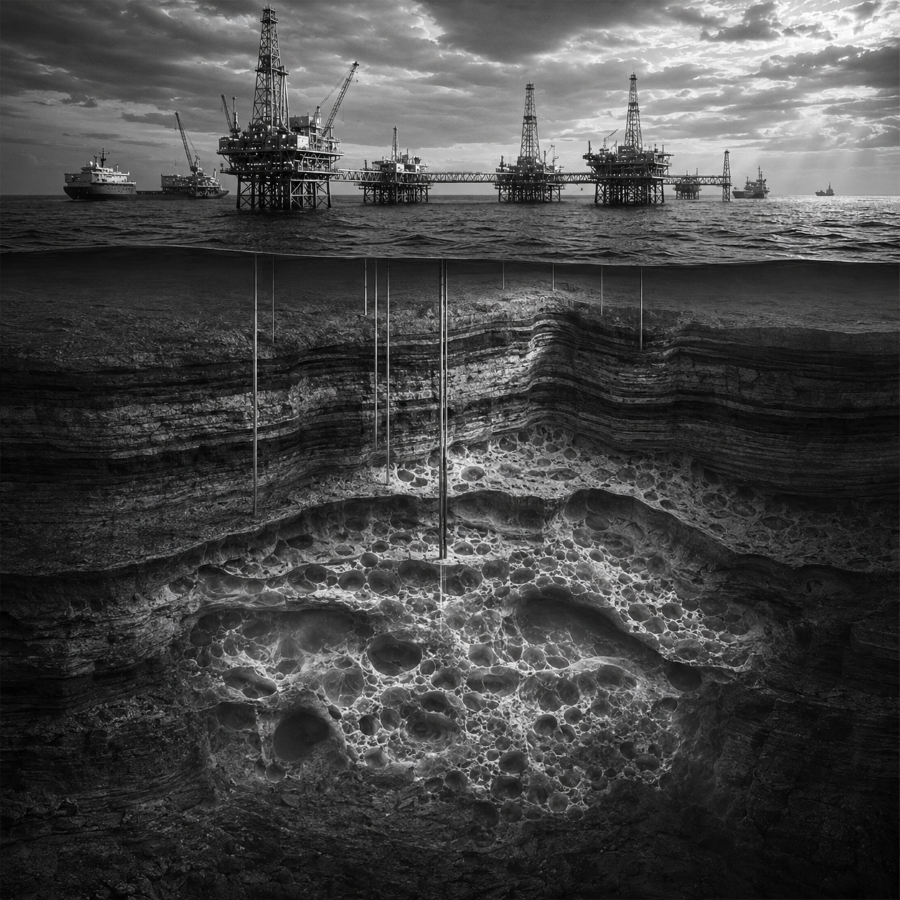
Earth’s helium derives mainly from the radioactive decay of uranium and thorium present in deep rocks. The alpha particles emitted during this process are, essentially, helium nuclei. Over geological time, these atoms accumulate in certain underground formations and, if they become trapped beneath impermeable layers, eventually mix with natural gas deposits.
It is precisely this association with methane that makes its extraction economically viable. Helium accounts for only a small fraction of the natural gas produced, but by weight it is worth much more than natural gas. Concentrations can vary from less than 0.1% to over 7%, but they are sufficient to justify dedicated separation and liquefaction plants.
World helium production is heavily concentrated in a small number of countries. For much of the 20th century, the United States dominated the market thanks to its vast natural gas reserves, found mainly in Texas, Kansas and Oklahoma, to the extent that, as early as the 1920s, it had established a national strategic reserve designed to guarantee the supply of a resource considered essential to the country’s security.
It is no coincidence that helium came to be regarded as strategically important long before the era of microchips and MRI scans. Between the First and Second World Wars, in fact, it was regarded as a military resource of paramount importance for use in large airships. Unlike hydrogen, which provides greater lift but is highly flammable, helium is an inert gas and poses no risk whatsoever of explosion or fire. It was precisely for this reason that, in the 1920s and 1930s, the United States decided to severely restrict its export, effectively maintaining a near-monopoly on global supplies.
Germany, which had no natural gas fields of its own and could not access American reserves, was forced to rely on hydrogen to power its gigantic Zeppelin airships. It was a necessary choice that was to have dramatic consequences. On 6 May 1937, whilst docking at Lakehurst, New Jersey, the Hindenburg airship – 245 metres long and a symbol of German technological pride – caught fire and was destroyed in a matter of seconds. Thirty-six people died. Images of the catastrophe were seen around the world and marked not only the end of the era of the great airships, but also one of the clearest demonstrations of helium’s strategic value. Had Berlin had access to American helium, the most famous disaster in aviation history would never have occurred.
Over the last two decades, however, the geography of global production has changed profoundly. Qatar has emerged as one of the key players on the international market thanks to the vast reserves of the North Field, joining other major producers such as Russia, Algeria and Canada. Today, alongside the United States, the Gulf emirate is one of the pillarsof the global supply of a raw material that remains strategic, albeit for reasons very different from those that concerned governments in the 1930s.
This high degree of geographical concentration makes the entire supply chain vulnerable to geopolitical crises and logistical problems.
The gas that makes the high-tech economy possible
Helium’s importance stems primarily from its unique physical properties. No other element possesses, at the same time, such a low boiling point, high thermal conductivity and complete chemical inertness.
When cooled to -269 °C, liquid helium becomes one of the most efficient coolants in the world. This characteristic makes it indispensable in the superconducting magnets of nuclear magnetic resonance (NMR) equipment. Every MRI scanner installed in hospitals around the world relies on liquid helium to keep the magnets at temperatures close to absolute zero.
The electronics industry is another major consumer. Semiconductor manufacturing requires precisely controlled environments and highly sophisticated thermal processes. Helium is used to cool silicon wafers, maintain inert atmospheres and ensure the quality of production processes. In an industry where a few nanometres can determine the success or failure of an entire production batch, there are no equivalent substitutes.
Scientific research also depends on this element. Particle accelerators, cryogenic laboratories and numerous measuring instruments use liquid helium to operate at extreme temperatures.
In the aerospace and missile industry, helium is used to pressurise fuel tanks, cool components and ensure the safety of operations. NASA and the world’s leading space companies make extensive use of it.
In the metallurgical industry, it is used for welding special materials and for creating oxygen-free protective atmospheres. Even the production of optical fibres and LCD screens requires large quantities of this element.
Unlike other critical materials, used helium cannot be easily recycled. Once released into the atmosphere, it is lost forever. Every litre used therefore represents a non-renewable resource.
Qatar and the Strait of Hormuz bottleneck
Over the last fifteen years, Qatar has become a helium superpower. Thanks to
In partnership with Iran, Doha has developed one of the world’s largest liquefaction and separation facilities.
According to analyses reported by the IUMI (International Union of Marine Insurance) and the“Qatari Helium Shortages Report”, Qatar accounts for around 30 per cent of global liquid helium production.
This enormous capacity is concentrated mainly at the Ras Laffan plant, on the country’s east coast. From there, the helium is loaded into specialised cryogenic containers and shipped to Asia, Europe and North America.
The problem is that all these exports must necessarily pass through the Strait of Hormuz.
The ongoing instability in the Persian Gulf and the continuing tensions between Iran, the United States and Israel have transformed what had for years been regarded as a mere necessary passage into one of the most vulnerable points in the global economy.
According to estimates cited in the IUMI report, the closure of shipping lanes in the strait disrupts almost 30 per cent of the global supply of helium.
Unlike oil, for which there are strategic reserves, alternative pipelines and a number of producers, the helium supply chain is much more rigid. Spare production capacity is limited; and it is extremely difficult to ramp up production quickly in other countries.
Logistical disruptions have already demonstrated how dangerous they can be in 2017, when the diplomatic crisis between Saudi Arabia and Qatar led to a temporary halt in Qatari exports. At the time, numerous high-tech industries were forced to cut back on consumption and seek alternative suppliers.
The current situation is far more serious, as it directly affects the world’s main maritime corridor.
According to analysis published by The Motley Fool, the closure of the Strait of Hormuz has a severe impact on oil and LNG, but also on a wide range of strategic commodities, including helium, highlighting just how much advanced economies depend on a handful of global logistics hubs.
But it is not just a question of transit: Qatar, which in 2025 produced 33.2 per cent of the world’s helium, is now facing serious difficulties, not only because of the closure of the Strait, but also because the Iranian air strikes in March 2026 on the Ras Laffan complex have halted the extraction and refining of the noble gas. Even in the event of a swift truce (or ceasefire) allowing the immediate reopening of the Strait, it will take years to rebuild the damaged facilities and restore helium production to pre-war levels.
From microchips to hospitals: the domino effect on the value chain
The consequences of a prolonged helium shortage are far more far-reaching than one might imagine.
Semiconductor manufacturing is probably the most vulnerable sector. Taiwan, South Korea, Japan, the United States and Europe itself all depend on a stable supply of high-purity helium. A significant disruption would slow down chip production, with the effects quickly spreading to the automotive sector, consumer electronics, telecommunications and artificial intelligence.
The healthcare sector is also facing significant consequences. Hospitals that use MRI scanners rely on the availability of liquid helium to keep their superconducting magnets operational. Although many modern systems have reduced their consumption, the prolonged nature of the crisis is driving up running costs and causing supply problems.
Scientific research is another vulnerable link in the chain. Physics laboratories, materials research centres and infrastructure such as particle accelerators rely on a continuous supply of materials. A sudden shortage leads to delays, suspensions and additional costs.
The space sector is also affected. Helium is used to pressurise tanks and propulsion systems. The growth of the private space economy makes this dependence even more apparent.
Advanced manufacturing industries, ranging from specialist welding to the production of optical fibres, are facing price rises and supply difficulties.
The impact is amplified by the very nature of the market. Global demand is relatively inelastic and supply is extremely concentrated. Even a relatively minor disruption is enough to cause sharp price fluctuations.
The war in Iran and the risk of a new crisis in critical raw materials
The helium saga shows that the conflict between Iran, Israel and the United States is not just about regional security or the price of oil. Some of the world economy’s most sophisticated value chains are at stake.
Experience in recent years has shown that globalisation has created systems that are extremely efficient, but also surprisingly fragile. Semiconductors, rare earths, lithium, cobalt and – as many heads of state have only just discovered – even helium depend on a limited number of producers and a few shipping routes.
If the crisis in the Persian Gulf continues and the closure of the Strait of Hormuz becomes a permanent reality rather than a temporary threat, the world could face not only an energy crisis, but a genuine crisis involving critical raw materials.
It is likely that the United States and its allies will seek to prevent a total blockade through naval operations and diplomatic pressure. But recent history shows – and we have often discussed this very issue here – that it is not necessary to completely close a strait to cause significant economic disruption. Uncertainty, rising insurance premiums and the perception of risk are enough to alter trade flows and send prices soaring.
Helium, invisible and silent, thus offers a broader lesson. In the wars of the 21st century, it is not only oil and missiles that determine the balance of power on the international stage. Sometimes the fate of entire industrial sectors can depend on a noble gas that makes up just five parts per million of the Earth’s atmosphere, but without which a significant part of contemporary technological civilisation simply cannot function.