







486 dishonest scientists and their ingenious scheme for the systematic falsification of peer reviews
In the world of scientific research, the integrity of the peer-review process is essential to ensure that published studies are based on well-conducted experiments, reliable and well-documented analyses, and well-developed and reasoned arguments and conclusions. When this process is compromised, the damage can be enormous, not only for the scientific community but also for society as a whole.
This is the case with the recent scandal involving China, a country which, unfortunately, has gained an increasing notoriety in the field of scientific fraud linked to peer review. The data reveal a worrying trend: scientists from the People’s Republic of China are responsible for over half of the articles worldwide that are retracted due to peer-review issues. The unenviable all-time record for this fraudulent practice is currently held by the journal *Tumour Biology*, which was forced to retract 107 articles published between 2012 and 2016, the majority of which were authored by Chinese researchers.
A scandalous practice
We have already come across the concept of peer review on several occasions: this represents a fundamental cornerstone of the scientific method and its most obvious practical application. When an author submits a manuscript to a scientific journal, the journal’s editorial team identifies experts recognised for their expertise and experience in that field of research and, with their consent, shares the work with them in confidence.
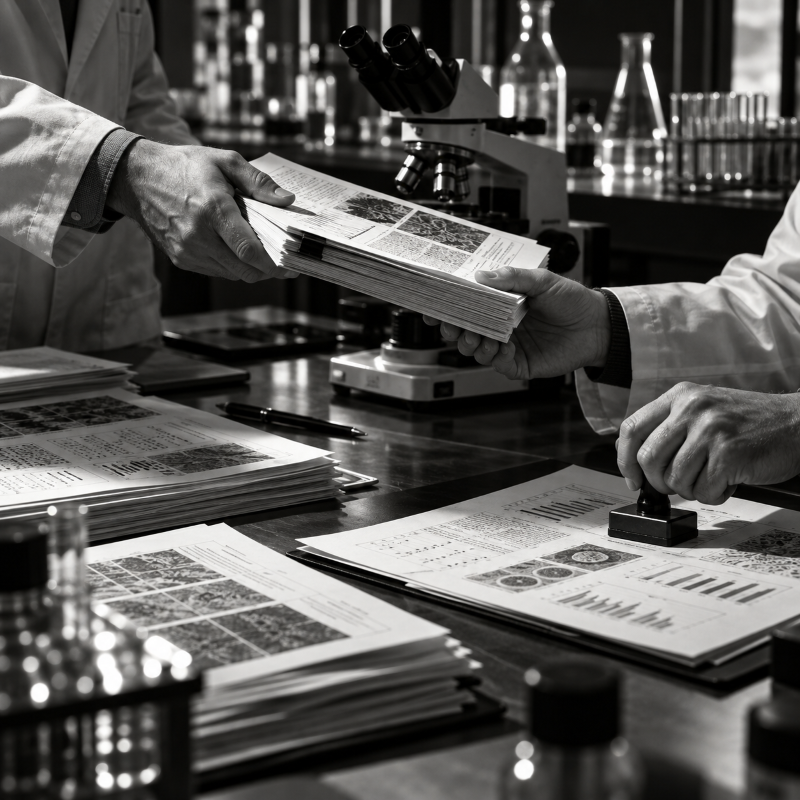
These experts must carefully examine all the data contained in the manuscript, as well as the accompanying figures, tables and data sets. They check that everything is in order, that the research is based on sound principles, and that there are no omissions, methodological errors or calculation errors. They also scrutinise the conclusions and look for weaknesses in the research process. In practice, they retrace and replicate the entire project, checking that they independently arrive at the same conclusions. If necessary – always anonymously, through the journal itself – they contact the authors and request further verification, new experiments or new calculations in order to address any potential gaps or sources of error. They may also invite them to study and take into account other works, or ask them to amend part of the text or the conclusions. Only if, at the end of these interactions, they decide that the final version of the article is well-conducted, original and free from errors, do they give the journal their approval for the article’s publication; it is only from that moment onwards that it can be defined as a ‘scientific article’. This process ensures that articles adhere to scientific methods and that, amongst other things, they are accurate, procedurally sound and of value to the scientific community.
However, like any system that depends on the integrity of individuals, peer review is susceptible to manipulation.
Statistics show that, in recent years, the falsification of peer review has become a systematic practice, fuelled in part by the ever-increasing number of articles published each year. As highlighted by Ivan Oransky – co-founder of Retraction Watch, the journal of the Centre for Scientific Integrity which monitors publications and retractions – one of the triggers for this fraud is the use of external third parties who, in return for payment, offer to review articles. Often, these agencies provide false or even fabricated reviews, which help researchers to publish their work without thorough scrutiny by independent experts.
The technique exploits an inherent weakness in the entire system. The number of scientific papers awaiting peer review and those already published is increasing almost exponentially worldwide. In China, India and countries that have only recently achieved international scientific standing, this increase is even more dramatic. This phenomenon stems not so much from an acceleration in scientific progress, but from the pressure to publish that grips every researcher: research grants, project funding, university chairs and research staff positions are allocated on the basis of the number of publications each scientist can boast. So – as in the African proverb about the gazelle and the lion – every morning, when the sun rises, every scientist, whether a young researcher or an established luminary afraid of being ousted, wakes up and starts running … to publish.
For this reason, scientists are increasingly reluctant to devote part of their time not to their own work but to validating the work of others by offering – free of charge and without any benefit or recognition – to act as reviewers of other people’s work. Added to this is the fact that, with the proliferation of specialist fields, even the editorial board of a scientific journal often finds it difficult to select reviewers who are undoubtedly competent in that particular area of research.
For this reason, it is becoming increasingly common for authors to include, alongside the text they submit to the journal, a few suggestions regarding fellow scientists who might act as reviewers. This is all perfectly legitimate. Perhaps some young authors hope, in this way, to catch the eye of a leading figure. Some crafty individuals, however, take advantage of this, and this can lead to rather dishonest ‘collaborations’ such as: ‘you review my article and I’ll review yours’. And, of course, each behaves very generously, quickly praising and approving the other’s article.
But, if that is not enough, one can devise outright scams, such as submitting to the journal the email addresses of non-existent scientists or fake emails from real scientists; emails which, however, end up in the author’s own inbox. The author will then willingly self-assess and approve their own piece, giving – under a false name – the journal their go-ahead for publication using the fake email address of the authoritative scientist or a completely fabricated one.
In the case of the journal *Tumor Biology*, the problem was exacerbated by the fact that most of the retracted articles had undergone sham peer reviews by external agencies that had a direct interest, alongside the authors, in ensuring that the articles were accepted. The falsification was not limited to merely positive reviews; in some cases, it involved the complete fabrication of scientific data – a crime that has irreparably damaged the reputation of the researchers involved and their academic institutions.
The discovery
The unravelling of this fraud network began in 2017, when *Tumour Biology* announced the retraction of 107 articles due to irregularities in the peer-review process. Investigations revealed that around 90 per cent of the articles involved had received fake or fictitious reviews, and many of the authors involved had not only provided the names of potential reviewers but had also commissioned completely fabricated reviews from external agencies. Out of more than 500 accused individuals, a total of 486 researchers were definitively convicted of taking part in this fraudulent scheme. The punishment meted out to the guilty researchers was severe: their research projects were suspended, their funding withdrawn, and some had their promotions revoked.
The Ministry of Science and Technology (MOST) has announced that it intends to crack down more vigorously on fraudulent practices, threatening even harsher penalties for offenders.
The explanations given by the accused are also curious. For example, Zhiwen Chen, a professor at the School of Environmental and Chemical Engineering at Shanghai University, is the author of five of the retracted articles. Chen told Chemistry World: “We found no fraud or plagiarism in the experimental data, only my own negligence, which led to an incomplete peer-review process.” He also added that he intends to resubmit the articles for peer review, maintaining their validity for publication.
The dynamics
The falsification of peer review is not a new phenomenon, but the case involving the People’s Republic has led to greater global awareness. China, with its growing academic influence, has become an easy target for dishonest agencies and entrepreneurs seeking to capitalise on the pressure to publish articles in high-profile scientific journals. This ‘rule of the game’ is, in fact, a fundamental requirement for gaining access to funding, academic posts and other competitive advantages.
The scandal has also come to light due to the growing number of publications by Chinese researchers. According to the latest available figures, China has produced over 1.2 million scientific articles, almost doubling the figure for the United States, which follows with over 700,000, and India, which stands at just under 400,000 and ranks third, ahead of, in order, the United Kingdom, Germany, Italy and Japan.
This exponential growth has led to increasingly fierce and self-perpetuating competition and, for journals, an ever-increasing workload. Inevitably, this leads to greater reliance on external agencies which, rather than providing genuine scientific peer review, may engage in fraudulent practices to ensure that articles are accepted.
Beijing’s reaction
The Chinese government’s long-term response has been prompt and decisive. The Ministry of Science and Technology has launched a series of internal investigations to examine the authenticity of the country’s scientific work, to take countermeasures and to prevent future fraud. The government has announced that it will severely punish anyone found guilty of participating in peer-review fraud. In addition to suspensions and revocation of qualifications, legal action is also envisaged: Beijing is exploring how to implement specific legislation against scientific fraud.
MOST has also stated that, to prevent similar scandals in the future, it intends to reform the entire academic management system. Chinese universities have been urged to monitor their teams’ publication processes more closely and to ensure that researchers are aware of the ethical implications of data fabrication. But, above all, of the criminal implications.
The *Tumour Biology* case has sparked a wider debate on the quality and integrity of global scientific research. Peer review is a fundamental tool for ensuring the credibility of science, but recent scandals show how it can be manipulated.
In the long term, confidence in the integrity of scientific publications – and not just those from China – could suffer globally. Publishers and scientific journals will have to adopt stricter measures to ensure that peer-review processes are transparent and free from conflicts of interest. Universities will need to assess their researchers’ output more carefully so as not to lose the academic prestige they have built up to date. But research funding bodies will also need to step up their oversight, particularly in countries where the practice of data fabrication is more widespread.
Science at risk
Science is a collective endeavour, built on a foundation of trust and honesty. Cases of fraud such as the one involving China not only damage the reputation of researchers and institutions, but also undermine scientific progress itself. Because science works when we can rely on data, evidence and the integrity of researchers.
In an increasingly competitive world, the temptation to falsify data or manipulate the peer-review process may seem alluring, but science is stronger than any single mistake. What is needed now is a collective commitment to ensuring that transparency, honesty and scientific rigour prevail, and that incidents such as this become nothing more than a sad reminder of an era we do not wish to relive.