











From Paracelsus to nuclear energy: the incredible story of transmutation of the elements. And why it is important to follow the scientific method while keeping the charlatans off our path to sustainability
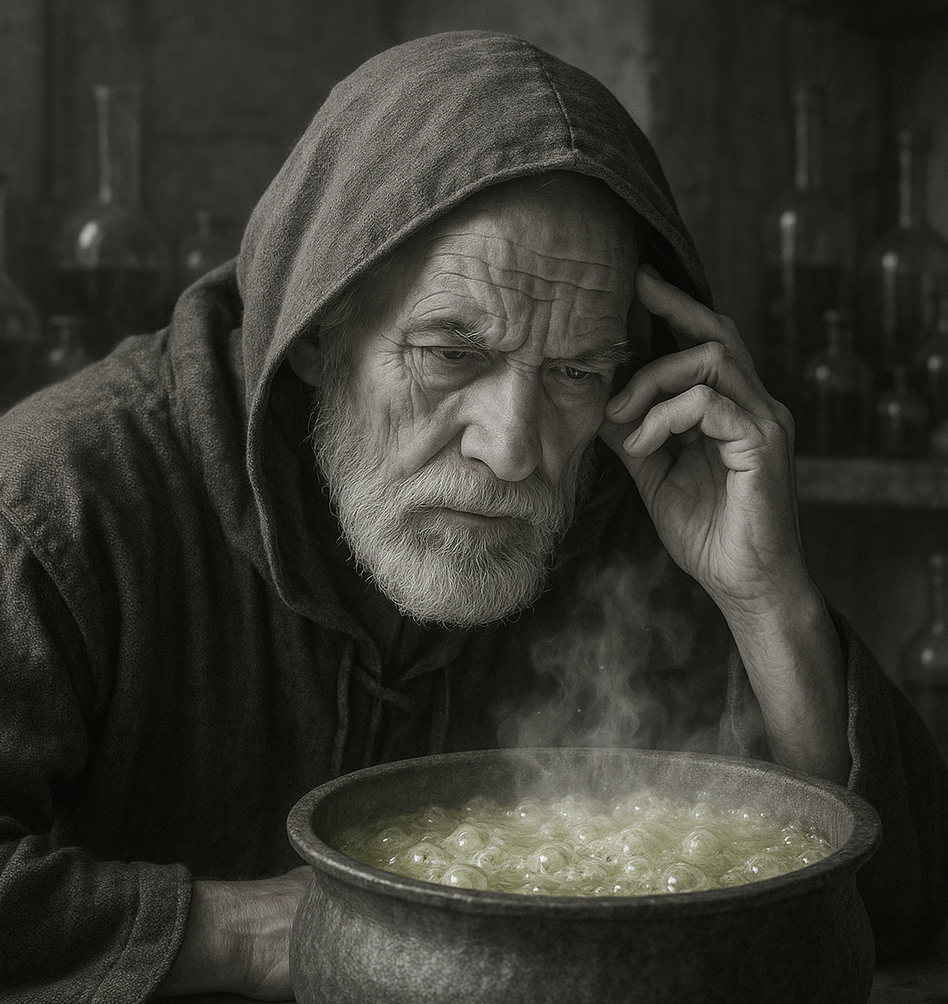
We are in the middle of the Middle Ages, sitting in his laboratory observing a crucible in which a stinking green liquid bubbles, we find a scientist. To be precise, an alchemist: the ancestor of modern chemists. He has spent his life trying to find a way to turn lead into gold. Why? Because he is an alchemist, and because, unlike us, he cannot rely on centuries of chemical research, the scientific method and all the gadgets we have today in our super-equipped laboratories. Like any self-respecting alchemist, his ultimate goal is the transmutation of metals and the invention of the philosopher’s stone, the legendary substance capable of turning any metal into gold. But, perhaps, the main goal is not to be taken for a fool by his neighbours. For centuries, this quest has fascinated brilliant and desperate minds at the same time, in a mix of science, mysticism and… a pinch of madness.
Alchemy: between magic and science
Recipes for alchemical processes are known to date back to ancient Egypt, but this discipline found its greatest expression in the European Middle Ages.
The alchemists mixed the first elements of science with ancient mysticism in an explosive cocktail of experiments and occult philosophy.
Their search for the philosopher’s stone was as much a spiritual journey as it was a rudimentary scientific endeavour. Some alchemists believed that the transformation of metals was merely a metaphor for the transformation of the soul: a path to purification and enlightenment. But the most concrete aspect of alchemy, at least for many, was the dream of turning lead into gold.
But why lead? Perhaps because it has a density and malleability approaching that of gold. Or perhaps because – unlike gold – it is easily attacked by various chemicals. Certainly because, grey, opaque (and even poisonous) it represents the bad metal par excellence.
And why gold? This question is even easier: gold was not just shiny and unchangeable, it represented (much more concretely) wealth, power and the possibility of escaping a life of poverty and anonymity. After all, isn’t it easier to become rich if you can literally create gold at will? However, transmutation was not just a means to get rich. For many, it represented ultimate power over nature, an understanding so profound of the secrets of the universe that it could rewrite the very rules of matter: it was a symbol of spiritual perfection and inner transformation. And it also represented free access to the courts – and the coffers – of kings, popes and emperors.
The Philosopher’s Stone: reality or fantasy?
The idea of the philosopher’s stone has fascinated alchemists for centuries, but what was it really? Some alchemists described it as a red powder, others as a liquid elixir, still others as a solid substance.
Whatever its form, it was said to have the power not only to transform base metals into gold but also – a not inconsiderable side effect – to grant immortality.
One of the most famous alchemists who dealt with the creation of the philosopher’s stone throughout his life was Nicolas Flamel, a 14th century French copyist, who is said to have discovered the secret of the stone after deciphering a mysterious manuscript.
His sudden wealth and some generous donations to churches and hospitals in Paris fuelled rumours about his alleged discovery. However, there is no concrete evidence that Flamel ever transmuted metals into gold, if anything, the suspicion is that he beguiled numerous simpletons by exchanging their money for miraculous potions. His legend, however, remains shrouded in mystery.
But although there is no evidence that the philosopher’s stone was ever found or created, its search inspired countless experiments and stimulated the development of techniques and principles that would lay the foundations for modern chemistry. And you say.
Paracelsus and Spagyric Medicine
In the Renaissance, alchemy began to evolve, moving from the goal of transforming metals to the search for cures for diseases. Paracelsus, a 16th century Swiss physician, was one of the main proponents of this new alchemy, which he called ‘spagyric medicine’.
Paracelsus believed that disease was caused by chemical imbalances in the body and that metals could be used to restore the balance.
Gold, for example, was considered a metal that could give life and strength. Paracelsus developed several chemical preparations based on metals, many of which are considered the forerunners of modern pharmacology.
But despite his contributions to medicine, Paracelsus was never able to transmute metals into gold. Yet, his belief that chemistry could be used to improve human health laid the foundation for modern medicine and chemistry, which became increasingly distinct from traditional alchemy. And, that too, if you will pardon the pun.
Robert Boyle and the birth of modern chemistry
With the Enlightenment, alchemy began to lose ground, giving way to chemistry proper. Robert Boyle, a 17th century Anglo-Irish physicist and chemist, is considered one of the founding fathers of chemistry. Boyle believed that science should be based on observation and experiment, not mystical speculation. He introduced the scientific method into chemical investigation, insisting on the importance of repeatable experiments and empirical data. His 1661 book, ‘The Sceptical Chymist’ (spelled just so), marks a turning point in the history of science, moving away from alchemical practices and embracing a more rigorous and scientific methodology.
Boyle, like many scientists of his time, was also fascinated by the transmutation of metals. However, while others sought the philosopher’s stone, Boyle sought to understand the nature of matter.
He theorised that metals were composed of smaller particles and that transmutation might be possible if these particles could be altered.
In fact, Boyle was not too far from the truth: he was anticipating concepts that would be developed centuries later with the discovery of atoms and subatomic particles.
The discovery of radioactivity and the beginning of nuclear transmutation
Fast forward to the 20th century, where a real revolution took place: the discovery of radioactivity by Henri Becquerel in 1896 and the subsequent work of Marie Sklodowska and her husband Pierre Curie. The idea that matter could spontaneously change into another element through radioactive decay laid a new foundation for the transmutation of elements. But the real breakthrough came with Ernest Rutherford, who in 1919 succeeded in transmuting an element for the first time in the laboratory by bombarding nitrogen with alpha particles to transform it into oxygen. Finally, the alchemists’ dream is realised, but in a way they could never have imagined.
Nuclear fission: gold for real
With the advent of nuclear physics, transmutation became a scientific reality. In 1938, Otto Hahn and Fritz Strassmann, together with Lise Meitner and Otto Frisch, discovered nuclear fission: the process by which the nucleus of an atom heavier than iron – such as uranium – splits into lighter nuclei, releasing a large amount of energy. This process is the basis for atomic bombs and, later, nuclear power plants.
But there’s more: in 1980, researchers at the Lawrence Berkeley National Laboratory in California used a particle accelerator to turn bismuth into gold. Yes, you read that right: real gold! However, there is one small problem: the cost of the process far exceeds the value of the gold produced. It’s a bit like spending 100,000 euros on an electricity bill to build something worth 100: technically possible, but decidedly impractical.
Nuclear fusion: the energy of the stars
If nuclear fission allows us to break atoms, nuclear fusion offers the possibility of uniting them. This process is what powers stars, including our Sun. In recent decades, scientists around the world have been trying to replicate nuclear fusion on Earth to produce clean and almost unlimited energy. Fusion involves joining nuclei of elements lighter than iron – such as hydrogen – to form heavier elements, releasing enormous amounts of energy in the process.
International projects such as ITER (International Thermonuclear Experimental Reactor) are trying to realise this modern ‘philosopher’s stone’. Although nuclear fusion is still in its experimental stages and requires extreme conditions (temperatures of millions of degrees Celsius), it represents a concrete promise for the future of energy. And who knows, maybe one day not too far away, fusion will allow us to create gold in a sustainable and affordable way, just as the alchemists dreamed.
The importance of rigorous science and honesty in sustainable progress
The history of transmutation, from the philosopher’s stone to nuclear physics, teaches us a valuable lesson: scientific progress requires rigour, honesty and an open mind.
While the dreams of the alchemists were based more on fantasy and greed than on reality, it was the rigorous scientific method that brought us closer than ever to transforming one element into another.
In the age of sustainability, it is crucial that scientific research is conducted with integrity and transparency. Our search for innovative solutions to tackle climate change and global energy challenges depends on trusting science. Turning away the charlatans and supporting evidence-based research is essential to ensure a prosperous and sustainable future for all. And who knows, maybe one day we will be able to turn our thirst for knowledge into gold… or, at least, into a greener, more liveable planet for all.