


Redistribution, open source and the new technological feudalism: a re-reading of SDG#1 through the myth of Robin Hood
Robin Hood was not just an outlaw: he was a rebel with a big heart. He lived on the edge, in Sherwood Forest, but his gaze was always on those who were worse off. He stole from the rich, yes, but not for himself: he did it to restore dignity to those who had none. With bow and arrow, he fought injustice, and left us with a powerful message – that rebellion, when born from caring for others, can be a generous act of love.
But today, in a world of data and algorithms, who are the ‘rich’ really? Who are the ‘poor’?
And above all: is Robin Hood still with us… or has he put on the tie of the Sheriff of Nottingham and works in a multinational corporation?
Sherwood Forest has become a network
Robin Hood taught us that injustice can be fought with courage and generosity. But today, in the world of data and algorithms, arrows have become codes, and Sherwood Forest no longer has trees, but servers, cables and clouds, and looks more like a server farm. Cyberspace is the new contested territory, and the feudal lords are Big Tech: companies that control the codes, the platforms, the infrastructure.
The ‘rich’ are those who know how to navigate digital, who have access, skills, connections. The ‘poor’ are those who lag behind: those without access to the internet, those without digital skills, those cut off for economic reasons, the elderly, those living in peripheral areas, those without tools or support.
In Italy, almost 70% of the over-75s do not use the Internet (source: ISTAT). Not by choice, but because no one thought of them when it was decided that everything would become ‘smart’. And so, while apps promise convenience, those who do not know how to use them remain outside. It is not just a technical problem: it is a question of dignity.
And Robin Hood? Maybe today he wears a corporate badge, attends AI ethics roundtables and signs codes of conduct. But if he really wants to stay true to his spirit, he needs to get back among the people. It must ask itself who is losing out, who can’t get in, who needs a helping hand. Because innovation, if it is not for everyone, is not fair. And justice, real justice, is not measured in gigabytes, but in humanity.
Inequality is not only material: it is digital, and growing every day.
Digital Robin Hood: open source as an act of rebellion
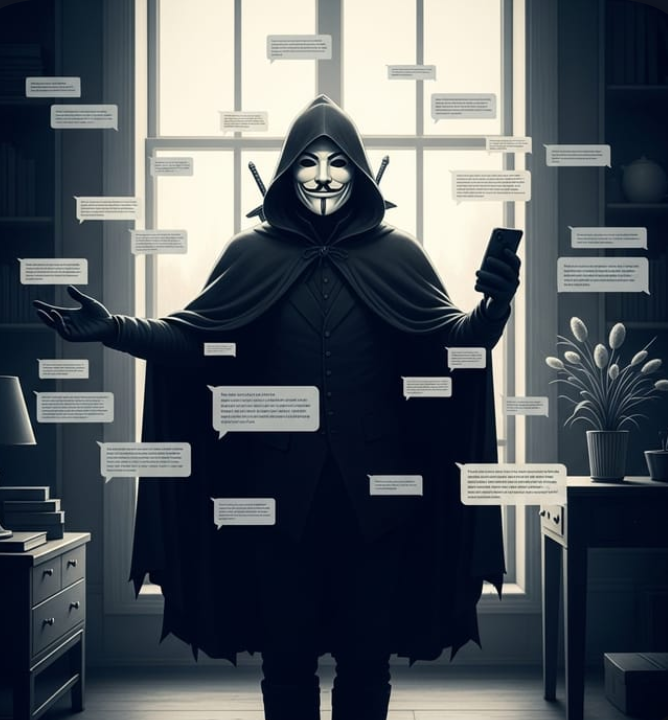
But all is not lost. There is a digital Robin Hood: it is a living community of people who write code to share, not to control. He does not wear a green hood, but perhaps a worn sweatshirt in front of a screen, and instead of a bow he uses a keyboard and connections.
The open source movement is its sharpest arrow: free software, shared knowledge, open access.
Projects such as Linux, Wikipedia, Mozilla are tools created to restore access, knowledge, freedom. There is no profit at the centre, but the desire to build something that serves everyone. And behind these projects are real stories: students, activists, engineers, citizens who choose to put their time at the service of a fairer vision.
In Italy, networks like Ninux take the Internet where the market does not go. Platforms like OpenPolis help to understand how public money is spent. Civic hackers are the new archers of digital justice, often invisible, working to make services more accessible, more transparent, more human. They do not act for profit, but to redistribute power. And they do it with creativity, courage and vision.
In a world where the algorithm decides who sees what, who has a voice and who remains silent, open source is a form of gentle resistance. It is saying, “This knowledge belongs to everyone. This technology can be right.” And perhaps, Robin Hood has not changed sides. He is still among us. Only today he fights with empathy, competence and a stable connection.
But what if Robin Hood had sold out?
What if our hero had changed his tunic? What if instead of living in the forest, today he worked in an open space, with a company badge and a tight tie?
Many web pioneers, those who once promised freedom, sharing, access for all, have now become part of the system. Start-ups born to ‘democratise the digital’ now sell our data to advertisers. Algorithms that were supposed to be transparent and fair now decide who sees what, who has a voice and who remains invisible.
The forest is no longer free: it is fenced, guarded, monetised. Those who cannot pay, stay outside.
Freedom has become a premium service, privacy a paid option.
Robin Hood, perhaps, is no longer the rebel we used to know; in fact, he is in danger of being the Sheriff. Perhaps today he writes corporate policies, participates in panels on AI ethics, and signs codes of conduct that nobody really enforces.
But it is not a surrender. It is an invitation. To remind us that the digital can still be a just, human, open space.
That the rebellion is not over: it has only shifted. Today, more than ever, we need someone to go back and fight for the voiceless. Perhaps with fewer arrows, but with more listening.
Digital poverty is real
Digital poverty is not an abstract concept: it is a reality that one touches with one’s hands, every time someone is left out of a video lesson, an online interview, a public service that is now ‘only done via app’. These are stories of people, not numbers. Of children who cannot attend school remotely, of parents who cannot fill out a form, of elderly people who do not know how to book a doctor’s appointment.
Yet the Deloitte & ISPI report – The Digital Divide: A Barrier to Social, Economic and Political Equity (September 2025) – presents clear and disarming numbers. More than 2.6 billion people in the world do not have access to the Internet. In rich countries, 93% are connected. In the poorest, only 27%. Even within the same borders, the gap is deep: in the cities people are surfing, in rural areas they are lagging behind.
As Andrea Poggi (Head of Public Policy & Stakeholder Relations Centre at Deloitte Central Mediterranean) reminds us, ‘The digital divide is not only an infrastructure issue, but also a skills issue. Young people and women are the groups most exposed to the digital divide: in low-income countries, for example, 90 per cent of girls between 15 and 24 years old do not have access to the Internet and their chances of acquiring digital skills are 35 per cent lower than their male peers”.
This exclusion is not only unfair: it comes at a very high cost. The lack of connection is not just a question of cables or signal: it is a question of people. According to the World Bank, the world could lose up to USD 2 trillion in economic growth over the next decade because of the digital divide.
The true cost of digital poverty is not measured in graphs or budgets: it is measured in the lives that are left behind. It is the story of those who cannot send a CV because they do not know how to open a PDF file. Of those who forego a doctor’s appointment because they don’t know how to use their hospital’s app. Of those who would like to have their say on a topic that concerns them, but do not know where to click to participate.
They are dreams that remain locked in a drawer, voices that cannot be heard, hands that do not know where to click. It is not a lack of will, it is a lack of tools, of accompaniment, of trust.
When digital excludes instead of including, it is not just a design error: it is a wound in everyday life. It is the young person who is unable to register for a course, the elderly woman who misses a doctor’s appointment, the parent who cannot follow their child’s electronic register.
Every digital exclusion is a story that breaks. And every time we do not realise it, that wound widens. Because digital, if it is not designed for everyone, is not progress: it is distance. And behind every ‘not connected’ there is a person waiting to be seen.
Redistributing digital knowledge is not just an ethical choice: it is an act of justice. It is to recognise that the right to be connected is now part of the right to be a citizen. Training is needed, infrastructure is needed, but above all, will is needed. Because digital, if it is not for everyone, is not progress: it is just another way of creating distance.
Conclusion
And so, the provocation is inevitable. The real Robin Hood today does not fight with bow and arrow, but with lines of code, with community networks, with open platforms. Digital sustainability does not come from press releases, but from everyday choices. It requires courage, sharing, creative disobedience. It requires breaking the mould, challenging the logic of profit, building alternatives.
The question is simple and uncomfortable: are you helping to liberate the forest or are you building the castle? Choose a side: digital knowledge is a right, not a privilege.