
















Every click consumes energy. Digital is not light: you need electricity, servers, infrastructure. Therefore, SDG 7 – clean and accessible energy – is also a digital challenge: let us, like Wakanda, build a future where innovation and responsibility walk together.
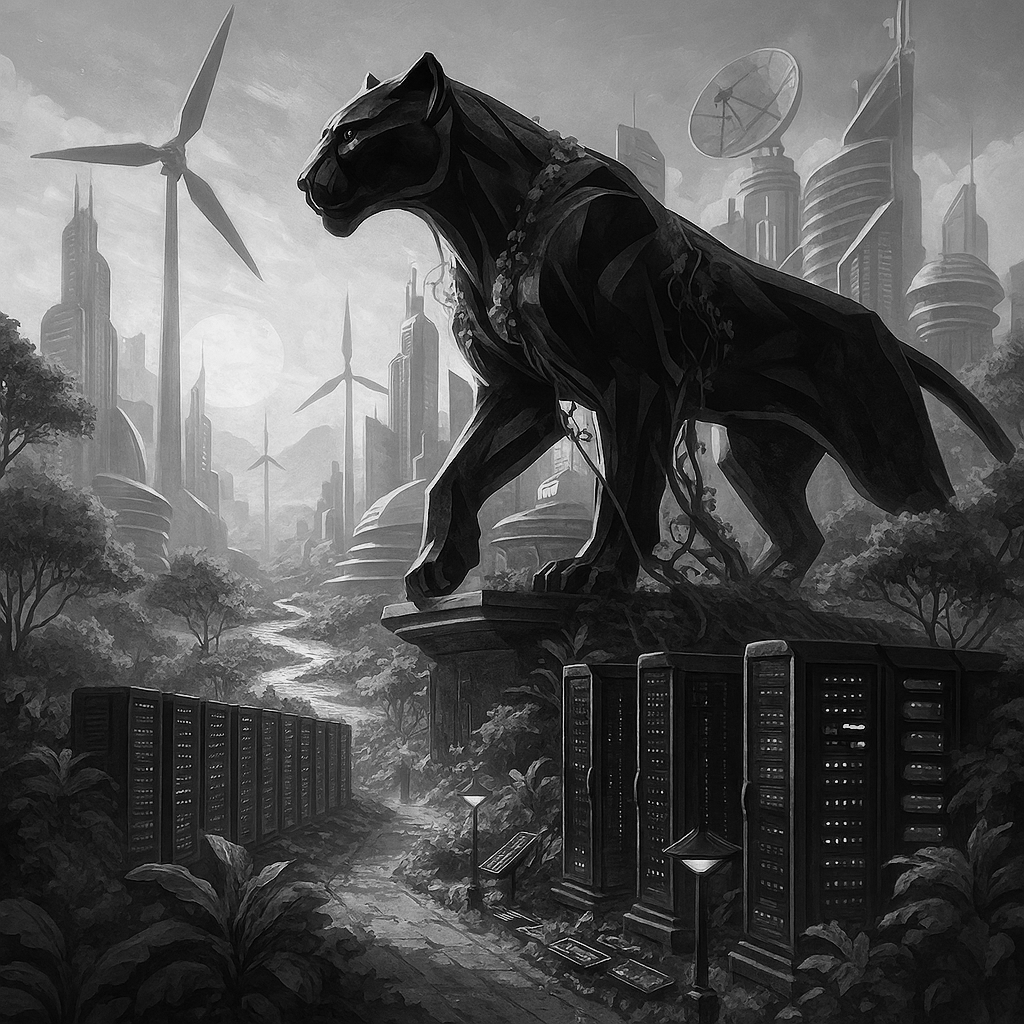
When T’Challa, the legendary Black Panther, decided to break the isolation of Wakanda, he did not just offer advanced technology to the world. He offered a vision. A city where innovation does not consume, but coexists with nature. Where vibranium powers intelligent infrastructure, and every watt is used wisely. Today, that vision is not just science fiction: it is an urgent provocation, it speaks to us about our present, it challenges us to rethink the way we live, consume and build digital.
In our world, ‘Vibranium’ is renewable energy. And the challenge is no longer just to install solar panels or wind turbines. It is to make sustainable the invisible infrastructure that powers our digital life: data centres.
Behind every click, a power plant
Behind every selfie saved on the cloud, every streaming video, every request to a virtual assistant, there is a world working non-stop: that of data centres. Gigantic ‘digital hearts’ that beat day and night to keep our connections alive. But these hearts consume. And a lot.
According to theInternational Energy Agency (IEA), the world’s data centres already consume more than 460 terawatt hours (TWh) per year-an amount equal to two per cent of the entire global electricity demand. To put it bluntly, that’s more than the energy consumed by a country like Sweden. And that’s not all: by 2026, this consumption is expected to more than double to over 1,050 TWh.
In the United States, the situation is already critical: data centres account for more than 4 per cent of national electricity consumption, generating more than 105 million tonnes of CO₂ in 2023 alone [source: U.S. Department of Energy, 2024]. And in Ireland, where many tech companies have chosen to establish their infrastructure, the paradox is even more striking: data centres consume more electricity than all the households in the country combined [source: Commission for Regulation of Utilities, Ireland, 2023]. A thought-provoking fact: while digital promises lightness and speed, its energy impact is all but invisible.
In Italy, the sector is booming. Our country hosts 13% of European data centres, with an annual growth rate of more than 8%. In 2023, investments in co-location exceeded EUR 650 million [source: IDC Italy, 2024].
Shuri and energy efficiency: from fiction to reality
In the world of Black Panther, Princess Shuri designs technologies that optimise every single joule. Every technology she creates is designed to optimise, to respect, to serve the common good. In our world, this intelligence translates into responsible innovation.
The big tech companies have realised it: digital is no longer an ethereal cloud floating above our heads. It is made of cables, servers, fans, entire buildings pulsating day and night to run everything we take for granted-from streaming TV series to chatting with artificial intelligence. And all this has a real energy cost.
That’s why they are trying to run for cover. They are rethinking their data centres, trying to make them more efficient, less polluting, more in tune with the planet. But it is not a walk in the park. Behind every improvement there are engineers, tough choices, investments and metrics to keep an eye on. One of the most important is called Power Usage Effectiveness, or PUE. In simple terms, it measures how much of the energy consumed by a data centre actually goes to the servers, and how much is wasted on cooling, lights and support systems. n perfect PUE would be 1.0: all energy used to run data, zero waste. But today we are still a long way off: the global average is around 1.5, which means that for every watt used to process data, another 0.5 watts is spent on cooling, lighting, dispersion. [source: Uptime Institute Global Data Centre Survey, 2024].
It is as if every time we ask a search engine to find something, part of the energy is used just to keep the engine running and fresh. That is why efficiency is not just a technical issue: it is an environmental responsibility.
Reinventing the data centre: from infrastructure to ecosystem
What would a data centre inspired by Wakanda look like? Powered by 100 per cent renewable energy, like Meta’s in Iowa, which harnesses local wind power. But that’s not enough. The heat generated by servers, often considered a problem, can become an asset. In Sweden, EcoDataCenter has turned this challenge into an opportunity: the heat is reused to heat buildings and power a pellet factory, creating a virtuous cycle reminiscent of the Wakandan balance.
But energy is only part of the problem. The heat generated by the servers is another challenge. In Wakanda, environment and technology merge. In the real world, it is not enough for data centres to work: they must also stop ‘overheating’ the planet.
That is why the way we cool our ‘digital brains’ is being rethought today. Some are already in the field. Free-cooling, for example, is a simple but effective technique: it uses outside air to lower the temperature, avoiding the use of energy-intensive systems. It is like opening the windows to let in a cool breeze, instead of turning on the air conditioning.
Then there is liquid-cooling, which sounds futuristic but is already reality. Here, special fluids flow between components like a technological bloodstream, absorbing heat and transporting it away from critical points. It is a solution that not only cools better, but also consumes less.
These are intelligent technologies, of course, but they are not enough on their own. A broader vision is needed, an infrastructure that is not only efficient, but also ‘in tune’ with the environment. Not a foreign body, but something that breathes with the planet, that gives back what it takes. A bit like Wakanda, where every invention seems designed to coexist with nature, not dominate it.
Digital sustainability is a shared responsibility
T’Challa chose to share the knowledge of Wakanda to help the world. It is a gesture that reminds us that knowledge should not be withheld, but spread. Similarly, the transition to sustainable digital cannot be left to big tech alone. It is a collective responsibility.
TheUN Agenda 2030, with its Goal 7 – Clean and Affordable Energy, asks us to act. But it is not enough for big tech to do it. A shared commitment is needed.
Developers can write lighter code that consumes fewer resources. Governments can incentivise energy efficiency. And we, as users, can make more conscious choices: avoid unnecessary streaming, uninstall unnecessary apps, prefer services that invest in sustainability. Every digital gesture has a real impact. And every click is also an environmental choice.
Wakanda as a moral compass
In an age dominated by artificial intelligence and apparent dematerialisation, the story of Black Panther reminds us that true progress is not that which runs faster, but that which knows where to go. The most genuine innovation is not the one that generates profits, but the one that generates balance.
The future will not belong to those who consume more, but to those who can build, like Wakanda, a world where power and responsibility walk together. Where technology is not just brilliant, but just. Where every byte is also a heartbeat of the planet.