




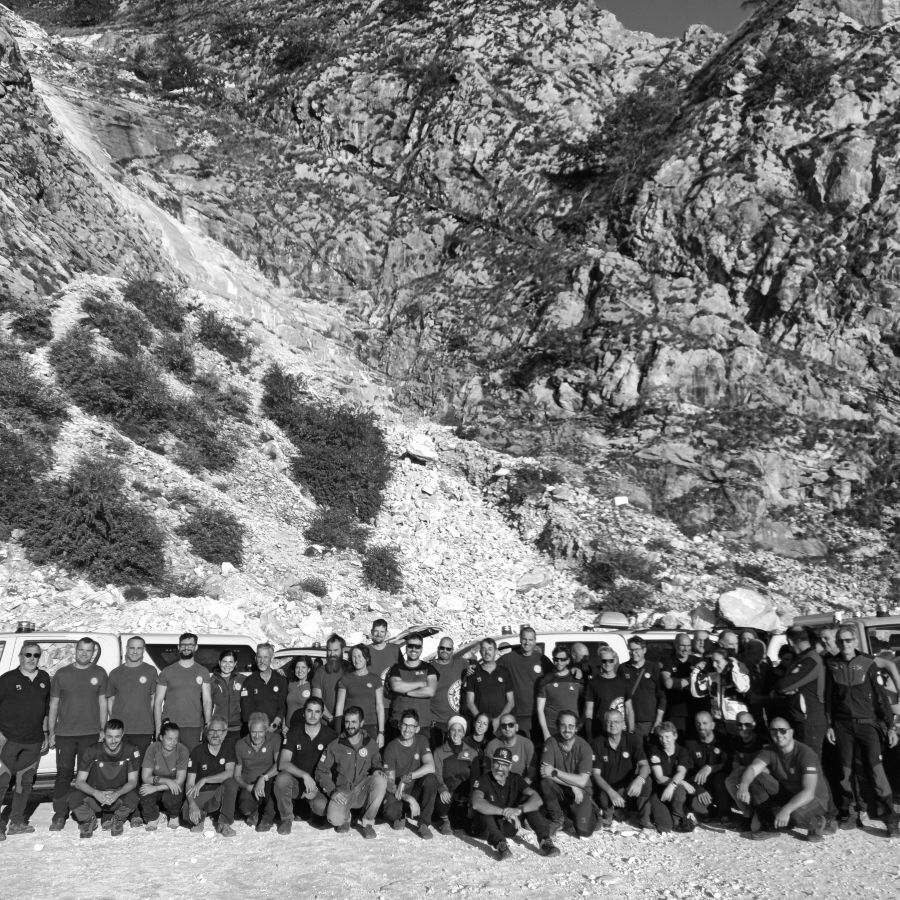

Three days of discussion, experimentation and training saw 56 caving rescue technicians from all over Italy take part from 10 to 12 October. The occasion was theOpen Day CTS 2025, organised by the Speleological Technical Commission (CTS) in collaboration with the National School for Caving Rescue Technicians of the National Alpine and Speleological Rescue Corps (CNSAS),
The event took place inside and outside theAntro del Corchia, in the marble quarries in the municipality of Stazzema (LU). The cave, one of the largest and best known karst complexes in Italy with its 80 km surveyed so far, over 20 entrances and a depth of 1210 m, offered an ideal environment to test and demonstrate in the field the most advanced technologies developed in recent years by the CNSAS for cave rescue.
An underground laboratory for rescue technology
The aim of this first edition of the initiative is twofold: on the one hand, to illustrate to the technicians of all the CNSAS caving delegations the technical innovations born from the work of the CTS; on the other hand, to allow participants to experience them directly in an underground environment, verifying their performance and operational functionality.
During the three days, several systems that are now fully operational and available to teams during medical rescue operations were presented and tested, including:
– Indoor camp ‘Estìa’, an advanced logistics module designed to manage complex interventions at a great distance from the entrance. Composed of lightweight and waterproof modular kits, Estìa allows you to set up a real indoor camp capable of accommodating a team of nine technicians divided into three “Night” tents and one “Day” tent. It provides thermal comfort, hygienic kits, water purification systems, freeze-dried food and everything necessary for the rest and operational recovery of personnel in the cave, accommodating several teams of nine technicians each in succession and guaranteeing autonomy and rapid assembly and disassembly.
– System ‘Ermes’ a patented system for Internet connection in caves, based on two watertight cases – one internal and one external – connected by a telephone pair. It allows voice, video and data connectivity inside the caves. Produced in collaboration with BPG Radiocommunications, it allows technicians and medics engaged in deep rescue to make video calls, transmit health data, ECG tracings, ultrasound images and other information in real time outside the cave and from there, via an external connection, virtually anywhere in the world. To date, it has been successfully used in exercises up to 2,400 metres from the entrance, and represents a major breakthrough in medical rescue in the underground environment by allowing medical personnel in the cave to be directly supported by specialist medical personnel who may be located in hospitals around the world.
– Ether’ radio-telephone link, a patented system produced in collaboration with BPG Radiocommunications, which allows direct and encrypted communication between base camp and inside the cave, without the need to set up an advanced camp or use technicians outside the cave with ‘radio bridge’ functions. Transmission takes place via radio in real time and in full-duplex mode (you talk and listen at the same time, as with a telephone), guaranteeing clarity and continuity in operational communications. The control unit, contained in a watertight case, also acts as an encrypted radio link with mobile radios in the area and can record conversations thanks to an internal memory card. Autonomy is ensured by internal rechargeable batteries and auxiliary modules.
– Ecometer ‘TDR’, a tool for diagnosing and monitoring telephone lines in caves. It makes it possible to map the route of the cable from the entrance of the cave to the point where the incident occurred, detect interruptions or short circuits and locate them precisely, thanks to a reflected signal that shows the point of abnormality on a display. Derived from devices used in telecommunications, the model selected by the CTS represents the best compromise between performance, cost and robustness for caving rescue operations.
Alongside technologies that are already operational, CTS technicians also presented projects at an advanced stage of development, illustrating their purpose, potential and possible future applications in real-life rescue operations.
Learning, comparison and contributions from the field
The Open Day is aimed at all cave rescue technicians interested in learning more about the technological and communication aspects of cave rescue, especially those with IT or telecommunications skills.
The aim is to train local contact persons capable of using and disseminating these technologies within their delegations, so as to expand the number of CNSAS operators capable of effectively employing the new systems.
The result of this first edition proved to be a complete success: the participants not only acquired the necessary knowledge for the operational use of the devices, but also contributed their observations, suggestions and improvement proposals. All collected suggestions will now be evaluated by the CTS to check their feasibility and, if possible, implement them in future system updates.
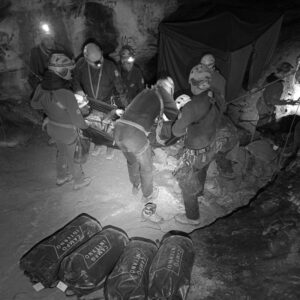
The CNSAS National Speleological Medical Commission took part in the Open Day with two nurses who were able to simulate a diagnostic examination with an ultrasound scanner in a cave connected remotely via Ermes, talking to a specialist doctor who, from his office, was able to see the images in real time and provide support and guidance.
Lastly, the event was also attended by the CNSAS national leadership, with the presence of the national vice-president and three national councillors, including the national head of Speleological Rescue, testifying to the importance attributed to the role of research and technological innovation in constantly improving the Corps’ operational capabilities.
Their participation was a recognition of the technical and training value of the initiative, but also a sign of concrete support for the work of the Speleological Technical Commission, which for years has been the driving force behind the development and experimentation of cave rescue.
The mission of the Caving Technical Commission
The CNSAS CTS is the body responsible for designing, testing and implementing innovative equipment and techniques for rescue in the underground environment. It is part of the national technical commissions of the Corps, which in turn is a technical body of the Italian Alpine Club (CAI) and an operational component of the National Civil Protection Service.
Through constant experimentation, the CTS contributes to improving the safety and effectiveness of rescue operations by developing tools capable of dealing with the most complex and remote scenarios.
A future of collaboration and innovation
The CTS 2025 Open Day demonstrated how collaboration between the different CNSAS components and the dissemination of technological expertise represent a strategic investment in the safety and efficiency of future rescues.
This initiative was not limited to training, but encouraged the sharing of experiences, the birth of new ideas and the consolidation of a network of technicians ready to work with increasingly advanced tools, to ensure that – even in the most remote and difficult to reach places – the technology and professionalism of the CNSAS continue to make a difference.