









The exploitation of wind energy began together with human civilisation; today it is a decisive element in the decarbonisation of energy and sustainability
Wind energy, which we recognise today in the modern turbines scattered across hills and plains, has its roots much further back in history than we can imagine. To understand how we came to harness the wind to produce electricity today, we have to go back thousands of years: when human civilisations were beginning to discover that the wind could be more than just a breeze lifting desert sand.
The beginning of the journey: sails and mills
The first examples of the use ofwind power date back more than 5,000 years. We can imagine the surprise of the first sailors when, while ploughing a river pushing forward with oars and poles aimed at the bottom, the wind picks up: they discover that an invisible force can carry them faster up and down the banks. At that point, they rest their arms and begin to ingenuity to gather and make better use of that unexpected help.
Thus, already around 3000 BC, the ancient Egyptians harnessed the wind to sail down the Nile in sailing boats. That same wind power propelled trade, economic growth and the daily lives of the Egyptian people.
A thousand years later, the Babylonian king Hammurabi also got busy irrigating the plain between the Tigris and Euphrates with the first prototype windmills. In Mesopotamia, the wind soon became an ally; and as early as the 7th century BC, the Persians built windmills to pump water but also to grind grain. These mills, with their large blades made of reed mats rotating around a vertical axis, represent the earliest known examples of wind power applied to manufacturing. Admittedly, they were very rudimentary devices, but they were an important step towards the controlled use of wind.
Windmills in Europe: from the Middle Ages to the Renaissance
Let us now move on to medieval Europe. During the 12th century of the Vulgar Era, especially in northern Europe, horizontal-axis windmills sprang up and became widespread. More complicated, because they need to be continuously oriented in the direction of the wind, but more efficient. In countries like the Netherlands and England, windmills not only became part of the landscape, but also proved essential for agriculture and land drainage. The inhabitants of the Netherlands, in particular, do not just call their land by this name, referring to the fact that it is largely below sea level, but get busy using mills to pump water and conquer land, making entire areas subtracted from the sea habitable and building – literally – a nation to live on. Now that’s DIY, unlike the IKEA of their Swedish cousins.
Leonardo also designed various devices to pump water by means of wind power; but it was not until the end of the Renaissance that windmills became a symbol of progress. These monuments to human ingenuity entered the landscapes painted by Pieter Bruegel the Elder and other Flemish painters. Even Cervantes, turns windmills into mythological enemies, giants to be defeated. And although the good Don Quixote takes them down with a spear, the wind does not stop. On the contrary, it is destined to get stronger and stronger.
The decline and renaissance of wind energy
With the advent of industrialisation and steam engines in the 19th century, wind power suffered a decline. New technologies based on fossil fuels seemed to have the … wind in their sails, and the mills were slowly forgotten.
But in 1887, a Scottish engineer, James Blyth, decided to breathe new life into wind by building one of the first wind turbines to produce electricity.
Although his project only works to power his house, it is a sign that wind energy has not been forgotten.
The first wind turbine: a giant in the wind
However, it was in the Soviet Union that wind power underwent a technological renaissance. In 1931, in the Crimea, the first real large-scale wind turbine for electricity production was born, an idea realised by Professor Yevgeny Alexandrovich. This turbine, known as the Balaklava Turbine, is capable of generating up to 100 kW of power – an impressive value for the time. The Soviet Union saw wind as a promising resource, capable of generating cheap power even in the most remote areas of their gigantic land without forcing them to incur costs for infrastructure and gigantic power lines. And this turbine demonstrates that wind power can be turned into electricity, virtually on the spot, to power industries and communities. Although not yet comparable to modern turbines, the Balaklava turbine is a pioneer of the future of renewable energy and a demonstration that wind must also participate in the Sovietisation of society.
Modern wind turbines: from the energy crisis to recent developments
In the 1970s, the global energy crisis and rising oil prices brought back interest in wind energy. Countries such as Denmark and the United States begin to invest in large-scale turbines, laying the foundations for the modern wind power industry. In particular, Denmark becomes the beating heart of this development, building some of the first large turbines and designing entire wind farms.
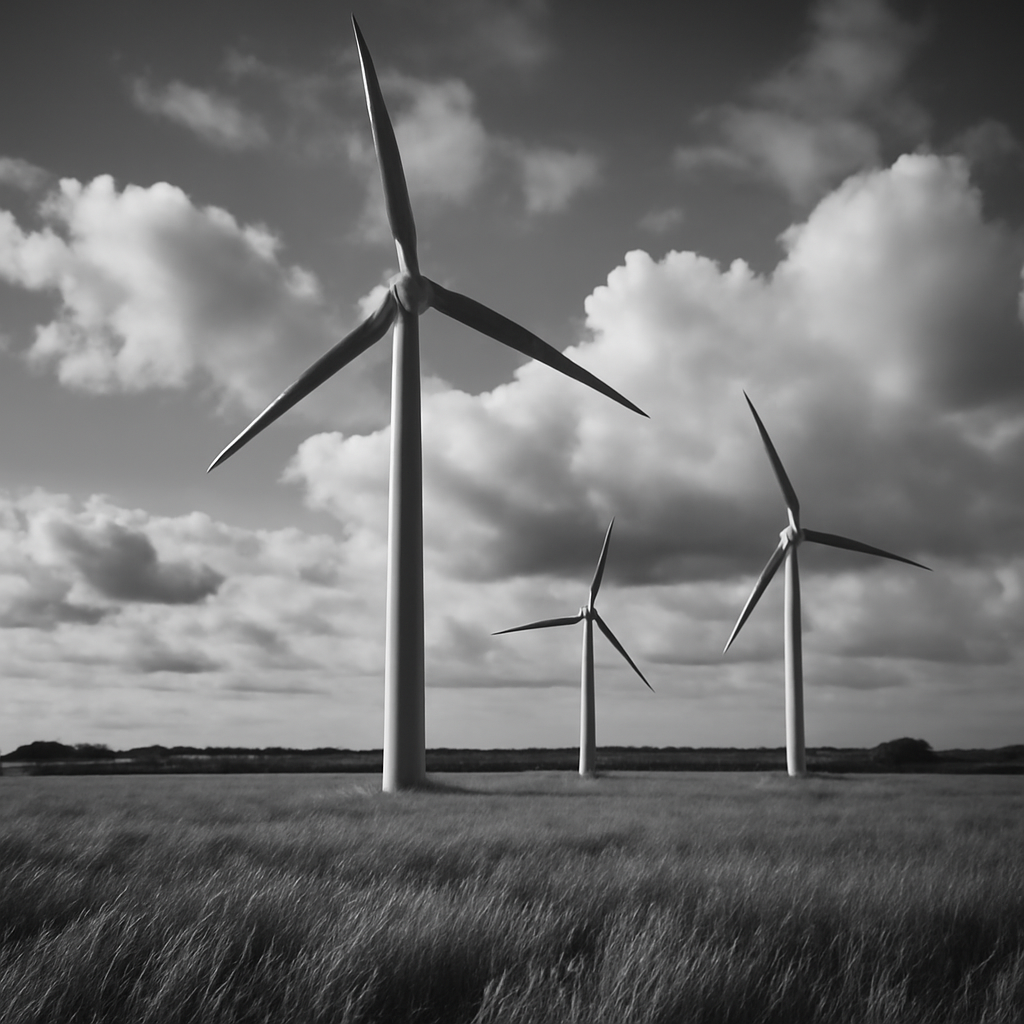
As technology improves, these systems become more and more efficient and larger. While in the 1970s a turbine could generate around 50 kW, today’s modern offshore wind turbines can produce up to 16 MW of power each. And let’s not forget that these are as tall as skyscrapers, with blades exceeding 100 metres in length. Will the cities of the future be dominated by huge turbines instead of skyscrapers?
For wind energy a new horizon … beyond the horizon
After large installations on land, wind energy has found its ideal habitat in the oceans. Offshore wind turbines, installed offshore kilometres from the coast, are becoming an essential component of the world’s energy mix. The main advantage of offshore wind is that the wind blows stronger and more consistently at sea than on land, which allows the turbines to run at full capacity for longer. Offshore wind is also an attractive solution for reducing landscape impact and land use – a non-trivial problem that often provokes opposition from local communities.
Installing an offshore turbine is not like flying a kite: it presents considerable challenges. Construction costs are higher than for a land-based installation because of the harsh environmental conditions and the need to build solid foundations to anchor the turbine to the seabed. Offshore maintenance is also no joke: it requires specialised teams and specialised vessels. Finally, the construction of these turbines can interfere with marine life, and there is still much to be done to minimise the environmental impact.
Nevertheless, the future of offshore wind power looks bright. While today offshore turbines develop a total capacity of 63 GW (7 per cent of global wind power), the International Energy Agency (IEA) and the Global Wind Energy Council predict that offshore wind will exceed 300 GW of installed capacity globally by 2030. This target will be driven mainly by projects in Europe and China, with the North Sea and the Baltic Sea hosting some of the largest installations. Italy, too, aims to play its part with plans for offshore parks in the Sicilian Channel and the upper Adriatic Sea.
And while we are all used to seeing the big turbines soaring over hills and plains, who is to say that the rough waters of the ocean will not dominate the wind industry in the future?
The technological challenge and the future of wind energy
Despite these difficulties, wind energy is continuously expanding. According to the IEA, global installed wind power capacity exceeded 900 GW in 2023, and is expected to exceed 1,800 GW by 2030. A lower capacity but still comparable to what the IEA estimates for 2023 and estimates by 2030 for photovoltaic energy: 1,200 GW and 3,300 GW respectively.
Offshore wind power, in particular, has seen exponential growth thanks to technological innovations and public and private investment. New technologies, such as floating turbines, will allow offshore plants to be installed in even deeper waters, where winds are more powerful and stable. These developments open up new possibilities for the expansion of wind power in areas where the depths of the sea prevent the installation of traditional turbines, such as the Mediterranean and the Pacific Ocean.
The importance of wind energy for sustainability
Wind energy has a long and fascinating history, and today it represents one of the key solutions for reducing carbon emissions and tackling the climate crisis. With the right combination of technological innovation, investment and political support, wind power could play an even more significant role in the transition to a sustainable energy future.
The wind, which once propelled sailing boats down the Nile, now propels the world towards a cleaner, more sustainable tomorrow.