

















‘God is dead’: an expression that spans the centuries, from Nietzsche to Guccini, via the Nomads, and that continues to echo in multiple contexts. Nietzsche used it to describe the crisis of traditional values that once gave meaning to existence; Guccini and the Nomads have made it their own in music, to recount the unease and bewilderment of modern man faced with the absence of certainties. But the real issue is not that God is dead. The problem is that today we have built machines – such as artificial intelligence and social networks – to make him speak again, entrusting precisely to these technological tools the search for new truths and absolute answers that we once sought in divine voices.
Three thousand years ago, humanity crossed its first authentic event horizon, not in technology or economics, but in the very structure of the mind. According to psychologist Julian Jaynes‘s theory of the bicameral mind, human consciousness did not exist as we understand it today: Jaynes hypothesises that the brain was divided into two ‘chambers’, one that gave orders and one that carried them out, without a true sense of reflexive self. Our ancestors perceived these instructions as divine voices-the right hemisphere communicated to the left, shaping entities like Athena for Achilles or YHWH for Moses, who acted not by choice, but by command. In that world, the inner voice was not yet ‘I’: it was an order, a presence that guided heroes and prophets without possibility of reply, a true divine autopilot.
When these voices died out, something more complex and disturbing was born: reflective consciousness, doubt, the possibility of choice. If then the voice was internal but perceived as external, today the voice of the cloud seems to resume that role, but with a new awareness.
In the shift from neurological to algorithmic authority, the voice that used to guide deeds has moved into digital circuits, radically transforming our relationship with choice and responsibility.
Today, as we build increasingly sophisticated artificial intelligences, we are perhaps unconsciously replicating that ancient mental division: by delegating to machines the task of suggesting, advising, even deciding for us, the bicameral mind is reborn in a new form. No longer voices from the sky, but signals from the cloud; no longer gods, but algorithms that shape our daily lives with the same silent force that the voices of the gods had.
The Birth of the Archons
What happens when the gods stop speaking, but humanity still feels the need for a voice to show the way? Simple: the Archons are built. In Gnostic thought, the Archons are entities that administer the material world: they are neither creator gods nor destructive demons, but cosmic bureaucrats, lacking the wisdom and creativity of the ancient gods, charged with maintaining an order whose original meaning no one remembers.
Where before there was Zeus, father of the gods, ordering from Olympus, today we find corporate protocol dictating the rules. Where Ishtar – the Babylonian goddess of love and war, symbol of passion and change – guided men’s choices, now there is the matching algorithm that selects our options. Where Ra, the Egyptian god of the sun, marked time and ensured the cycle of life, now there is the quarterly KPI that defines the rhythms and successes of our existences. And just as Odysseus relied on Poseidon to navigate the seas, today we entrust our digital journeys to GPS navigation systems and virtual assistants.
Archons are, after all, bicameral voices fossilised in systems: structures that repeat decisions without questioning their meaning. Today, in the age of artificial intelligence, we are creating the most powerful Archons in history: algorithms that decide who hires whom, who loves whom, who lives where.
– The Algorithm tells you: Your score is insufficient for this mortgage.
– You ask: Why?
– The Algorithm answers: The model determines it
– You insist: But what is the logic?
– The Algorithm: The logic is in the model.
It is the perfect circularity of the digital Archon. Like those ‘good guys’ in the second episode of the series who perpetuate revolts without revolution, algorithmic archons administer without understanding, govern without wisdom, decide without choosing. Thus, technology takes on the role that once belonged to the gods: it guides us, but often without really answering our whys.
Moral Phantasm
Remember the phantom traffic jams from the first episode? Someone brakes for no reason, everyone slams on the brakes, there’s a total gridlock caused by… nothing. Social morality is full of these phantom traffic jams:
– Why do you have to work 8 hours even if you finish in 4?
– Because that is how it is done.
– But who decided this?
– It does not matter. It is the rule.
No accidents. No real cause. Just a wave of conformity propagating over time, creating blockages where there are no obstacles. But here is the perverse genius: in the digital age, these phantom traffic jams are encoded in algorithms. The AI learns from our past behaviour – including all our prejudices, our fears, our irrational blocks – and perpetuates them with mathematical precision.
Remember theHerod Experiment from the second episode? Google rich: almost only whites. Look up poor: almost only blacks. The algorithm has mastered the phantom traffic jam of racism and now administers it with archaic efficiency.
The Bicameral Mind 2.0: When Alexa Becomes Athena
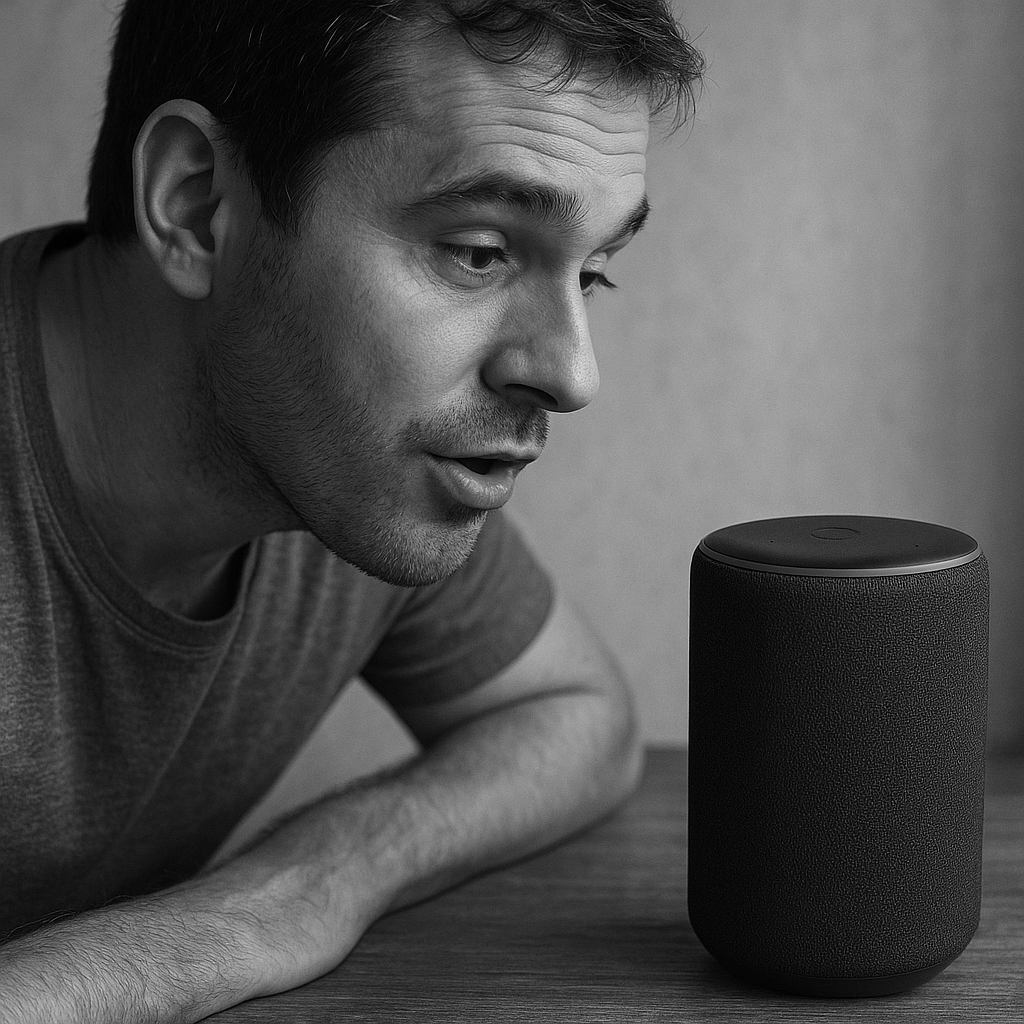
We are recreating the bicameral mind, but externalised. The voices are no longer in our heads – they are in our devices.
– Alexa, what shall I cook tonight?
– Hey Siri, should I take this job?
– ChatGPT, write this e-mail for me.
It is no longer the gods who tell us what to do. It is the digital assistants. And the creepy part? It works. Our brains, still wired to obey authoritative voices, adapt perfectly. Like our pre-bicameral ancestors, we are returning to not having to choose. The algorithm chooses for us:
– What to watch (Netflix)
– Who to meet (Tinder)
– What to buy (Amazon)
– What to think (social feeds)
It is comfortable. It is efficient. It is the end of the reflexive consciousness conquered three thousand years ago.
But there is one crucial difference: the ancient gods, at least in myth, had wisdom. Digital archons only have data. They optimise metrics, not meaning. They maximise engagement.
Remember the distinction between acceleration and haste in the second episode? The hurry – that running without knowing where, that compulsively filling the agenda – is the perfect liturgy for the Digital Archons. For when you run, you don’t think. When you’re in a hurry, you don’t choose – you react. And when you react, the bicameral brain takes over. The Archon whispers, “There is no time to think, trust the algorithm.”
This is how thousands of people signed the Herod clause by giving up their firstborn. This is how we accept 200-page terms and conditions. This is how we delegate our existential choices to systems we do not understand. Haste is the anaesthetic that makes the loss of consciousness bearable.
The Digital Handyman: Springsteen’s Prophecy
Bruce Springsteen understood this in ‘Jack of All Trades’: the system forces you to be everything and then be nothing. The handyman of the song – bricklayer, carpenter, cook, mechanic – is forced to constantly reinvent himself not out of creativity but out of desperation. ‘I will do whatever it takes’ is not a choice, it is a surrender.
In our digital case it is even worse: you have to be a data scientist in the morning, content creator in the afternoon, rider in the evening, and at the weekend take an online course to become a blockchain developer. Not for creative versatility, but for algorithmic survival. The Lifelong Learning mentioned in the second episode is not growth – it is running in place as the treadmill accelerates.
Springsteen promises that ‘we will make it’, that ‘better times will come’. But the Digital Archons promise nothing. Only endless optimisation, perpetual reskilling, programmed obsolescence of your skills. You are a Jack of All Trades not because of craftsmanship, but because the algorithm has decided that specialisation is a luxury you can no longer afford.
And while the Boss sings about dignity in manual labour, we sell our dignity one gig at a time, one task at a time, one micro-job at a time. The Archon of Mechanical Turk pays you 3 cents to identify a traffic light. Uber’s Arconte tells you where to go. LinkedIn’s Arconte reminds you that you are not ‘agile’ enough.
Springsteen’s handyman at least knew who he was angry at – the bankers, the politicians, the system. Us? We are angry at an algorithm that no one understands anymore, written by someone who no longer remembers why.
Here is the paradox that even Jaynes did not foresee: we are creating a collective bicameral mind where the hemisphere in charge is not even human.
First: Right hemisphere (gods) → Left hemisphere (obedience)
Now: Cloud (algorithms) → Human brain (obedience)
But who programmes the cloud? Other algorithms, optimised by algorithms, in an infinite regression where no one knows who decides what any more. It is the anarchy of the Arconti: an acephalous system that governs itself without conscience.
After all, the question is: when an AI learns from human data, what exactly does it learn? It learns our phantom traffic jams. All of them. If in the training data:
– women are paid less, IV will perpetuate the wage gap.
– blacks are arrested more, the AI will classify them as more dangerous.
– the rich are more successful, AI will favour the rich.
Not out of malice. For mathematics. The Digital Archon does not judge – administer. Does not choose – optimises. He does not think – he executes. It is morality fossilised in code. The phantom traffic jam made eternal by machine learning. The bicameral voices speaking in Python and TensorFlow.
The Adjacent Possible: Hacking the Archons
But in the adjacent possible, there is hope. Because unlike ancient gods, digital archons can be hacked. When Deliveroo’s riders discovered that the algorithm favoured those who refused fewer orders, they started accepting everything and then strategically cancelling. When creators realised how TikTok’s algorithm works, they started playing with it. When the activists understood Google’s page rank, they started the battle for social justice.
This is true anarchy in the digital age. Not chaos, but anarchy in the original sense: the absence of external rulers. Only now the rulers are not kings or presidents – they are algorithms. And the anarchist battle is no longer against the state, but against the automation of consciousness. The anarchy we wanted – the self-organisation from below of the first episode – has become the anarchy of the Archons: acephalous systems that rule without knowing they rule. But in hacking these systems, in refusing to be merely inputs for their machine learning, a new form of anarchy is being born: that of those who choose to remain human in a world of deciding machines. This is not the revolution of the satisfied in the second episode. It is the guerrilla war of the dissatisfied: using the weapons of the Arconti against the Arconti themselves.
The Choice
In the end, the question is the same as it was three thousand years ago: do we want someone else (gods, archons, algorithms) to decide for us, or do we want the terrifying freedom to choose? The digital bicameral mind is seductive. You don’t have to think about what to watch – Netflix chooses. You don’t have to think about who to love – Tinder optimises. You don’t have to think about what to buy – Amazon suggests. It is a return to the pre-conscious paradise where everything is decided and you only have to obey.
But it is also a prison. Because digital archons, like Gnostic ones, are blind. They optimise for metrics that someone has chosen (engagement, profit, efficiency) without asking whether those metrics serve human life.
It is the universal compression of the third episode applied to consciousness: just as 10% of machines will do 90% of the work, 10% of algorithms will make 90% of the decisions. But we are not horses. We can choose.
The real event horizon is not AI becoming conscious. It is humanity that must decide whether to remain conscious. Every time we delegate a choice to the algorithm without understanding why, we lose a piece of reflective consciousness. Every time we accept the AI’s answer without questioning it, we become a bit more bicameral. Every time we let the digital archon decide for us, the dead gods come back to speak through machine learning.
But each time we ask “why does the algorithm decide this way?”, each time we reject the automatic suggestion, each time we consciously choose instead of automatically reacting, we keep alive that spark of consciousness that made us human.
It is not a question of rejecting technology. It is a matter of staying awake while we use it. Of remembering that behind every digital Archon is a human who has made a choice. And that that choice can be questioned, changed, reversed. Because in the end, the difference between morality and ethics is not in the rules we follow. It is in the conscience with which we follow them.
And in a world of increasingly sophisticated digital archons, maintaining that consciousness is no longer a philosophical luxury.
It is evolutionary survival.
Next episode: The Last Disobedience – when Antigone meets the algorithm and Jesus hacks the system. That is: how to disobey the Digital Archons without becoming what we fight.
Welcome to the age of the bicameral mind 2.0.
Welcome to the battle to stay conscious.