



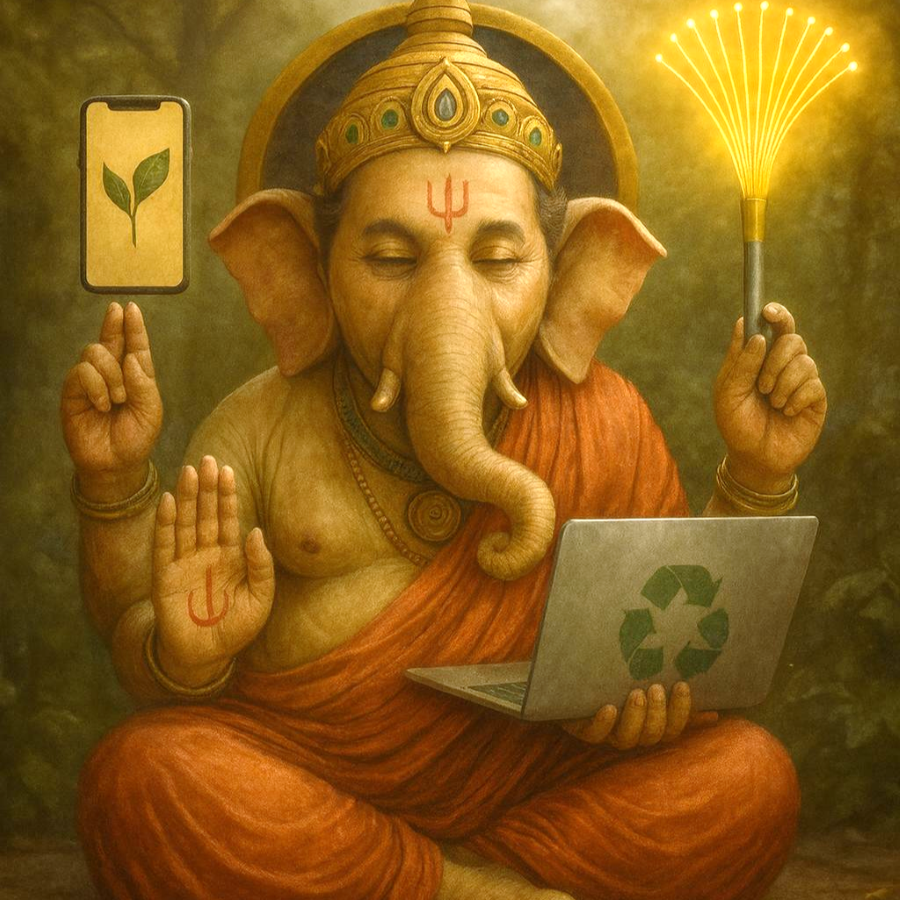


With his elephant head and serene smile, Ganesh is not just a deity: he is a presence that accompanies us in times of transition, when chaos seems to take over. He is the symbol of one who knows how to listen, who knows how to see beyond appearances. Ganesh reminds us that there is a thin thread between what we touch and what we feel, between logic and intuition, between the human and all that is not human but still speaks to us. He is the archetype of one who embraces complexity without fear.
We live immersed in an invisible network of data, servers, algorithms that promise connection and often generate disconnection, a world dominated by technology in which the greatest obstacle is precisely theillusion that the digital is neutral, immaterial, harmless. But this network has a body: it consumes energy, water, rare materials. And it directly impacts the life of the Earth. Not only through data centres, but along the entire technological chain, from the mine to the cloud.
In a world that runs, that forgets, that simplifies and considers sustainability just an abstract word, Ganesh invites us to stop. To seek balance, to cultivate harmony, to find that wisdom that does not shout but whispers. His image reminds us that even in disorder beauty can be born. In the Hindu tradition, he is the god who removes obstacles and opens the way to new beginnings.
Minerals, algorithms and bees: the invisible biodiversity of digital
When we talk about digital sustainability, we often think of energy: data centres, consumption, emissions. But there is another dimension, quieter and less talked about, which directly touches the heart of SDG 15 – Life on Earth: biodiversity threatened by technology supply chains.
Every smartphone, laptop, server contains rare minerals extracted from fragile ecosystems. Coltan, lithium, copper, rare earths: materials that are indispensable to power our connected lives, but often come from areas of high biodiversity, where extraction destroys habitats, contaminates soils and endangers endemic species.
The case of coltan and the gorillas of Congo
Coltan is invisible, but it is everywhere. It is inside our phones, computers, tablets. Without it, the connection is broken. But behind this essential mineral lies a story that does not appear in user manuals. Coltan is mainly extracted from a soil rich in biodiversity in the Kivu region of the Democratic Republic of Congo. It is here that the Kahuzi-Biega National Park, one of the last refuges of the mountain gorillas, is located.
This natural wealth is also its vulnerability. Illegal extraction has devastated whole swathes of forest, pushed species to the brink and fuelled armed tensions involving already fragile local communities. According to the WWF, the number of eastern gorillas has declined by more than 60% in the last 25 years. This is not due to natural causes, but to the systematic destruction of their habitat. It is as if, without meaning to, we are wiping out a part of the world every time we choose comfort without awareness.
Technology can be a bridge, but only if it does not forget its roots. And those roots, in this case, are in the land of a disappearing jungle. Humanising the digital means getting to know these stories, asking ourselves where what we use comes from, and choosing more just supply chains. Because behind every byte, there is a life. And behind every choice, there can be care.
Algorithms and pollinators: the link we don’t see
Digital agriculture, with all its promise of progress, also has an impact on biodiversity. Fields today are no longer just traversed by tractors and skilled hands: they are flown over by drones, monitored by sensors, analysed by algorithms. Precision farming systems promise efficiency, optimised harvests, less waste. But behind this silent revolution lies an urgent question: at what price? The risk is to favour monocultures, intensify the use of pesticides, and reduce the living space for pollinating insects, birds, and small mammals.
Wild bees, essential for 75 per cent of food crops, are disappearing. In Europe, one in three species is already at risk of extinction. Yet without them, even the most sophisticated of digital systems will not be able to guarantee food security. True innovation is not that which ignores nature, but that which listens to it. Because every field, every flower, every bee flight is part of a balance that we cannot afford to lose.
When technology protects life
Enhancing SDG 15 in the digital age means rewriting the relationship between innovation and nature. It is not just about reducing impact, but about generating positive impact.
– Behind each device there is a chain of materials to be traced to ensure that extraction does not destroy forests, rivers or communities. It is a way to give transparency to progress.
– Recycling and reuse is not just a technical gesture: it is a form of respect. Every remanufactured smartphone is a saved resource, a protected ecosystem.
– Imagine sensors that monitor the health of pollinators, servers powered by agro-ecological forests, algorithms that foster biodiversity. Integrating technology with regenerative practices is possible, and urgent.
– The digital economy can also help renaturalise the planet. From carbon credits tech that finances the rebirth of forests, to projects that use blockchain to protect habitats: innovation can become an ally of biodiversity.
Ganesh and the ethics of connection
Ganesh invites us to rethink our relationship with technology. His elephant head reminds us of the wisdom of nature. The mouse, his vehicle, teaches us that even the smallest has a role. The lotus flower he holds is purity, the ability to bloom even in mud. And the sweet he offers is the fruit of shared knowledge.
In a digital key, Ganesh tells us about an ecosystem where every byte is aware, every server is responsible, every innovation is also regenerative.
Digital sustainability as everyday practice
How can we translate this teaching?
– Design lightweight software that consumes fewer resources.
– Optimise the code, reducing the computational load.
– Choose infrastructure powered by renewable sources, such as Aruba’s Green Data Centre in Italy.
– Reuse heat from data centres, as EcoDataCenter in Sweden does.
– Educating users in a conscious use of digital: less superfluous streaming, more attention to invisible consumption.
Every digital gesture is also an environmental gesture. Every click has an impact. And every innovation can be an offering to the Earth.
The strength of the herd, the wisdom of the elephant
Ganesh teaches us that true strength is that which removes obstacles for all. Digital sustainability is not an individual mission, but a collective one. Every developer, designer, user, policy maker has a role to play. Every choice – from programming language to energy source – can help protect life on Earth.
Conclusion: the future is sacred
In a world that runs, Ganesh invites us to stop. To reflect. To recognise that the Earth is not a resource, but a relationship. And that the digital, if guided by wisdom, can become a space of flourishing, not extraction.
Because true sustainability is not only technical. It is spiritual. It is the way we decide to inhabit our time. Biodiversity is not just a biological issue. It is a network of relationships, of balances, of stories. And digital is also part of it. Every technological choice can be a gesture of care or a gesture of destruction. It is up to us to decide whether we want a future where innovation flourishes along with the Earth, or one where connection costs too much.