

The CNSAS Medical Commission tests new technologies in the Grotta A Male in L’Aquila
Three intense days of practical tests, research and collaboration between medical and cave rescue technicians: from 7 to 9 November, the Grotta a Male in L’Aquila was the scene of an important experimental phase dedicated to new technologies for medical cave rescue, promoted by the Medical Commission (CoMed) and the Speleological Technical Commission (CTS) of the Corpo Nazionale Soccorso Alpino e Speleologico (CNSAS).
The aim: to test, under real-life conditions, innovative tools to monitor the wounded at depth and transmit clinical data and vital parameters in real time to specialist teams on the surface and in hospitals.
An underground telemedicine laboratory
The first day, Friday 7 November, was dedicated to the theoretical-practical testing of various medical devices supplied by the company Sylco Srl, including a Minitor 5 multi-parametric monitor of extremely reduced size and weight, capable of sending the image of its screen in real time to smartphones or tablets via Bluetooth connection (up to 20 metres) or Wi-Fi. In addition, a compact Primedic Heartsave MyPAD AED defibrillator for automatic external defibrillation in confined spaces was tested. Finally, an Amoul E6 mechanical massager was also tested, useful for providing constant cardiac massage even in environments where the rescuer’s movement is restricted.
The multi-parameter monitor was connected to the Ermes system, developed by the CTS of the CNSAS, to create a complete medical-technical communication flow: the vital data of the injured person are collected and sent via Ermes to the outside of the cave, where they can be transmitted via radio or internet network to hospitals and medical centres, even hundreds of kilometres away.
Hermes: Internet inside the caves
Ermes is a patented in-cave Internet connection system, the result of collaboration between the CTS and BPG Radiocommunications. It consists of two watertight cases – one located at depth, the other on the surface – connected by a simple telephone pair.
Thanks to this light and robust infrastructure, Ermes enables voice, video and data connections even kilometres from the entrance of a cavity.
The system allows rescuers and medics at depth to make video calls with the outside world, send clinical data such as ECG tracings or ultrasound images, and receive live specialist medical support from hospitals or coordination centres. Ermes has already been successfully tested in exercises up to 2400 metres from the cave entrance, and today represents one of the world’s most advanced technological solutions for underground medical rescue.
Insulation to protect life inside the mountain
During the three-day event, various insulating aids were also tested and compared, which are essential to ensure the survival and thermal comfort of the injured person in a hypogeal environment, where the temperature can drop to a few degrees above zero and humidity is always close to 100 per cent.
These are heavily padded thermal suits, designed to completely cover the injured person – even in the case of polytrauma – while leaving the medical intervention points accessible to the medical staff.
A model devised by the Medical Commission (CoMed), a body suit developed by the company AURA and a Tyromont thermal bag, which can be modified and adapted for use on caving stretchers, were compared and tested.
Field trials at Grotta a Male
The highlight of the exercises was on Saturday 8 November, with activities in the underground environment at Grotta a Male, in the Assergi (AQ) area, in the Gran Sasso and Monti della Laga National Park.
This is the largest cave in the massif, with a development of about 500 metres and a maximum depth of 84 metres: an ideal context for testing new technologies under real operating conditions.
The simulation involved the downward transport of an injured figure on a decomposable stretcher designed by CTS, fully protected by the CoMed suit.
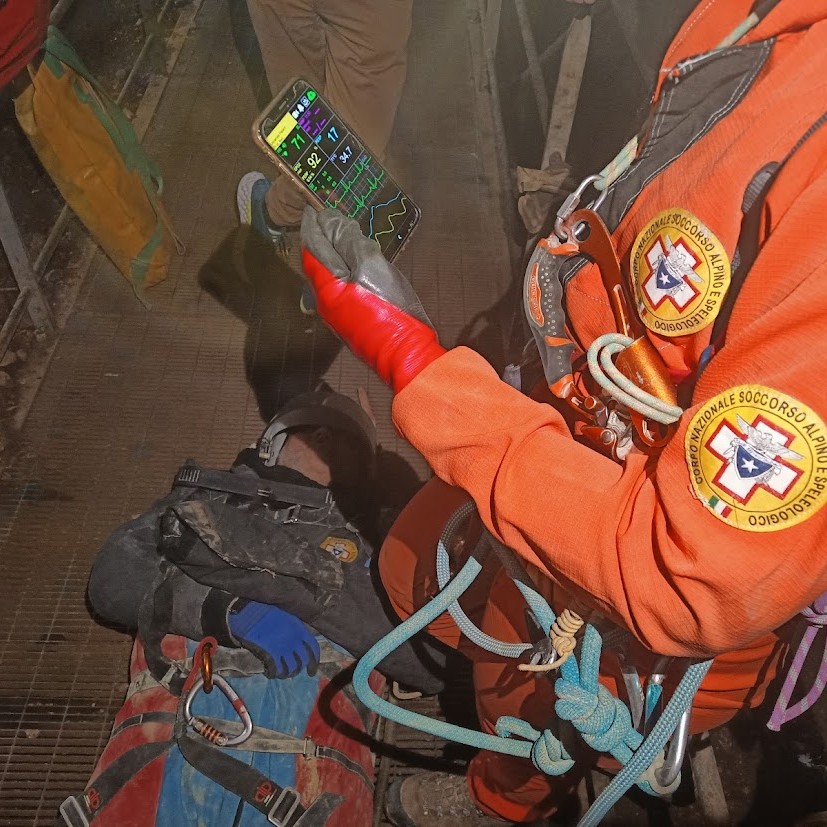
Throughout the entire manoeuvre, the ‘patient’ was constantly monitored by the Minitor 5 multi-parameter device, with particular attention paid to the size, during transport, of the monitor itself, the reliability of the data and the durability of the batteries in extremely cold and wet conditions.
Once at the bottom of the cavity, the healthcare team established a Wi-Fi connection via Ermes with a Sylco technician on the surface, who was able to view the patient’s parameters directly on his computer in real time.
The outcome of the test was entirely positive: participants expressed satisfaction with the stability of the connections, the clarity of the images and the system’s ability to integrate naturally into the medical rescue procedures.
Towards an increasingly connected rescue
The L’Aquila trials confirm the CNSAS’s commitment to bringing technology to the service of human life even in the most hostile and remote environments.
The integration of miniaturised medical instruments and advanced communication systems such as Ermes paves the way for a future in which remote specialist support may be available even hundreds of metres inside the mountain, significantly improving the chances of survival of a seriously injured person.
This synergy between the Medical Commission and the Speleological Technical Commission – under the supervision of the CNSAS National Medical School for high-risk emergencies in mountain and underground areas – represents a model of interdisciplinary collaboration and a strategic investment for safety, training and innovation in speleological rescue in Italy.