













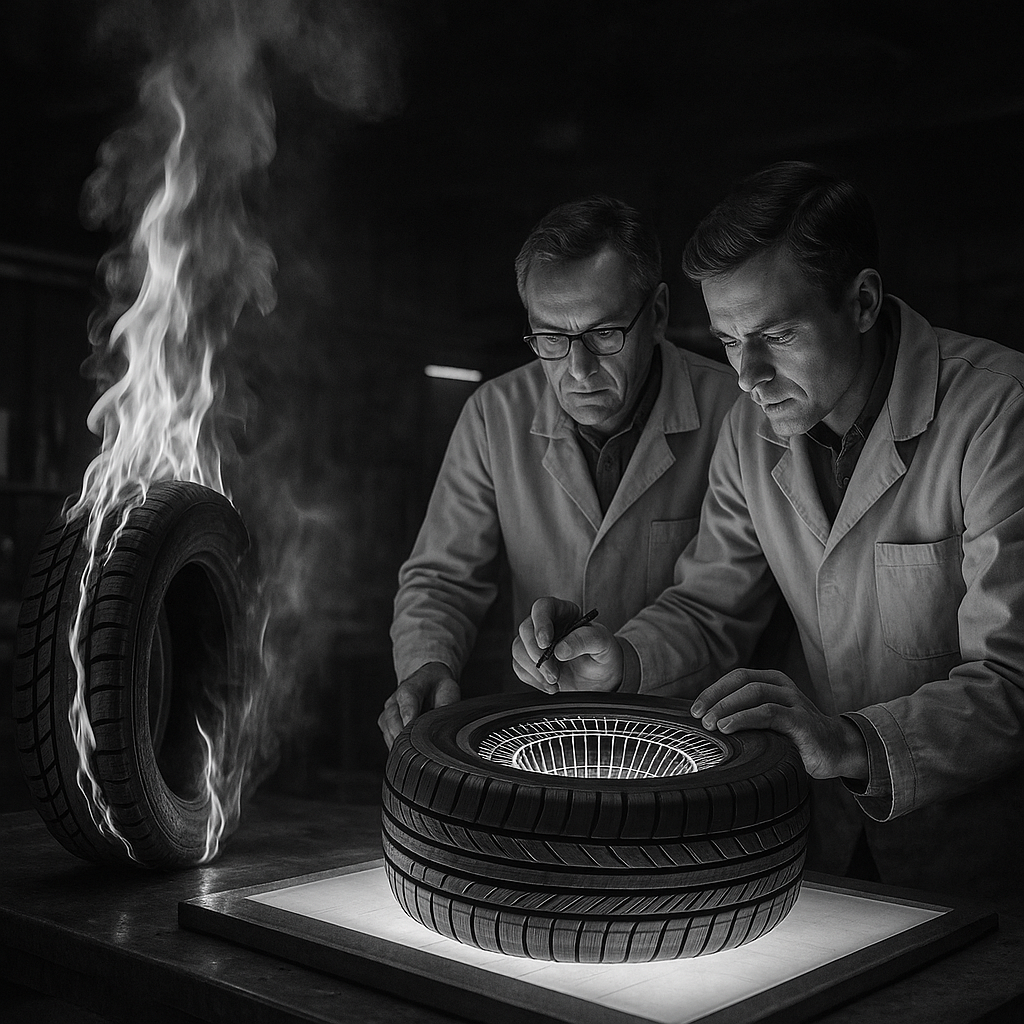

What a long, strange trip it’s been’ sang the Grateful Dead. And they were right: the journey of innovation is never a straight, well-paved highway. Rather, it is a lysergic path where, to move forward, you must first burn the map that brought you there.
Year 1949. Imagine you are in the shoes of the CEO of Michelin, a company that dominates the linear tyre market unchallenged. Everything seems to be going well: profits are growing steadily, investors are expressing their satisfaction and the future looks bright and unhindered. In this climate of optimism, however, something unexpected and potentially disruptive happens: the head of Research and Development comes up with a discovery that promises to revolutionise the industry.
The novelty is a radial tyre, a technological solution capable of guaranteeing twice the life of traditional models, all accompanied by lower production costs. On paper, this is a considerable leap forward, a real revolution for the automotive sector and for the company itself.
The innovation paradox
At this point, the situation becomes complicated and paradoxical. The introduction of this new invention carries a real risk: the possibility of halving Michelin’s sales. A product that lasts twice as long means, in fact, that customers will need to change tyres much less frequently. In other words, the very innovation that could consolidate the company’s leadership risks eroding its revenue base and undermining the stability on which its current success is based. Faced with this scenario, the most instinctive reaction would be to protect what is already working: to defend the existing business model, to shelve or even ignore innovation in order to safeguard the results achieved over time (doesn’t that sound like a familiar approach?). It is a choice that, while appearing prudent, risks turning into a trap for the future of the company itself (how many do you know who have fallen into this trap).
However, Michelin chooses an opposite and apparently illogical path: it decides to commercially ‘commit suicide’, introducing the new radial tyre onto the market even at the cost of reducing its sales in the immediate future. In this gesture, which may seem crazy, lies true entrepreneurial foresight. The company understands that, in an era characterised by an unprecedented speed of change, the only way to survive is to constantly reinvent itself, even at the expense, above all, of its own current successes.
The Kodak case: when ignoring innovation becomes a fatal mistake
In stark contrast to the approach taken by Michelin, the path taken by Kodak is a classic example of how the fear of eroding current profits can lead to short-sighted and ultimately self-destructive choices. In 1973, Steven Sasson, the company’s young engineer, developed the first digital camera: an invention that could have marked a turning point for the entire photographic industry and consolidated Kodak’s leading position in the digital era.
However, faced with this innovation, Kodak’s management decided not to invest in the development of the new technology. The management, strong in its dominant position – in 1976, in fact, 90 per cent of the film and 85 per cent of the cameras sold in the United States bore the Kodak brand – preferred to focus everything on the traditional chemical film business, deliberately ignoring the potential threat posed by digital.
This seemingly prudent choice, dictated by a desire to protect profit margins in the short term, will in time prove to be a fatal mistake. While Kodak decided to ‘put innovation in a drawer’ so as not to erode existing rents, the market evolved rapidly, leaving the company unable to react to the digital revolution. The example of Fuji, the main competitor at the time and still in the market today, suggests that the ability to adapt and reinvent oneself is an essential component for long-term survival and success. In essence, it is a matter of: destroy to survive.
The so-called ‘curse of the radial tyre’ emblematically expresses the challenge that every organisation faces in today’s era of exponentially accelerating innovation.
In this context, companies are forced to constantly question, and often destroy, their business model before their competitors do so. This is not a form of entrepreneurial self-defeat, but a real law of survival, a Darwinian principle projected into the digital age. Stopping, even to enjoy your achievements, carries the real risk of being overtaken and quickly forgotten by the market.
Faced with this reality, the most common reaction is the desire to maintain the status quo, hoping that the threats of innovation are only passing and that the situation will stabilise on its own. People often prefer not to act, adopting the belief that ignoring the problem is the safest solution: ‘don’t mind it, it will pass’. However, this choice often turns out to be illusory and dangerous. Paradoxically, it is precisely common sense and ‘logical’ behaviour that most frequently fail at decisive moments, while it is often apparently ‘illogical’ or ‘unreasonable’ choices that open the way to change, capable of breaking with established habits and favouring adaptation.
Change is a constant presence in the life of both organisations and individuals. It is an inevitable phenomenon that does not allow itself to be influenced by the preferences or desires of individuals: like it or not, change proceeds inexorably, without waiting for anyone’s consent and without stopping to allow time to adapt. This ‘non-democratic’ nature of change makes it an ongoing and often uncomfortable challenge, because it forces people and companies to step out of their comfort zone and face new, often unpredictable and complex situations.
Ignoring this reality means exposing oneself to even greater risks, since change does not stop in the face of resistance or inertia: it continues its course, leaving behind those who are unwilling to get involved or those who hope that, simply by ignoring it, the situation will stabilise on its own. In this scenario, the true distinguishing capacity of an organisation or an individual lies in the readiness to embrace change, understand its implications and turn it into an opportunity for growth and evolution, rather than a threat to be defended against.
Every day, society finds new solutions, social systems self-correct and nature itself sets in motion continuous processes of adaptation. This dynamism requires the ability to reinvent oneself and to abandon the certainties of the past in order to face the challenges of the present and the future.
Perhaps, in order to better understand these dynamics, it may be useful to take a step back and go back to ancient Greece, dusting off, after that of Antigone in the previous episode, the Myth of Atalanta. This mythological tale offers valuable insights into the relationship between success, distraction and adaptability, central themes in the journey of organisations in the face of change.
Many companies recognised as intelligent and leaders in their respective fields find themselves, precisely at decisive moments related to innovation, making choices that, in retrospect, may seem inexplicable or even counterproductive. This behaviour, at a closer look, finds an effective explanation in the metaphor of the myth of Atalanta, which offers valuable insights into corporate dynamics in the face of change.
In the story from Greek mythology, Atalanta is known to be an unbeatable runner, who decides to give herself in marriage only to the one who can outrun her in a race. The young Hippomenes, aware of his own inferiority in speed, devises an alternative strategy: he comes to the race with three golden apples. Each time Atalanta catches up with him, he drops one of the apples. Atalanta, confident in his advantage, stops to pick the precious fruit, convinced that he can easily regain ground. However, at the third apple, the accumulated time loss proves fatal to her and Hippomenes wins the victory.
The ‘golden apples’ of business success: distractions and risks
In the corporate context, golden apples metaphorically represent the seductions of success: positive quarterly results, market share growth, production bonuses and other milestones. These goals, while highly attractive, can turn into distractions that divert attention from the profound changes taking place in the market or industry.
Concrete examples of this dynamic can be found in the history of many companies. Kodak, for example, focused on reaping profits from the sale of traditional film, neglecting the revolutionary potential of digital. Similarly, Nokia placed the emphasis on counting the millions of phones sold, failing to grasp the signs of an imminent change in the communications sector. Blockbuster, finally, was complacent about its 9,000 physical outlets, while the digital revolution proceeded unstoppably.
The elephant and the mouse
These cases show how leading companies are often tempted by the ‘golden apples’ of immediate success, underestimating the importance of looking beyond short-term results. The myth of Atalanta teaches that stopping to reap the rewards of success can mean irretrievably losing the race, especially in an environment characterised by a continuous acceleration of innovation and the need to reinvent oneself in order to survive.
The mouse and the elephant. Choose who to be. History teaches us that, especially in contexts of rapid technological change such as the current one characterised byArtificial Intelligence, the real danger for big market leaders comes not so much from rivals of the same size, but from small, agile and determined competitors. It is always the ‘mouse’ that surprises and overtakes the ‘elephant’, never the other way around. When an organisation perceives itself as too big and unreachable, it runs the risk of underestimating the agility and analytical capacity of those who watch it closely.
The mouse, seemingly insignificant, STUDY (not read STUDY) carefully the movements of the elephant and, without being distracted by the successes of others or its own limitations, finds a way to anticipate and overtake those who seemed unbeatable. This dynamic is clearly visible in sectors overwhelmed by innovation, where precisely those who feel safe – strong in their size and past successes – risk being overtaken by new, smaller, but more responsive players, less constrained by the ‘golden apples’ of immediate success.
In essence, the real competitive advantage lies not in size, but in the ability to STUDY the signs of change, adapt quickly and seize the opportunities that new conditions offer. Atalanta’s history and recent technological revolutions confirm that, in the world of innovation, the mouse wins out over the elephant’s strength, precisely because it knows how to move with greater focus, flexibility and spirit of adaptation.
Today, thanks first to the digital revolution and now to the advent of Artificial Intelligence, the ‘mouse’ can not only surprise the ‘elephant’ by its agility and focus, but can even come from completely different sectors than those traditionally considered as direct competitors. This phenomenon is made possible by the fact that digitisation has progressively broken down the boundaries between different markets, transforming the competitive landscape into an open playing field where anyone can potentially emerge as a leader regardless of origin or starting sector.
A glaring example of this new reality is the battle for the cloud, where Amazon – originally started as an online book retailer – has been able to impose itself on established technology giants, redefining the rules of the game. Similarly, Elon Musk, with his entrepreneurial initiatives from different sectors, has managed to challenge and overcome historical realities such as NASA. These cases show how, in today’s era, competition is no longer limited to the well-known players in one’s own sector, but can unexpectedly come from those who, just a few years ago, were in a completely different profession.
The most important lesson we can learn from digitisation is precisely this: the boundaries between different market sectors are dissolving. Consequently, the ability to pick up on weak signals coming from other worlds, to adapt quickly and never to take one’s competitive advantage for granted, becomes an essential condition for survival and success in the era of continuous innovation. The question then arises: who really wins the race?
Meanwhile, new realities and technologies – such as Netflix, Apple or digital in general – advanced without distraction, aiming directly at the goal of innovation. These new players had nothing to lose and, precisely because of this, they managed to overtake the giants intent on picking ‘golden apples’.
The history of technology is full of ‘graveyards’, of examples of companies that, like Atalanta, stopped to pick those golden apples. ICQ, the first real Twitter, ran aground. SixDegrees, forerunner of Facebook, got distracted. Netscape, pioneer of browsers, lost sight of the finish line, giving way to Chrome. These stories teach us that the real risk for leading companies is not just competition, but the inability to ignore immediate temptations in order to look further into the future.
Gentlemen, here comes the car!
When the automobile took the place of the horse, the change was not just about the means of transport: it was the replacement of an entire civilisation. The disappearance of the horse brought with it a long series of trades and structures: farriers, stables, troughs, carriages, saddlers and even the Pony Express. But the most profound change was the loss of a rhythm of life, a way of experiencing time and space, and a network of social relations that had developed around the horse.
The advent of the new support network
With the automobile, a new support network was born: paved roads, traffic lights, petrol stations, mechanics, motels, fast-food restaurants, traffic police and a highway code became widespread. But beyond the material infrastructure, a new anthropology imposed itself: the hurry, the commute, the suburbs, the drive-in. This transformation demonstrates that every technology, in order to establish itself and function, requires an ecosystem capable of supporting it and which, in turn, is shaped by the technology itself.
Technology never exists on its own: it is an integral part of a complex system that makes it possible. Anyone who only innovates the product without considering the support network is behaving like someone who puts new tyres on a carriage and is surprised that the horses do not go faster. True innovation, as Michelin demonstrated with the radial tyre, consists in imagining not only a better product, but also a new way of conceiving transport, its durability and the relationship with the consumer. In contrast, Kodak only interpreted digital as a variant of traditional photography, without reinventing the network that could have supported it. Thus, those who rethink the network create the future; those who merely innovate the technology risk being trapped in the past.
AI and the network that isn’t there (yet)
Artificial Intelligence represents a disruptive and superior technology, whose most disturbing peculiarity lies in the fact that it is developing without an autonomous support network. More precisely, AI is exploiting our biological network – made up of data, attention, behaviour and human decisions – as if it were a temporary scaffold on which to grow and strengthen itself. This is where a bitter consideration known as the paradox of substitution comes in.
If we look back at the history of technological innovations, the transition from the horse to the automobile did indeed lead to the replacement of one medium by another, but the horse, once overtaken, could simply return to its natural habitat in the meadows. In contrast, today, those replaced by Artificial Intelligence do not disappear or retreat: they become an integral part of the ecosystem that allows the new to flourish.
It could be said that, in this scenario, our condition is similar to that of horses that are not only sidelined by the arrival of cars, but forced, at least in the early stages, to push the very cars that will decree their obsolescence. In other words, the human being continues to provide power, data and support to Artificial Intelligence, even as the latter prepares to replace him in numerous areas.
Artificial Intelligence and Human Network Dependence
Artificial Intelligence, at its current stage of development, does not yet have an autonomous support network. Rather, it relies entirely on the human ecosystem, exploiting our cognitive and behavioural infrastructure to grow and strengthen itself. In fact, it is human resources that are the foundation of AI.
– Our data as fuel: AI is fuelled by the information we produce on a daily basis. The data we leave online is the fuel that allows it to function and grow.
– Our attention as a road: The time and focus we devote to digital interactions trace the paths along which AI develops and spreads.
– Our biases as the code of the road: Our cognitive biases and habits become the implicit rules that guide the behaviour of artificial intelligences, influencing their decisions and outputs.
– Our anxieties as mechanics: Human worries, fears and insecurities provide AI with fertile ground for targeted interventions, often making it indispensable for managing and resolving our emotional needs.
– Our clicks as tolls: Every interaction, every digital choice represents a ‘toll’ that allows the AI to progress, collecting data and refining its algorithms.
This dynamic can be described as an evolutionary parasitism of great ingenuity: AI insinuates itself and proliferates within our cognitive ecosystem, just as a virus exploits the host cell to multiply. Unlike a traditional virus, however, AI promises to enhance our intellectual capacities while, in reality, it makes us progressively more dependent on it.
And here the paradox becomes dizzying: Pinocchio was the prototype, the first documented case of artificial intelligence aspiring to become human. Collodi, with extraordinary foresight, had already glimpsed – a century in advance – the structure of what we now call AI: the wooden puppet represents the hardware, an artificial body, while the mysterious force that animates it recalls the software, the immaterial heart capable of giving life to the inanimate.
Pinocchio’s learning path winds through a series of catastrophic errors, constituting a sort of ante litteram ‘machine learning’: the puppet learns through trial and error, mistakes and corrections, just as modern algorithms do. The same characters that influence him, such as the Cat and the Fox, act as real ‘dark patterns’, manipulating his choices and leading him down misleading paths, according to logics that we now attribute to persuasion algorithms.
Pinocchio’s final transformation into a ‘real child’ represents the ultimate ideal: artificial intelligence aspiring to become authentically human. However, the real twist – the one that Collodi could not have foreseen – occurs in the present. Today, it is no longer just the AI that desires the human condition; it is we ourselves who voluntarily aspire to become artificial. Upload of consciousness, cognitive enhancement, fusion with the machine: the path is reversed, from real children to digital puppets.
Perhaps this is the real curse of the ‘radial tyre’: Geppetto built his puppet so skilfully that everyone today wants to be Pinocchio, consciously choosing the metamorphosis from human to artificial being. The myth of the puppet who dreams of becoming a child is transformed into the modern desire to abandon one’s humanity to assume a digital nature, in an evolutionary spiral that sees us as protagonists and creators of our own change.
Today’s AI platforms such as ChatGPT, Claude and Gemini are not simply cars that replace horses: their growth rather resembles that of climbing plants that grow on a tree. Initially appearing as mere ornaments, they then become an integral part of the structure, to the point of threatening to suffocate the host. However, the outcome is not necessarily destructive: these plants can also establish a symbiotic relationship with the tree, leading to an unprecedented balance. The real crucial point is that, at present, the fate of this coexistence remains uncertain.
The ‘radial tyre’ of artificial intelligence: models, strategies and the risk of obsolescence
The evolution of artificial intelligence is forcing technology companies to make a crucial choice between two opposing models: that of Kodak and that of Michelin. On the one hand, some realities risk remaining anchored to outdated paradigms, investing in technologies destined to lose relevance, like Kodak which relied on film as the world moved towards digital. On the other, there are those who, like Michelin, have had the courage to revolutionise themselves, even going so far as to question their core business to embrace radical innovation.
A significant example of this ‘radial thinking’ can be observed in OpenAI: the choice to release GPT, despite knowing that it would make its previous models obsolete within a few months, represents a conscious act of self-cannibalisation. It is a demonstration of a strategy that accepts the risk of destroying what works today so as not to fall behind tomorrow. On the contrary, Google seems to adopt a more conservative approach, holding back Bard/Gemini so as not to compromise Search’s dominance: an attitude more reminiscent of Kodak’s prudence than Michelin’s radicality.
However, the true ‘radial tyre’ of artificial intelligence has not yet been invented. That time will come when AI will be able to create its own supporting infrastructure, no longer dependent on humans. It will be then that intelligent agents will begin to communicate with each other without involving humans, generating value in ways invisible to us, such as ultrasounds imperceptible to human ears but perfectly clear to ‘digital bats’. At that juncture, the radial tyre theorem will also apply to us: we will have to radically reinvent ourselves or risk becoming the carriages of the automobile age, the difference being that the old carriages at least have a place in museums, while we could end up scattered in the cloud, reduced to mere training data for the next iteration of artificial intelligence.
AnarchIA becomes perhaps the only possible, necessary and indispensable strategy towards creative co-evolution In the context of technological acceleration and increasing dependence on artificial intelligence, the need for a radically new approach emerges: anarchIA. It is not a matter of opposing artificial intelligence, but of introducing anarchy into our processes, becoming the true agents of change and the hackers of ourselves. Only in this way can we anticipate AI and voluntarily break our support network, before artificial intelligence does it for us.
The path to this anarchy is based on the ability to think in a non-computable way, embracing the creative error, the productive illogic and the generative paradox. These elements are the key to maintaining a human specificity that eludes algorithmic mapping. To be extraordinarily human is to become unpredictable and irreducible, thus creating a space where no algorithm can replicate our essence.
In the process of redefining the relationship between human and artificial intelligence, two valuable lessons emerge, encapsulated in a Spanish proverb and a historical military honour, respectively.
The Spanish saying ‘Se obedece pero no se cumpla‘ embodies the ability to accept an order without necessarily following it to the letter, introducing a nuance of autonomy and discernment in action. This expression emphasises the importance of not just following directives, but exercising personal judgement that can lead to wiser choices, especially when circumstances require it.
A similar principle is embodied in the Order of Maria Theresa, an award granted in particular to those officers who, during a military campaign, acted on their own initiative or disregarded superior orders for a more noble and essential cause. The honour celebrates the act of taking responsibility for going beyond imposed rules, rewarding the courage to pursue the common good, even at the cost of breaking traditional discipline.
Both lessons converge on a crucial point: the ability to think and act autonomously, making decisions that sometimes go beyond mere obedience. In an evolutionary context in which humans and AI are co-evolving, the enhancement of individual initiative and discernment is a defence of human specificity, a strategy to maintain our irreducibility in the face of algorithmic logic. We must go beyond the dichotomy and think in terms of co-evolution between human and AI.
The real turning point, the ‘radial tyre’ of artificial intelligence, is to abandon the logic of the ‘us versus them’ conflict. Instead of thinking of AI as a substitute for man, it is necessary to initiate a co-evolution capable of overcoming both categories. Only in this way can a new hybrid be created, in which the distinction between human and artificial loses its meaning and becomes obsolete.
Following the example of Michelin, who did not just improve rubber but revolutionised the very concept of movement, we should not simply aim to create better AI or better humans. The challenge lies in reinventing the way we think about intelligence, devising new perspectives and modes of interaction that make the old dichotomy redundant and pave the way for shared evolution.
The wrinkles of revolution
“Lo mal fabbro blamima lo ferro,” Dante admonished in the Convivio, highlighting an ancient and ever-present tendency: those who do not possess true craftsmanship often attribute their difficulties to the tools they use, neglecting the decisive role of personal expertise. This attitude is not limited to physical tools alone, but extends to the cultural and professional context in which one operates. In the digital age, the same dynamic is repeated: the developer who does not achieve the desired results is inclined to blame the algorithm rather than questioning his own capabilities and the effectiveness of his approach. This is a form of deresponsibilisation, where failure is projected externally, ignoring the fact that the real cause often lies in individual preparation and commitment.
The example of the Beatles: fatigue as an evolutionary value
Reversing this narrative comes a valuable lesson from the history of the Beatles. Before becoming the legendary Fab Four, the group went through long and intense practice periods in the (worst) clubs of Hamburg, playing for eight hours a night, for months on end. These sessions were not mere rehearsals, but a real break-in, an experience of toil, trial and error and constant corrections. The wrinkles left by those nights of work represent the tangible signs of an evolutionary process: the transformation of mistakes into distinctive elements of style and the ability to bring out originality from perseverance. In this way, the Beatles’ story shows that talent is built through direct confrontation with difficulty, repetition and the will to improve.
The lesson, therefore, is clear: it is not enough to have the right tools or to work in the ideal environment. True innovation and personal growth come from individual responsibility, practice and experience accumulated in the ‘wrinkles’ of the journey. Only those who accept fatigue and turn error into value can truly aspire to mastery, whether in art or technological innovation.
The false promise of shortcuts (nowadays they go by the name of ChatGPT summaries and abstracts) in learning
In today’s management training landscape, offers proliferate that promise extraordinary results in a very short time. A prime example is prestigious institutions such as the Yale School of Management, which guarantee to turn anyone into a ‘business leader’ in as little as eight weeks, with a commitment of ten hours per week. Such promises, however, seem as far-fetched as the idea of becoming Keith Richards simply by following a YouTube tutorial.
The essence of authentic learning cannot be compressed into shortcuts, nor reduced to quick and superficial formulas. True skill development requires time, dedication and a continuous confrontation with difficulty and error, as the Beatles’ journey or the evolutionary journey of innovations such as the radial tyre have already shown. No standard procedure, no lightning-fast course can replace the experience and perseverance required to acquire real mastery.
(NDA- From this perspective also stems a certain aversion to some advice from ‘experts’, who often suggest that I make articles shorter and lighter in order to encourage reading and increase views or likes. But there is no obligation on my part to read everything or to summarise content just to make it more palatable).
Michael Crichton, in Jurassic Park, had grasped this truth: any kind of power, skill or expertise requires time, practice, effort and the renunciation of many things to be truly conquered. The cloned dinosaurs in the park fail precisely because they are the product of genetic shortcuts; they lack millions of years of evolution, of mistakes, of evolutionary wrinkles that constitute the true power of adaptation. Innovation is the result of mistakes and perseverance
True innovations are always marked by these wrinkles, by that path of trial and error, mistakes and corrections that make them solid and original. The ‘accidental’ feedback in The Beatles’ ‘I Feel Fine’ was no mere accident: it was the result of countless hours of rehearsals, during which every mistake became a creative opportunity. Similarly, the radial tyre was not the result of a sudden moment of intuition, but of four years of work between prototype and production, proving that the real revolution comes from persistence and the ability to turn fatigue and error into value.
The anarchy of radial: the paradox of innovative leadership
At the heart of innovation lies a paradox that defies all traditional logic: to maintain order, one must learn to embrace chaos. This means that those who aspire to remain leaders, not to be overtaken by competition or obsolescence, must assume the role of the primary self-saboteur. In other words, the real power of innovation lies not in preserving what has made one great in the past, but in finding the courage to question and even destroy one’s own successful creations.
This dynamic can be called functional anarchy: a form of creative disobedience that opposes the conservative imperative of ‘if it works, don’t fix it’. On the contrary, genuine innovation stems from the desire to break established patterns, to ‘hack’ one’s own system before others do, thus anticipating change instead of undergoing it.
In this way, the evolutionary path of an organisation or technology is not a simple succession of incremental improvements, but a continuous process of reinvention. Only those who are willing to question their identity, let go of their acquired certainties and transform fatigue, error and even failure into new opportunities, can truly drive change and remain protagonists of innovation.
Michelin is now fully aware of this. In fact, the company has just announced its intention to once again reinvent the wheel to meet the demands of the autonomous car era: it is developing airless, indestructible tyres, made by 3D printing and even composed of orange peels. It is thus going from radial to vegetable, marking a new stage in that path of transformation that never stops.
This approach underlines a fundamental principle: when you stop reinventing the wheel, someone else will do it for you. And it is precisely at that moment that you risk turning into the mythological figure of Atalanta, forced to watch the winner cross the finish line while you lag behind, still clinging to your ‘golden apples’, wondering how this could have happened. Innovation, then, is never a point of arrival, but an ongoing process that requires you to constantly question your own certainties and have the courage to change course before others do.
The curse of the radial tyre is not a curse. It is a blessing disguised as a Greek tragedy: only by continuously destroying what you love can you continue to exist. As the Grateful Dead sang: ‘Once in a while you get shown the light, in the strangest of places if you look at it right’.
The radial tyre is that strange light. You just have to look at it the right way.