








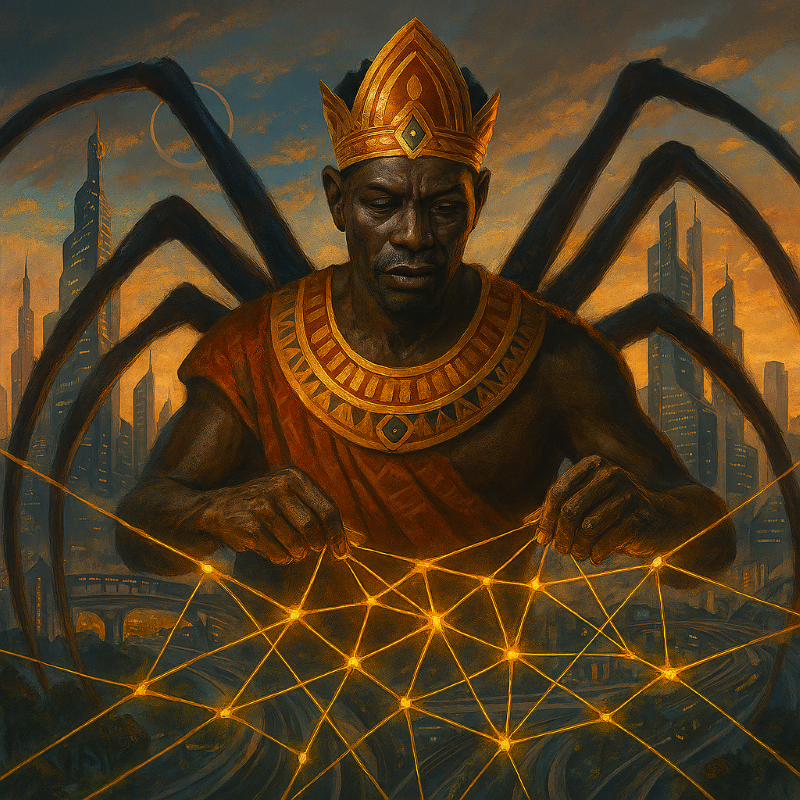


At the heart of digital cities, amidst invisible sensors, silent algorithms and streams of data flowing like urban veins, we need more than technology. It needs relational intelligence. It needs awareness. It needs a figure who knows how to weave stories, networks and meanings. It needs Anansi.
Anansi, the spider god of African stories, is not just a mythological character: he is a living, elusive, fascinating presence. He is the weaver par excellence – not just of webs, but of tales, of relationships, of possibilities. He is a bearer of wisdom who does not impose himself by force, but by intelligence. A trickster, yes, but not in the banal sense of the term: Anansi is a creative trickster, one who plays with the rules not to destroy, but to reveal what is hidden. With his cunning, he subverts order to show its cracks, overturns hierarchies to bring out new truths. He is the kind of figure who makes you smile as he changes your perspective. A bringer of change capable of undermining certainties, unmasking injustices and opening the way to new possibilities.
In Marvel comics, Anansi is recognised as the ‘first Spider-Man’, the progenitor of a spiritual line of justice weavers. But the real point of contact is the metropolis. Like Anansi, Spider-Man is a storyteller who acts in the everyday, who gets his hands dirty in the alleys, who defends the voiceless.
Both act in complex urban spaces, full of contradictions, where the network – digital or narrative – becomes an instrument of transformation. In an era of smart cities, sensors, algorithms and digital infrastructures, the message of Anansi and Spider-Man is more relevant than ever: it is not enough to connect, one must understand.
Metropolises are not just networks of data, but networks of meaning. And every citizen, like them, can become a weaver: of relationships, of choices, of the future. A truly intelligent city is one that knows how to listen, that creates bonds, that puts people at the centre. It is the one that builds community, not just infrastructure.
The city as a living network
SDG 11 invites us to rethink cities as inclusive, safe, resilient and sustainable spaces. But what does this mean in the digital age? It means recognising that every piece of urban infrastructure – from smart traffic lights to shared transport systems – is part of a larger network of relationships, choices and responsibilities.
Anansi teaches us that every node in the network is significant. It is not enough to connect: we must understand. Digital cities must be designed to listen, to adapt, to include. And this requires a new urban literacy, where technology is not an end, but a means. Where every citizen is also the author of his or her own space
Sensing and Urban Tech: the invisible thread
Urban sensing is the invisible thread that connects cities. Environmental sensors, IoT devices, smart cameras: everything contributes to creating a digital fabric that monitors, regulates, optimises. But who decides what is measured? Who interprets the data? Who benefits from the solutions?
Anansi invites us to question ourselves. Not to passively accept automation, but to ask ourselves whether urban systems really serve people.
According to a study published in Energies in January 2025, urban sensor systems consume up to 12 per cent of the total energy used by a city’s digital infrastructure. This means that, in an average European smart city, more than a tenth of digital energy is consumed by devices operating in the background: traffic sensors, environmental detectors, security systems, energy monitoring. A non-negligible impact, especially considering that much of this infrastructure is still powered by non-renewable sources.
Sources such as EU LEVA and the Multidisciplinary Digital Publishing Institute point out that without energy-conscious design, sensor technology risks becoming a paradox: tools designed to optimise urban efficiency that end up increasing overall consumption. Therefore, a design that integrates energy efficiency, durability and interoperability criteria is needed to avoid waste and redundancy.
Urban Tech must be designed with equity, transparency and participation in mind. It is not enough to collect data: sense must be constructed. And this sense comes from the dialogue between technology and community.
Sustainable mobility: moving is a political act
Urban mobility is one of the most visible fields of digital transformation. Apps for car sharing, bike sharing, integrated public transport and dynamic maps are more than just technological tools. They have become crucial assistants and daily travel companions, helping us to choose faster, more sustainable, more conscious routes.
By 2025, more than 70 per cent of European cities have adopted a Sustainable Urban Mobility Plan (SUMP). It is not just about reducing emissions, but rethinking the very way we move. The goal? Cities that are more accessible, more liveable, more human. Every urban journey, even the shortest, is part of something bigger: mobility that does not consume, but connects.
Take Gdańsk, Poland. Here, a new cycle corridor has been inaugurated that runs through the city, connecting the suburbs with the city centre. It is not just a cycle path: it is a political gesture, an infrastructure that improves safety, reduces traffic and invites people to rediscover the city slowly, in a healthier and more sustainable way (source: EU Urban Mobility Observatory).
Because sustainable mobility is not just a question of means. It is a daily choice. Walking, cycling, sharing a route means choosing a different model of city: a city that breathes, that slows down, that puts people – not just performance – at the centre. Every time we decide how to move, we are also deciding what kind of relationship we want to have with the environment, with others, with our time.
Active digital citizenship: weaving together
Anansi does not act alone. Its networks are collective. And today, every citizen can become a weaver. Through participatory platforms, open data, and urban co-design initiatives, we can build cities that do not suffer technology, but direct it.
The Foundation for Digital Sustainability launched the Digital Sustainability Award in 2025, honouring urban projects that integrate environmental sustainability and digital innovation. Among the winners, several Italian cities have adopted sustainable clouds and energy-efficient information systems.
Active digital citizenship is the key to a sustainable city. It means knowing one’s rights, understanding digital mechanisms, participating in decisions. It also means educating about complexity: not everything can be simplified in an app. Not everything can be automated. Space is needed for doubt, for confrontation, for storytelling.
Storytelling as infrastructure
Cities are not just made of concrete and data. They are made of stories. Of memories, of desires, of conflicts. Anansi reminds us that every network needs meaning. And sense is born from narration. To narrate the city is to build it. Giving voice to neighbourhoods, to the margins, to invisible experiences is part of sustainability.
A smart city is one that knows how to listen. That integrates stories into its algorithms. That recognises that every piece of data is also a life. And that every life deserves space, attention, respect.
Digital circular economy: every byte can weigh less
Urban digital sustainability also passes through the circular economy. Reducing e-waste, extending the life of devices, choosing open source software, promoting sustainable clouds: these are all actions that contribute to building lighter, more ethical, more resilient cities.
In Europe, the average urban e-waste production exceeded 16 kg per citizen in 2025, with only 42% properly recycled. Several Italian start-ups are promoting digital regeneration models, such as reusing devices and adopting low-impact software.
Anansi teaches us that every thread can be reused. That every web can be repaired. And that technology, if guided by values, can become a tool of care, not consumption.
Conclusion: Anansi is us
Anansi is not just a myth. It is a narrative strategy, a bridge between worlds. It is an invitation to think of the digital as a space of justice, of relationships, of transformation. in an age of digital urbanisation, it reminds us that sustainability is not measured in gigabytes, but in relationships. That every urban network must be woven with care, with ethics, with beauty. Because a smart city is not one that collects data, but one that builds community.
In a world that runs, weaving networks is an act of resistance.
In a world that simplifies, telling stories is an act of complexity.
In a consuming world, building community is an act of sustainability.
SDG 11 asks us to build sustainable cities and communities. Anansi shows us how: with intelligence, with care, with a network. Because every city is a story. And every citizen is a storyteller. It is up to us to decide whether we want to be simple users… or weavers of the future.