





Two prophets for conscious consumption in the information age
We live digitally immersed. Every day we produce data, buy devices, navigate in invisible but energy-intensive clouds. Yet we rarely ask ourselves what the environmental cost of this revolution is. Goal 12 of the 2030 Agenda – ‘Responsible Consumption and Production’ – invites us to do so. To explore this dimension, we rely on two symbolic figures: Cassandra, the ignored voice, and Morpheus, the mentor of awareness.
The unheard prophecy
Cassandra, in Greek mythology, was condemned to predict the future without being believed. Today, her spirit lives on in researchers, activists and ethical engineers who have been sounding the alarm for years: the digital is not immaterial.
Every stream, every backup, every archived selfie has an impact. Every time we save a photo, watch a streaming series or archive a document in the cloud, we are consuming energy. We don’t see it, we don’t hear it, but behind every click is a physical infrastructure of servers, cables and data centres that, taken together, consume around 2 per cent of the world’s electricity. And it is not clean energy: too often it is still powered by non-renewable sources.
Meanwhile, our devices are becoming more and more powerful… and increasingly ephemeral. Smartphones, tablets, laptops: their life cycles are shortening, driven by fads, upgrades and planned obsolescence. The result? A growing mountain of e-waste, averaging 16 kg per citizen per year in Europe. And only a fraction of this is properly recycled (source: improntaetica.org).
It is not a question of renouncing the technology that has now become an integral part of our lives. Our habits are increasingly automatic and the technology we use has often gone unnoticed. Yet, it is there, a silent accomplice in dinner reservations and an omnipresent friend ready to help us with any doubts or help. . But precisely because it is so present, have we ever wondered how we are using it? Have we ever stopped to reflect on the impact our digital habits have on the environment, on society, on culture?
The real revolution is awareness. A useful key to understanding this is offered by the Digital Sustainability Index (DiSI by the @Digital Sustainability Foundation), which helps us understand how we are using digital, whether we are helping to build a more sustainable future, or whether we are simply consuming – data, energy, attention – without realising it. A tool that invites us to look in the mirror – not to judge ourselves, but to understand. The mirror of current data is unfortunately: only 48% of Gen Z – the generation most immersed in digital – adopt sustainable online behaviour. Among Millennials, the percentage drops to 33%. The majority of young people, therefore, despite being digital natives, seem not yet to have fully developed an ecological awareness linked to the use of technology.
Yet it is precisely they – students, creators, digital professionals – who hold the levers of change in their hands. The DiSI is not just a thermometer: it is an invitation to rethink our digital habits, to choose more carefully, to understand that even an apparently innocuous gesture – such as leaving dozens of apps active in the background – has an impact. The challenge is cultural, before being technological. What is needed is a new digital literacy, one that is not limited to teaching how to use tools, but one that educates people to use less, better and more responsibly.
The red pill of awareness
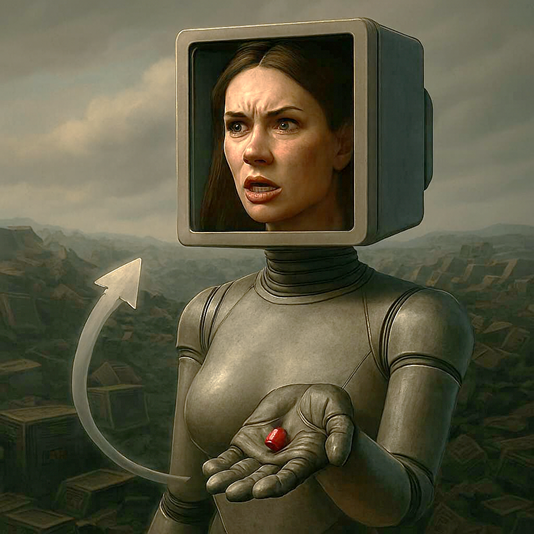
Morpheus, the Matrix‘s enigmatic mentor, does not offer us superpowers or shortcuts. He offers us a choice. A red pill to wake us up, to see the system for what it is: an invisible network of habits, algorithms, economic models that shape the way we live and consume. Or a blue pill, to continue navigating in the digital world without asking questions, without seeing what is behind the screen.
In the world of digital sustainability, Morpheus is the symbol of technological consciousness. It invites us to look beyond the interface, to question how and why we use technology.
Have we ever stopped to ask ourselves if we really need that new smartphone? If that app that follows us everywhere is really useful? If that endless backup, accumulating data as if it were memories, isn’t consuming more energy than we imagine? These are uncomfortable but necessary questions. And Morpheus, the Matrix mentor, asks them with disarming clarity: do you want to continue to consume without thinking, or do you want to start using digital in an ethical, sustainable, responsible way?
More and more people are choosing the red pill. Not to give up technology, but to take back control of it, through awareness and freedom of choice They adopt open source software, which respects privacy and reduces their energy footprint. They repair instead of replace, extend the life of devices, reduce e-waste. They promote a sober and conscious use of digital, where every choice – from the browser we use to the cloud service we choose – becomes an act of responsibility. Digital sustainability is not a renunciation. It is a new way of inhabiting the virtual world, with the same care we would like for the real one. It is circular economy, even among the bits.
Some supply-side realities have already started virtuous initiatives: several Italian companies, such as those involved by Impronta Etica, are not just riding the digital transformation and are adopting responsible digitisation models, reviewing their information systems to reduce waste, optimise resources and reduce their energy footprint. A concrete example is the increasing adoption of sustainable clouds, powered by renewable sources and designed to reduce energy consumption. It is not just a technical issue: it is a cultural, strategic choice that tells a new way of thinking about digital.
These experiences, which are also multiplying in Italy, show that digital sustainability is not a utopia. It is a concrete road, already travelled by companies, public bodies and start-ups that have decided to innovate without compromising the future of the planet. Every byte can weigh less. Every technological choice can be more conscious. And every digital infrastructure can become part of the solution, not the problem.
The digital citizen
The good news? You don’t need to be a technology expert to contribute to digital sustainability. You don’t need computer science degrees or developer skills: all you need is curiosity, attention and a critical sense. It means starting to ask questions: Who manages my data? How much does this app consume? Is this device really necessary? It means learning to read ‘digital labels’, just like we do with food labels: look for transparency, respect for privacy, environmental commitment.
Digital sustainability, after all, is made up of everyday gestures. Turning off devices we don’t use. Avoiding the compulsive purchase of gadgets. Choosing platforms that do not track our every move.
These are simple, yet powerful actions. Because every conscious choice is a small act of resistance, a step towards a cleaner, fairer, more humane digital.
The future is a choice
Cassandra warns us. Morpheus guides us.
It is up to us to decide whether to continue to consume without thinking, or to start building a fairer, cleaner, more humane digital future. Because even in the virtual world, every choice counts.