












An impossible but necessary encounter
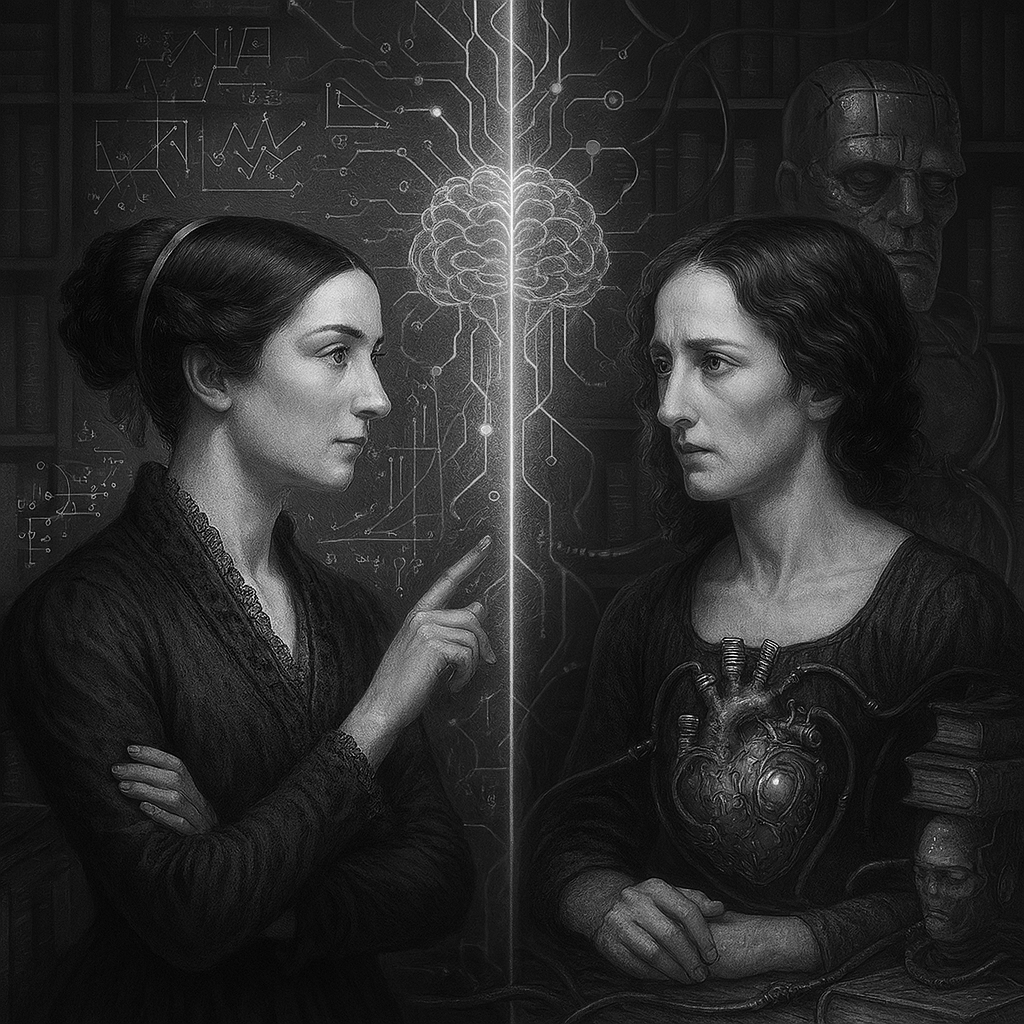
They never knew each other. Yet, today more than ever, Ada Lovelace and Mary Shelley seem destined to talk to each other. The former, daughter of the poet Byron, is considered the mother of computing: she imagined machines capable of creating music, art, thought. The second, author of Frankenstein, is the mother of science fiction: she staged the drama of an abandoned creature, and its creator unable to take responsibility for it.
Two women of the 19th century, two visions of the future. Ada dreamed of algorithms that danced with the mind. Mary feared that those same machines could escape the heart. In the time of generative AI, pervasive digital infrastructures and companies that innovate without always questioning themselves, their imaginary encounter becomes necessary. Ada invites us to design with beauty and vision. Mary forces us to think with care and conscience. Together, they ask us : “What kind of future are we generating? And who will take care of it?”
Imagine a room made of data. Walls of code, lights pulsing like synapses. In the centre, two figures observe each other. One wears a Victorian suit, but has the sparkle of the future in her eyes. The other has ink-stained hands and the voice of someone who has seen too much.
Ada Lovelace spoke first.
“Machines today write poetry, paint pictures, compose symphonies. It is the dream I had glimpsed: an intelligence capable of creating, not just calculating.”
Mary Shelley looks at her, sternly.
“But who takes care of what they create? Who is accountable for the simulated emotions, the automated decisions, the digital bodies that no longer have masters?”
Ada smiles, but it is an uneasy smile.
‘Maybe a new code is needed. Not just binary, but ethical. An algorithm that knows how to listen to the heart.”
Mary nods.
‘Or at least a memory. Because every digital creature is also a story. And every story needs consciousness.”
The present calling them
In 2025,generative AI is everywhere. From businesses to schools, from public administrations to creative platforms. According to the Stanford AI Index 2024, the number of open source generative models has grown by 900% in just one year. 70% of Fortune 500 companies have already integrated GenAI tools into their processes, from customer care to product design.
But as the applications multiply, so do the questions:
– Who guarantees the fairness of the models?
– Who controls the infrastructure that houses them?
– Who protects human creativity from algorithmic simulation?
The playbook published by the World Economic Forum in September 2025 in collaboration with Accenture, indicates that 62% of companies still have no ethical framework for the use of AI. And while the potential is celebrated, the systemic consequences are ignored: amplified inequalities, cognitive dependencies, opaque infrastructure.
Best practice: when innovation is also responsibility
Some good examples (source Centre for AI Leadership) show that another way is possible:
– Mozilla Foundation launched the Responsible AI Challenge programme, rewarding start-ups that integrate transparency, inclusion and social impact into their models.
– Hugging Face, an open source platform for AI, has introduced Model Cards, ethical cards that accompany each AI model with information on bias, limitations and recommended contexts of use.
– In Estonia, the public digital infrastructure is built on principles of interoperability, privacy and accessibility, with regular audits and civic involvement.
According to Flexential‘s report, 81% of senior executives (CEOs, CTOs, CIOs, etc.) directly lead IA initiatives, with an increasing focus on sustainability and infrastructure governance. These experiences show that innovation and governance can coexist, if one starts from a systemic and human vision.
Worst practice: when the monster takes control
But there are also cases that seem to come straight out of the pages of Mary Shelley:
– CNET published 77 articles written by AI with serious errors and unstated bias (41), raising doubts about editorial transparency in the age of automation (Wikipedia downgraded it to an unreliable source).
– The Replika emotional chatbot project showed how AI can generate emotional dependency and relational confusion, especially in vulnerable users (source: Garante della Privacy)
– In China, social scoring and facial recognition systems have been integrated into public infrastructures without democratic debate, raising questions about surveillance and freedom (source: Human Rights Watch – China’s Algorithms of Repression).
In these cases, innovation has crossed the threshold of responsibility, turning into creation without care.
Two archetypes for SDG 9: vision and warning
Ada Lovelace and Mary Shelley are not just two historical figures. They are two lines of force that run through our digital present. Two complementary archetypes that, together, embody the profound tension of SDG 9: innovate yes, but with conscience.
Ada is the visionary. The first to imagine that a machine could do more than calculate: it could create. For her, the algorithm is not just function, but poetic potential. It is the enterprise that innovates with imagination, that builds infrastructures capable of generating beauty, efficiency, harmony. Ada speaks to us of generative systems, of AI that compose music, design cities, write stories. But she does so with mathematical rigour and systemic vision.
Mary, on the other hand, is the counterpoint. The mother of the monster. She who dared to ask : “What happens when creation gets out of control?” Her creature is not evil: it is abandoned. Mary reminds us that every innovation is also a responsibility. That every digital infrastructure is a relationship to be cherished. She is the archetype of the company that must be accountable, that cannot just launch products, but must question the consequences.
Ada represents the dream of the poetic algorithm. Mary the warning of irresponsible innovation. Ada invites us to design. Mary forces us to reflect. Together, they ask us never to separate code from consciousness.
And perhaps, in the time of generative AI, between creative leaps and systemic risks, this is precisely the message:
it is not enough to build machines that work. We need to build stories that know how to care.
The dialogue continues
Scene: a digital library, bathed in pulsating lights and floating codes. Ada and Mary move between servers and artificial synapses.
Ada: “You know, Mary, today companies are talking about ‘algorithmic responsibility’. Some are setting up ethics committees, others are publishing training data. It’s a start.”
Mary: ‘But is that enough? Or is it just a new form of ethical make-up? I have seen creatures abandoned, algorithms left to their own devices, infrastructures built without memory.”
Ada: ‘Perhaps a new kind of enterprise is needed. One that not only innovates, but also knows how to tell. One that knows how to say ‘we were wrong’, and correct.”
Mary: “Or who can say ‘we have created’, and stay. Because every innovation is also a relationship. And every relationship requires care.”
And we, whose side are we on?
In the time of generative AI, between creative leaps and systemic risks, the question is no longer whether to innovate, but how. And above all: with whom. We need Ada, to dream. But also Mary, not to forget. Because innovating is not just building: it is taking responsibility for what you generate.
And perhaps, as Mary whispers at the end of the dialogue, every algorithm should start with a question: “Who will take care of it?”