

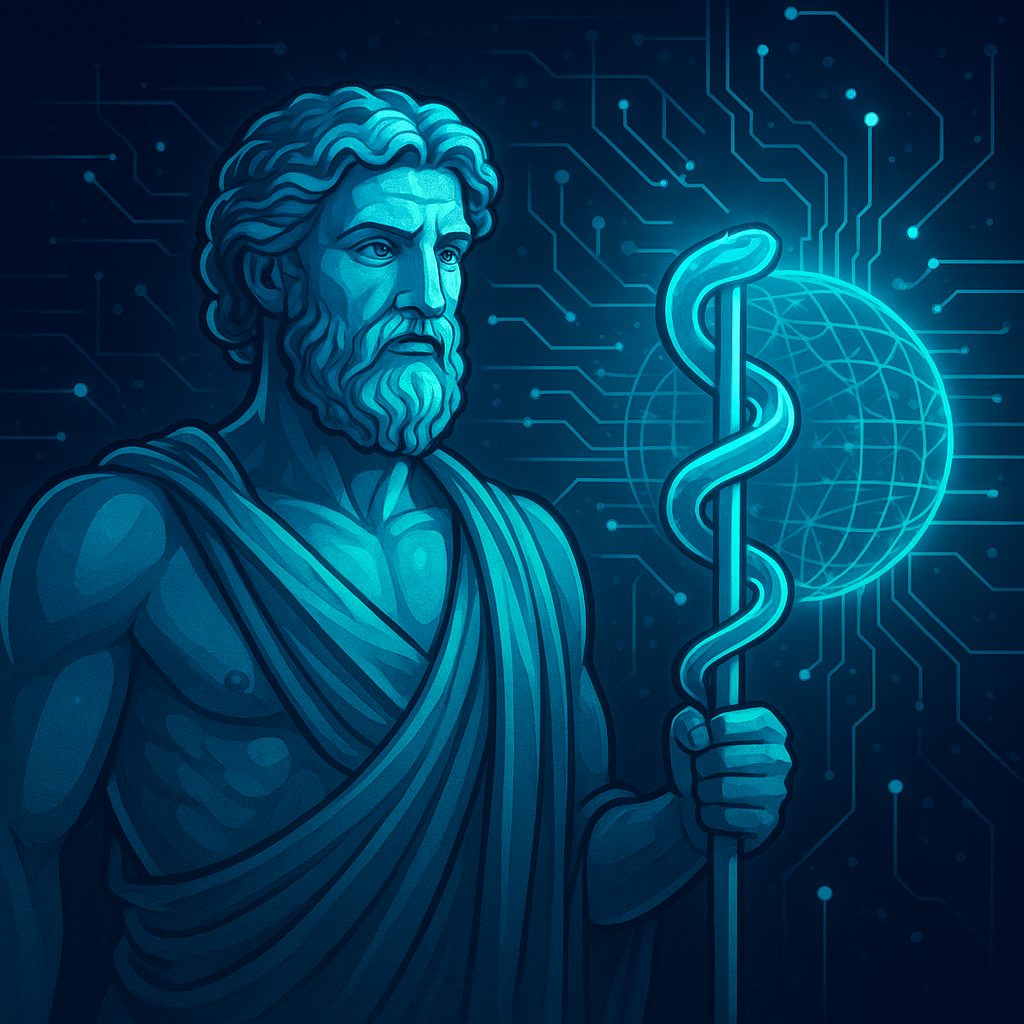


There is a symbol that has accompanied medicine for thousands of years: the staff of Asclepius, with the coiled serpent. We find it on pharmacy logos, in hospital corridors, in anatomy manuals. It is the sign of those who heal, of those who listen, of those who try to heal. But today that stick changes shape. It is no longer just wood and myth: it is optical fibre, code, artificial intelligence. It is the sign of a medicine that evolves, that becomes digital, but that cannot lose its soul.
From myth to lane: Asclepius speaks to us again
Asclepius, son of Apollo, was not a warrior. He was a healer. His staff represented regeneration, transformation, the cyclical nature of healing. Today, that stick could be a smartwatch that monitors the heartbeat. Or an algorithm that suggests a personalised therapy. But the meaning remains the same: caring.
In the world of digital health, Asclepius becomes a powerful metaphor: a bridge between ancient knowledge and modern innovation, between ethics and technology, between care and sustainability.
The silent digital health revolution
In 2025, technology is no longer an occasional guest in hospitals: it has become an integral part of care. It does not impose itself with clamour, but makes itself felt in the details that matter. Not in the headlines, but in the everyday gestures: in a more timely diagnosis, in a therapy built around the person, in the time that is taken to look each other in the eye and really listen.
According to the I-Com Policy Brief, our National Health Service has already undergone a profound transformation. Today, digital tools flank the work of doctors in the reading of clinical images, in assisted surgery, in the organisation of departments and even in the choice of treatments, thanks to the ability to cross-reference huge amounts of information. But behind every piece of data, there is a story. And behind every innovation, there must be a conscious choice: that of putting the person at the centre, always.
SDG 3: Health and well-being for all
Sustainable Development Goal (SDG) number 3 of the 2030 Agenda reminds us of something simple and profound: to ensure a healthy life and promote well-being for all, everywhere. This is not only a global mission, it is a daily responsibility. And on this journey, technology can become a valuable companion.
Today, thanks to remote medicine, even those who live in remote areas or have difficulty moving can receive assistance, advice, comfort. Diagnosis no longer arrives only in hospitals: it can come from a screen, from a signal, from an intuition supported by data. And if we can intercept a disease before it manifests itself, we change the fate of those who live with it.
Treatment, then, becomes increasingly personal. No longer standard protocols, but tailor-made treatments, like a tailor-made suit. Genetic and clinical data become tools to better understand, to intervene with more precision and less invasiveness. And in everyday life, apps and wearable devices help to monitor our state of health, to prevent, to manage chronic diseases with more awareness.
But this only has value if it is truly for everyone. If it is accessible, secure, transparent. If it does not forget that behind every number there is a story, behind every parameter there is a person. The real question is not whether the technology works. It is whether it really improves life. This is where digital sustainability comes in: that ability to combine innovation and humanity, progress and responsibility. Because the future of health is not built on data alone, but on the choices we make every day.
Italy and the world: different visions, same challenge
According to GMI Insights, the global market for AI in healthcare has reached $18.7 billion by 2023, with a projected growth of 37.1 per cent annually until 2032. In the US, the push comes from Big Tech and universities. In Germany and France, work is being done on regulation and interoperability. The Nordic countries shine in digital infrastructure and institutional trust.
And Italy? In 2025, the Italian artificial intelligence market experienced significant growth: according to the Milan Polytechnic’s Observatory, it recorded a 58% increase, reaching 1.2 billion euros. A figure that tells more than an economic trend: it speaks of a country that, while not leading the investment ranking, is trying to chart a different course.
Italy is aiming not just at performance, but at awareness. To the construction of a digital healthcare that does not forget the relationship, that puts trust at the centre, that considers sustainability not as a constraint, but as a choice. It is a vision that does not run after numbers, but uses them to make room for people. And perhaps because of this, it can become a replicable model.
My Smart Diary: a compass for citizens and doctors
In this scenario, tools like the Foundation for Digital Sustainability’s My Smart Diary become valuable. They are not just apps, but compasses. They help citizens and professionals to reflect on their relationship with innovation. To not suffer it, but to live it.
For patients, it is a way to navigate through online reports and medical chatbots. For doctors, a tool to monitor the emotional impact of AI. For facilities, an opportunity to integrate digital sustainability into care pathways.
The snake that heals (but can also bite)
In myth, the serpent coiling around the staff of Asclepius is a symbol of regeneration, transformation, healing. But also of danger. And so it is also with the digital. Technology can heal, sure. But if it is not guided by awareness, it can also hurt. The risks are not theoretical: they are already among us, silent but concrete.
– Overexposure and digital burnout. Digital health promises efficiency, but it can also generate overload. Doctors inundated with notifications, hyper-connected and anxious patients, health workers always ‘on line’. The risk? Losing human time, that of listening and pausing. Because it is not enough to be connected: one must also be present. For this we need spaces of disconnection, pauses that regenerate, moments of silence that restore lucidity and empathy.
– Digital inequalities. Not everyone has access to the same technologies. Some live in areas with poor connectivity, some lack digital skills, some cannot afford a device. And so, digital is likely to amplify inequalities instead of reducing them.
– Health Disinformation. Chatbots, social, search engines: today, health information is everywhere. But it is not always correct. Medical fake news spreads faster than cures, and can generate fear, confusion, wrong choices.
– Environmental impact. Behind every algorithm there are servers, data centres, devices. And behind every device, energy consumption, electronic waste, emissions. Digital health also has to reckon with environmental sustainability.
The digital snake, like the one in myth, can heal. But only if we handle it with respect, ethics and vision. Because true innovation is not the one that runs fast, but the one that knows where it is going.
With the entry into force of the European AI Act and Italian Law 132/2025, every high-impact tool-from medical chatbots to automated diagnostic systems-must comply with precise rules: transparency, security, human supervision (sources: 42lf.it and agendadigitale.eu). It is not enough for the algorithm to be effective. It must be transparent, secure, supervised..
Digital sustainability enters the ward
In Italy, AI in healthcare is no longer in the testing phase: it is already a reality, making its way every day between wards, surgeries and desks. Not with clamour, but with precision, efficiency and discretion. The numbers speak for themselves, but it is the daily stories that best tell of this transformation.
– Diagnostic imaging. In radiology departments, advanced software analyses X-rays, CT scans and MRI scans with a precision that complements – and sometimes exceeds – the expert eye of the doctor. It is not a question of replacing, but of enhancing. To offer a second reading, faster and more reliable, which can make the difference between an early and a late diagnosis.
– Customised therapies. By cross-referencing genetic and clinical data, AI makes it possible to build customised treatments. No longer standard protocols, but therapeutic paths tailored to the patient, like a tailor-made suit. This is precision medicine taking shape, with tangible benefits for those facing complex or chronic diseases.
– Intelligent triage. In emergency rooms, digital systems help manage emergencies, assigning priorities based on symptoms and vital parameters. The result? Reduced waiting times, more orderly flows, faster decisions. And, above all, more time to focus on what matters: care.
– Administrative automation. Behind the scenes, AI simplifies healthcare bureaucracy. Referrals, appointments, documentation: everything is smoother, faster. And every minute saved is a minute gained for the doctor-patient relationship. Because technology, when well designed, does not push people away: it brings them closer.
According to HealthTech360, Italy has a solid medical tradition and a wealth of health data, accelerated by PNRR investments and pandemic experience. These technologies do not replace the doctor. They flank him. They empower him. But they cannot replicate his empathy, intuition and ability to listen.
Technology and humanity: a possible balance
True innovation is that which accompanies. That shortens distances. That puts the person at the centre. Like a young oncologist who, thanks to an intelligent system, notices a lesion that the human eye might have overlooked. Or a chronic patient who receives a treatment plan tailor-made for him.
It is not a technical challenge. It is a human challenge. It needs training, governance, but also storytelling. Because trust does not come from an algorithm, it comes from a story.
The staff of Asclepius is in our hands today.
Every digital choice can heal or hurt. Digital sustainability is not an expert issue, but a collective responsibility. Every time a doctor uses AI to see better, but then stops to listen, that gesture becomes a bridge. Between the data and the person. Between the future and the present. Between what we can do and what we choose to do.
That is why the staff of Asclepius is still with us. Only today it is digital. And it asks us, as then, to use it wisely.