

















What happened on the day of the greatest discovery in chemistry
Earth, Water, Air, Fire.
Two and a half millennia ago, Aristotle had solved the problem of cataloguing all known substances in this way: they were but combinations, in different proportions, of these four fundamental elements. Ended there, simple as that, didn’t it?
This theory survived happily until the 15th century, when Paracelsus opposed it with the tria prima theory. According to the father of alchemists, the fundamental elements from which all others derive are only three. You’ll never guess them: they are Salt, Sulphur and Mercury. Well…
We have to wait until 1661, when Robert Boyle – in his book ‘The Sceptical Chemist ‘ – demonstrates the experimental inconsistency of previous theories and hypothesises that substances are made up of particles that differ in size, shape, arrangement and movement.
Another two centuries of tumultuous challenges between scientists – who attacked each other with theories and defended each other with experiments – passed. In 1864 we come to Lothar Meyer, who manages to sort 44 of the 57 elements then known in valence order. Only a year goes by and in 1865 John Newlands proposes to catalogue them in order of increasing atomic weight, noting a curious periodicity: it seems that the chemical-physical properties of the known elements repeat themselves more or less in groups of eight, just like musical octaves. Mystery…
Unfortunately, however, the proposals of Meyer and Newlands do not allow for either the correct cataloguing based on the properties of known atoms or the prediction of new, as yet undiscovered elements.
A frosty winter in St Petersburg
And now let’s take another step forward just five years and arrive at a frosty morning of Wednesday 17 February 1869. A date destined to remain in the History of Chemistry… although I bet it says nothing to most of us. Here’s the scene: we are in a sober and somewhat messy flat near the University of St. Petersburg. Books and notes scattered everywhere, even on the bed and next to the earthenware bowl that serves as a modest ancestor of the modern washbasin, make us realise at once that we are in the lair of an intellectual of the time.
That morning, Professor Dmitry Ivanovich Mendeleev does not have to give lectures but plans to visit dairies to study how to improve the fermentation processes that turn milk into cheese. But with the blizzard blowing out the windows… let’s just say he’s not dying to wander around the frozen countryside.
In order to find a good reason to stay warm, he pulls out an old project of his: looking for an arrangement of the known elements according to their atomic weight and valence. Already at breakfast, he scribbles some combinations of elements on the back of a letter he has just received. We know this for a fact because this paper – like all the other papers used that day – is kept in his study at the University of St. Petersburg and still shows a circular patch left by the tea glass.
The loner who does not return
He insists with numerous attempts and – having found a perfect excuse to give up visiting dairies – adds wood to the stove, deciding to concentrate on his systematic work.
He writes on a lot of papers trying to extract a common logic by multiplying or dividing the atomic weights by the valences, trying to find common multiples that explain the differences in atomic weights and, in short, trying a lot of combinations.
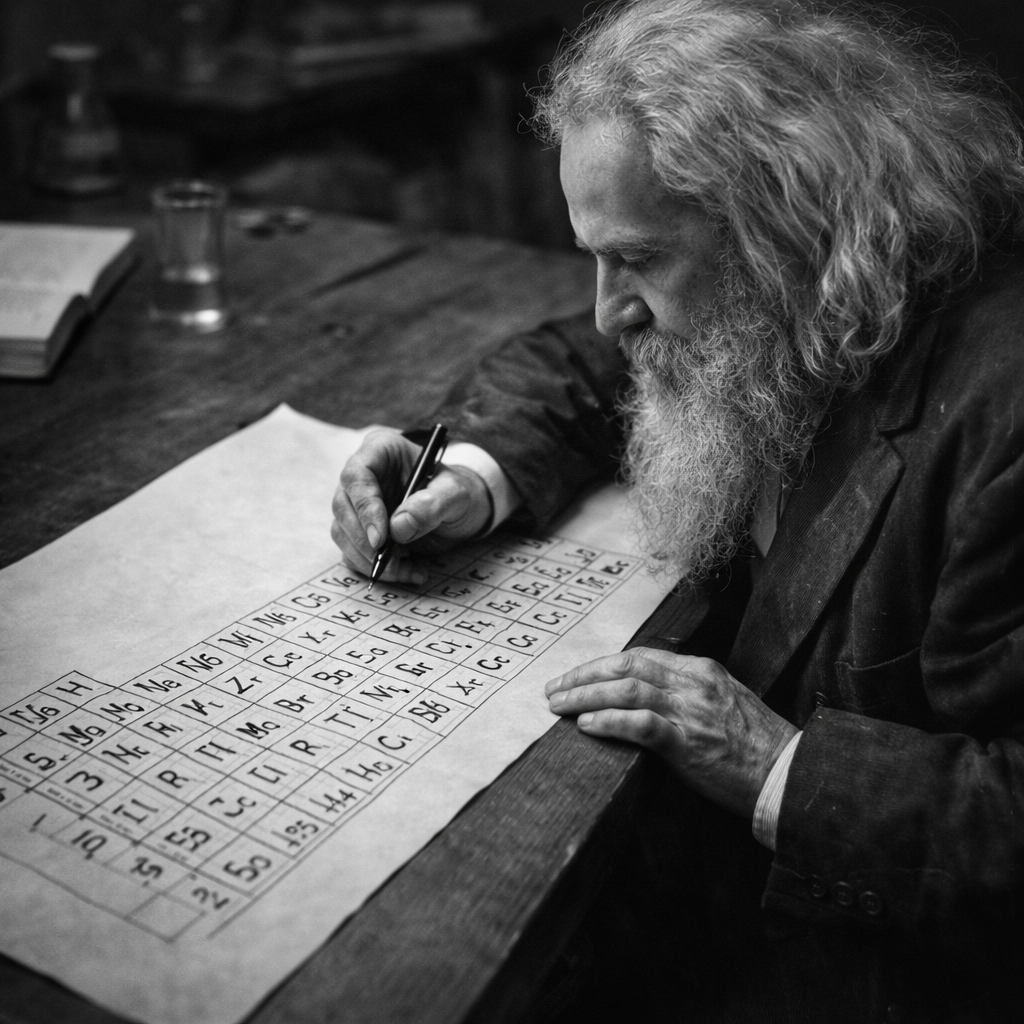
Being a fan of card solitaires, he then got the idea of writing the name, atomic weight and valence of one element on one sheet of paper, writing the properties of another on another sheet and going on like this until he got 63 tiles, each with one of the 63 elements then known.
Then try to distribute them on the table in a logical way, just like you do with the most common card solitaires.
All combinations are alternated and hours go by; without results… At sunset the professor is exhausted: he decides to take a nap.
After spending all day trying to understand the logic behind the properties of the elements, as soon as he falls asleep what does he dream about? All his tiles, of course. He tells his friend Aleksandr Aleksandrovich Inostrantsev about this dream – but it is better if we call it a nightmare – in which the tiles are swirling around in his head.
Then suddenly he woke up and ran to the table where he had left the element tiles scattered. A few more feverish turns of the cards and this time the ‘solitaire’ succeeds on the first stroke: on the evening of 17 February 1869, the Periodic Table was born.
Along the rows are the ‘groups’, which contain elements with similar chemical properties, along the columns are the ‘periods’, which line up the elements sorted by increasing atomic weight.
The Magic of the Periodic Table
The system Mendeleev has just built is not perfect, but it is revolutionary for its time. The Russian scientist has the intuition to insert blanks in the table where the elements that had not yet been discovered will be placed in the future. He thus succeeds in giving his table a real power to predict future discoveries.
And, amazingly, it not only predicts that those elements exist, but also manages to describe their characteristics, including atomic weight and certain chemical properties.
For example, Mendeleev guessed the existence of an‘eka-Boron‘, an element that would later be discovered as Scandium, and an‘eka-Aluminium‘, which would later be identified as Gallium.
But what does ‘eka‘ mean? Quite simply, it means ‘one‘ in Sanskrit. A bit like adding ‘…bis revision‘ at the bottom of the file name of yet another version of a document that is struggling to reach perfection. But back to us. When these elements are actually discovered, their behaviour will surprisingly correspond to what Mendeleev predicted.
In 1869, only 63 were known. Today we are up to 118. There are those who say that we have already discovered them all and there are those who claim that there are many more yet to be synthesised, but that is another story.
By focusing on the holes in his table, Mendeleev is able to predict the approximate atomic weight and properties of these unknown elements. And when these are later discovered or artificially produced and their properties are measured, it turns out that he was right, or at least very close.
For example, the empty space after Aluminium 13 – which Mendeleev christened eka-Aluminium of possible atomic weight 68 – is then occupied by Gallium 31 (atomic weight 69.7) discovered by Paul Emile Lecoq in 1875.
Even when the noble gases were discovered, all it took was to add a group at the bottom of the table and everything fitted together correctly again.
But the Periodic Table certainly doesn’t end there
But it certainly didn’t all end on that frosty evening: in 1871, Mendeleev would introduce predictions for three more elements:‘eka-Silicon‘, which would become Germanium,‘eka-Manganese‘, which would be Technetium, and‘eka-Niobium‘, which would correspond to the long-awaited transition element called Tantalum. These predictions not only prove the validity of Mendeleev’s system, but also confirm that chemical science is on the right track.
However, not all elements fit perfectly into its table. Some, such as the rare earth metals, do not align with the law of periodicity. Mendeleev hypothesised that these elements have ‘wrong’ atomic weight values and consequently rearranged them in his system. His intuition would prove correct, with many of these elements later being identified and defined in their correct atomic weights. Moreover, his ability to correct existing data and adapt the table to new discoveries will forever remain a mark of his flexible and pragmatic scientific approach.
On that frosty day that did not entice one to go around dairy farms, shut up in his room Dmitry Ivanovich Mendeleev invented a highly effective theoretical tool that not only overturned the knowledge of the moment and catalogued the elements known up to that time, but above all made it possible to make predictions. This is why historian of science John D. Bernal would call him ‘the Copernicus of chemistry’.