



Designing the future with intelligence, ethics and vision
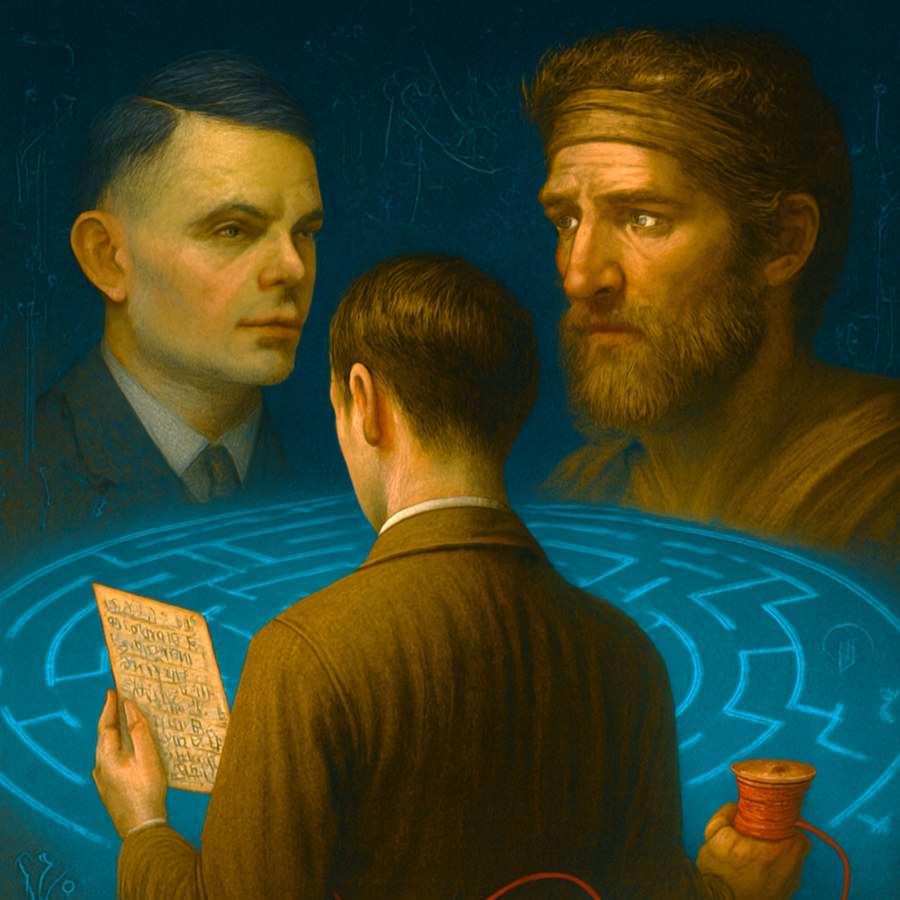
At the heart of digital work are two figures who have never met, but who can now converse. Alan Turing, the mathematician who taught machines to think, and Daedalus, the mythological architect who built the labyrinth – and the wings to get out of it. The former deciphers, the latter builds. Both work in silence, with precision, vision and responsibility. And together they offer us a key to re-reading work in the age of artificial intelligence: not as mere productivity, but as enlightened design.
In a time when work is increasingly mediated by platforms, algorithms and digital environments, we need to go back to questioning what ‘work’ really means. Not just in terms of efficiency, but in terms of meaning. Not just as performance, but as participation. And here, Turing and Daedalus help us to see beyond the surface.
The fragile genius: Turing and the dignity of digital labour
Alan Turing changed the world with his work, but he was marginalised. He is the symbol of those who innovate, but also of those who pay the price of misunderstanding. His talent was not immediately recognised, his humanity ignored. Yet it is precisely from this wound that a powerful narrative force is born.
Turing speaks to us of dignity, of redemption, of ethics. He is the archetype of the fragile genius, the invisible worker, the talent that does not bend. In a world where algorithms decide more and more, Turing reminds us that behind every system there is a person. And that digital work, to be truly sustainable, must recognise human value – especially that of minorities, the excluded, the non-conforming.
His legacy is not only technical. It is political, cultural, human. Turing teaches us that intelligence is never neutral. That every code carries with it a vision of the world. And that true innovation is not that which works, but that which includes.
The responsible designer: Daedalus and the sustainability of systems
Daedalus was not just an inventor. He was a builder of worlds. He created the labyrinth for Minos, but he also imagined wings for escape. He is the symbol of one who knows that every system can trap or free. That every project carries with it a responsibility.
In digital work, Daedalus speaks to us of ethical architecture: platforms that do not exploit, but enable; working environments that do not alienate, but generate value. It is sustainability as a design choice, not as a constraint. It is the awareness that every code, every interface, every process can be either a bridge or a prison.
Daedalus reminds us that designing is not just building. It is to foresee consequences, to imagine uses, to protect those who pass through. And that the beauty of a system lies not in its complexity, but in its ability to serve those who inhabit it.
SDG 8: Economic growth, but with conscience
Goal 8 of Agenda 2030 calls us to promote lasting, inclusive and sustainable economic growth. But to do so, we need a paradigm shift: no longer work as performance, but as participation. No longer growth as accumulation, but as generation of meaning.
According to the ASviS 2025 Report, Italy has made significant progress on Goal 8, but territorial and gender inequalities persist. The employment rate has risen to 61.5%, but remains below the EU average. Digitalisation has accelerated, but has not always guaranteed inclusion.
It is not enough to produce more to say that work is getting better. According to ISTAT’s SDGs 2025 Report, productivity per worker in Italy has grown by 2.1% since 2022. But behind this positive data hides a profound fragility: 13% of workers live in conditions of economic vulnerability, between unstable contracts and training that does not arrive.
It is the paradox of progress: indicators grow, but dignity does not always grow. And digitalisation, if not accompanied by vision and inclusion, risks amplifying distances. This is also confirmed by the International Labour Organisation (ILO): in Europe and Central Asia, inequalities mainly affect young people and the most fragile groups. They are the first to enter the digital world of work – and often the first to leave it, without protection or prospects. Growth in GDP per capita is not enough: we need work that is also safe, fair and sustainable (source: ILO Monitoring – SDG 8).
In this scenario, talking about digital sustainability also means talking about justice. Of fair access to skills. Of work environments that not only work, but are welcoming. Because decent work is not a side effect of growth: it is its condition.
Digital regeneration: the cure that cannot be seen
Technology can accelerate, simplify, empower. But if we never stop, it risks consuming us. In the ward as in the office, we need balance: between online and offline, between efficiency and listening, between data and silence.
Digital healthcare, for example, promises efficiency, but can also generate overload. Doctors overwhelmed by constant alerts, patients always connected, operators without respite. The risk? Losing the human time of care. We need spaces of disconnection, pauses that regenerate, moments of silence that restore lucidity and empathy.
According to TechEconomy2030 (see thearticle Open Data for SDG 8 written by @Giorgia Lodi), some Italian companies are experimenting with ‘low-tech shifts’ and training courses to manage digital information without anxiety. It is a best practice that combines well-being and sustainability, and can be replicated in other sectors.
Designing work: between code and conscience
Turing teaches us how to read systems. Daedalus teaches us how to build them. Together, they remind us that digital work is not just about efficiency, but about meaning. That every algorithm can be a trap or a possibility. That every design choice is also a political choice.
Digital sustainability – in work, in the economy, in society – comes from here: from the ability to combine intelligence and responsibility, vision and care, data and dignity. It is a challenge that concerns everyone: those who design, those who manage, those who work. Because every interface is also a relationship. And every system, if well thought out, can become a space for emancipation.
The future is in the hands of the designer
Decent work is not an inheritance. It is a daily conquest. And in an increasingly digital world, this conquest comes through design. From how we build environments, how we write codes, how we imagine interactions.
Turing and Daedalus offer us a compass. The first invites us to decipher with intelligence. The second to build with responsibility. Together, they remind us that the future is not just programmed with data, but with choices. And that every choice, in digital work, can heal or hurt.The labyrinth is already here.
It is up to us whether we also build wings.