









You learn from your mistakes, and sometimes you even win a Nobel Prize – all it takes is a bit of observation
Today, our time machine takes us back to the early decades of the 1900s, a world far removed from the one we know today. The Great War killed – through typhus, influenza, malaria and other diseases – five times as many soldiers as those who, more or less heroically, fell under enemy fire and were commemorated in grim war bulletins. It is estimated that, in total, between 15 and 20 million people died.
Then peace arrives. As the world tries to get back on its feet, the surviving soldiers finally return to embrace their families, bringing with them the Spanish flu, which alone claims a further 50 million lives.
There are no antibiotics; many infectious diseases are a death sentence with no appeal, and even the most common infections are often fatal. Bacteria were discovered by Antonie van Leeuwenhoek way back in 1676; but no one really knew how to stop them, other than by boiling clothes and objects that had come into contact with the sick. It is against this backdrop that a man emerges who, through a moment of distraction in the laboratory, but also through sheer ingenuity, changed the course of medicine forever. His name is Alexander Fleming.
A young genius
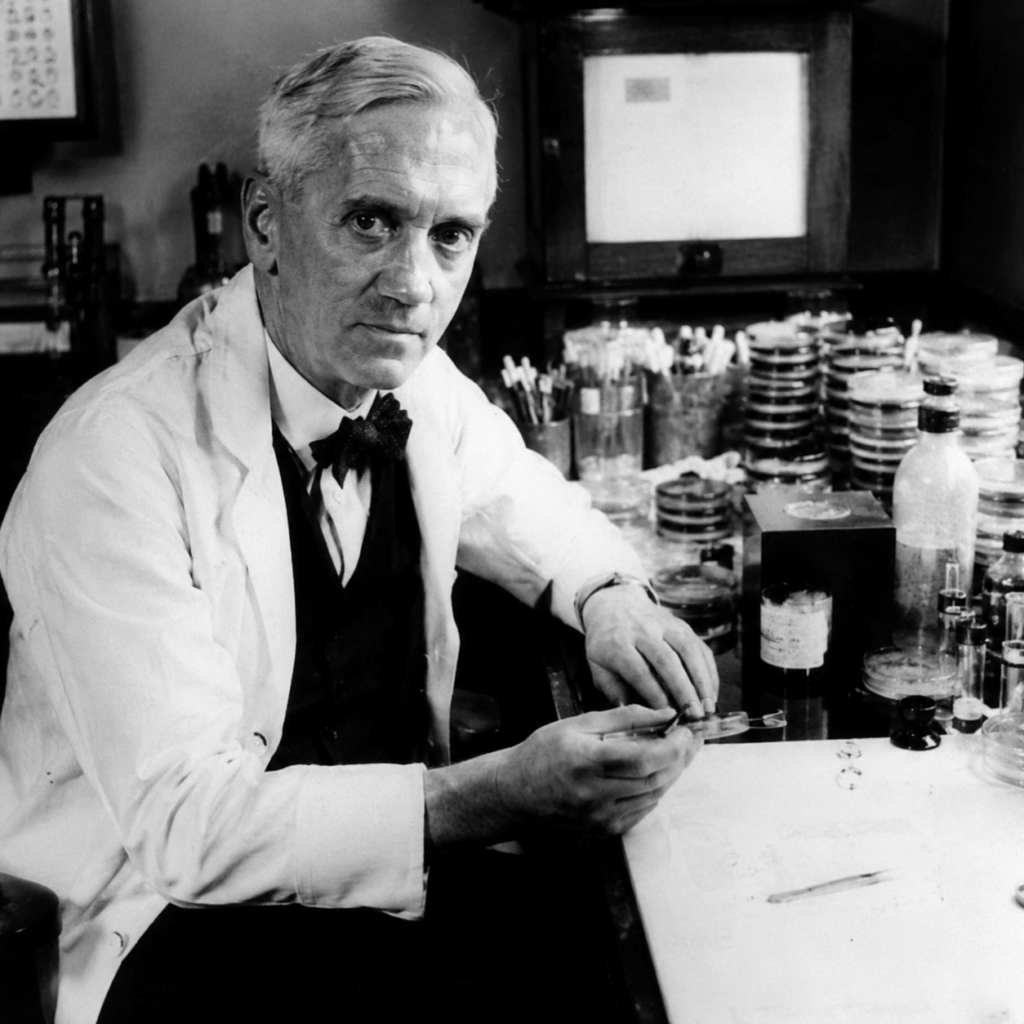
Fleming was born in 1881 on a farm in the Scottish Highlands. It was quite a contrast: on the one hand, the peaceful countryside with its green meadows and majestic mountains; on the other, a young boy who, driven by a keen curiosity, pored over medical books. This is no metaphor: he would wear a pair of large, thick spectacles for the rest of his life. Spectacles he hated so much that, when he became famous, he would try to slip them off at the last moment whenever someone was about to take his photograph. But now nobody wants to take a selfie with him.
He was no spoilt brat: having lost his father at the age of seven, he was brought up by his mother and older brothers, who did their best to encourage his passion for learning; a passion that led him to join the Kilmarnock Academy at the age of just twelve.
Fleming didn’t stop there. Thanks to the savings he’d built up working in a shipping agent’s office and a small fortune unexpectedly inherited from a distant uncle, he enrolled at St Mary’s Medical School in London, where his career really began to take shape. After graduating in 1906, he decided to devote himself to scientific research, a field that at the time was not exactly the most glamorous or lucrative in medicine. But, as is often the case, it is precisely where expectations are lowest that the most extraordinary discoveries are made.
War medicine
The First World War breaks out – at the time known simply as The Great War, because no one could have imagined that, just a few years later, the world would be plunged into an even greater one. Fleming, called up by His Majesty’s Army, serves as a doctor. In the field hospitals, not far from the front line, he watches in dismay as infections ravage the soldiers. The greatest carnage takes place not in the trenches but behind the lines, where infected wounds claim the majority of victims. Fleming does what a war doctor can do: he tries to save as many soldiers as possible from death, observes the infections with a keen eye and begins to develop a first-hand understanding of bacteria and how they behave when they attack the human body.
Meanwhile, surgical techniques are improving; but bacteria, which are unpredictable and difficult to eliminate, are an invisible and pervasive enemy, especially in the precarious sanitary conditions found in muddy field hospitals situated just a short distance from the front line. All that remains is to experiment: doctors try various methods and different treatments, but with little success. Against this backdrop, Fleming continues to reflect on his observations, but the real breakthrough will only come a few years later, when he returns to his laboratory in peacetime. And this is where fate, and a touch of luck, come into play.
Oops: a lab error
28 September 1928 was the day that changed the history of medicine, though Fleming did not yet know it. In the days leading up to it, in his laboratory at St Mary’s Hospital in London, he was working with cultures of Staphylococcus aureus, an aggressive bacterium that causes skin infections. He was getting ready to enjoy a well-deserved holiday in Suffolk with his family. But he was running late. As he hurried off, he forgot to cover some of the bacterial cultures.
When he returned to the laboratory at dawn on 28 September, he found that the staphylococci had multiplied wildly in all the Petri dishes in which they were being cultured, but also that just one of these had been accidentally contaminated by a mould that produced a whitish substance. No big deal – it’s just a mistake, after all. Just as he is about to throw it away, he notices that, around the mould, there is an area of the culture completely devoid of staphylococci. What is going on? Why on earth do these almost indestructible bacteria not dare to colonise the culture medium near that strange mould? Why do they beat a retreat, or rather, die on the spot, as soon as he takes a pinch of that mould and deposits it, as in a rear assault, behind another colony?
After some experimentation and analysis, Fleming realised that the mould in question was a type of Penicillium, which was not definitively classified as chrysogenum orrubens until 2011 . The bacteria-free area was due to this mould’s ability to produce a substance that kills bacteria. Over time, and thanks to his extraordinary skills as a researcher, Fleming managed to isolate and identify the whitish chemical compound produced by the mould: penicillin. This was capable of mercilessly eliminating not only staphylococcus, but also the bacteria causing pneumonia, scarlet fever, meningitis, diphtheria and even gonorrhoea, which soldiers who had survived the war had spread throughout the world.
This is how a laboratory error – the sort every scientist has made at least once – led to the discovery of the first antibiotic and revolutionised medicine, but only thanks to the keen eye of the person who was about to throw it all away.
It’s not enough to make a mistake; you have to make it worse
Although the discovery was remarkable, penicillin was not yet ready for use as a medicine. Mass production, in fact, proved to be a major problem. In 1939, after years of research, Howard Florey, an Australian chemist, and his colleague, Norman Heatley, worked tirelessly to produce the drug on a large scale. While Fleming was the genius behind the discovery, it was the ingenuity and perseverance of Florey and Heatley that allowed that discovery to become a reality. It was a team effort, requiring technological innovations, great ingenuity and the conviction that this substance could save millions of lives.
Meanwhile, the Second World War broke out: penicillin, now available in larger quantities, became a vital resource for Allied soldiers, saving thousands of lives during military operations. The world began to talk about the ‘magic’ of antibiotics.
When Fleming was awarded the Nobel Prize in Medicine in 1945, it was not merely a recognition of his work, but a celebration of a discovery that changed the course of history. At a time when infectious diseases were still claiming many lives, penicillin marked the beginning of the end for a host of diseases that, prior to that moment, had been fatal. We are not just thinking of wars and epidemics, but also of infant and maternal mortality in an era when a simple childbirth could quickly become a death sentence for both the newborn and the mother.
The impact of penicillin can also be measured in figures: in 1944, around 2.3 million doses of penicillin were produced every month in the United States alone. Today, penicillin and its derivatives form the basis of one of the world’s largest pharmaceutical industries; the science of antibiotic medicine did not stop at that discovery. It has evolved and branched out into new antibiotics. But penicillin is still there, at the heart of this revolution.
Mistakes and curiosities sometimes change the course of history
And if we think that only meticulous and organised scientists can make discoveries, Fleming’s story teaches us an important lesson: mistakes, especially accidental ones, can be just as decisive.
An interesting fact: the discovery of penicillin is often attributed to a single moment, but in reality it was the result of years of study, experimentation, setbacks and, above all, an extraordinary amount of patience and dedication.
Today, as we face new scientific challenges, let us remember that science is made up not only of many mistakes and countless failed experiments, but also of rare insights which, when combined with determination, can change the world. And if you happen to make a mistake, remember: perhaps, just like Fleming, it is the first step towards something extraordinary.
Is there a moral to this story? Perhaps there is: even those who aren’t involved in science, but have a passion of some kind, are bound to make a mistake now and then. Fleming teaches us that, sometimes, taking a few minutes to understand the mistake will certainly help us, if not to make Nobel-worthy scientific discoveries, then at least to… not repeat it again. Or, well, almost never again…