

















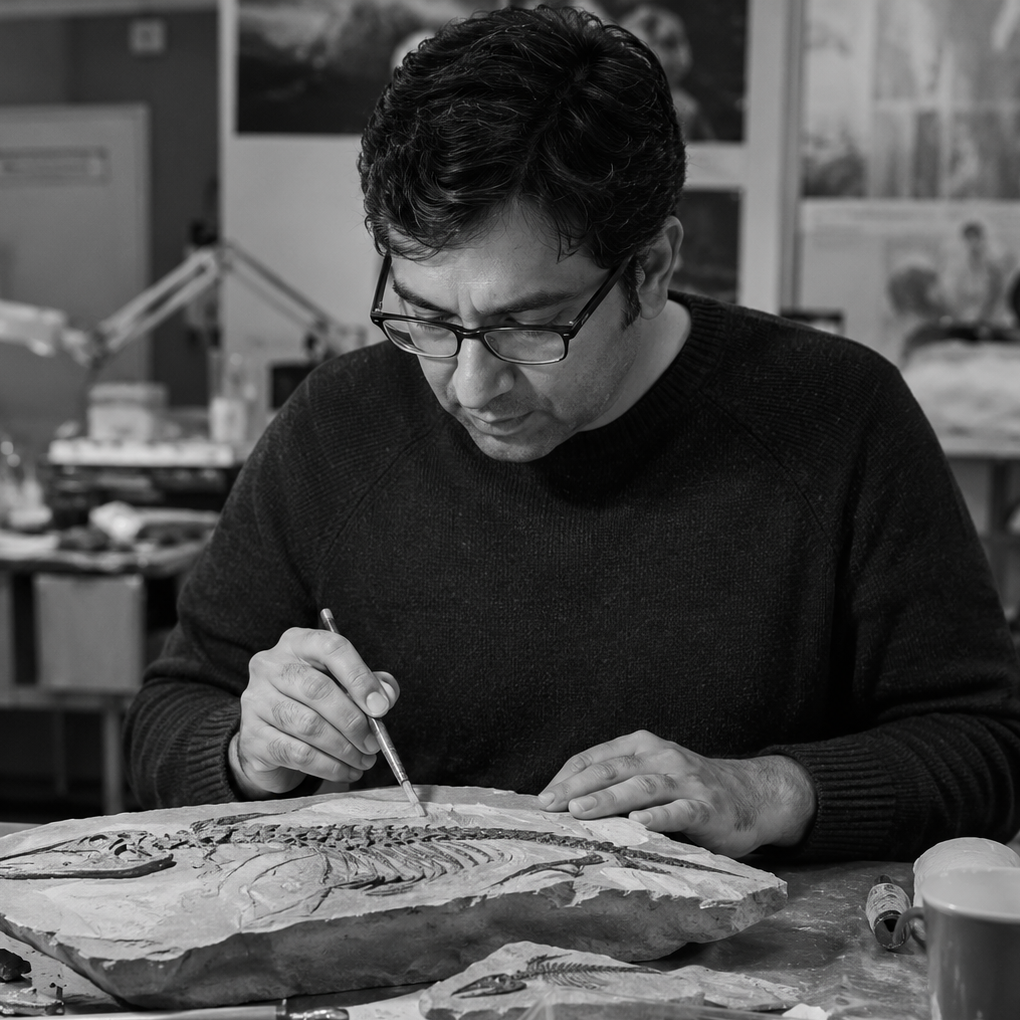

The strange story of a thirty-year fraud involving hundreds of scientists, the consequences of which are still being felt today
Today we’re going to talk about a series of discoveries that have written a new chapter in the history of palaeontology. We’re talking about the astonishing discovery of unexpected fossils – finds dating back hundreds of millions of years – which not only add new pages to that great, ancient book, but also erase and rewrite entire chapters and, with them, our understanding of the Earth’s history.
The man writing this new history is Vishwajit Jit Gupta: the renowned Indian palaeontologist who has thrown our previous beliefs into the fire and who, for over thirty years, has been telling us a completely different story. We are talking about a leading light in palaeontology: a professor at the University of Punjab in Chandigarh, Gupta has earned a rock-solid reputation as one of the world’s foremost experts on the geological formations and fossils of the Himalayan mountains. Between 1966 and 1989, he published more than 450 articles and five books on the subject, earning himself the title of ‘India’s most famous palaeontologist’. But now it is best to tell this story from the beginning.
The discovery of conodonts
It all began in 1967, when Gupta, together with the British geologists Frank H. T. Rhodes and R. L. Austin, published an article in *Nature*, the world’s most prestigious scientific journal. Gupta announced that he had discovered numerous ‘conodonts’ on the Himalayan plateau: microfossils of ancient marine animals that lived during the Cambrian and Triassic periods. The discovery, the first of its kind in India, catapulted him to the forefront of global palaeontology, earning him an unprecedented reputation.
But this is only the beginning: further research on the same peaks is leading to the discovery of new fossils. According to Gupta, they belong to life forms dating back some 400 million years and include dinosaurs and prehistoric fish, some of which display characteristics never observed before. The news, which spread rapidly, has made a big impression on the international scientific community and has been received with great enthusiasm.
In those days, Gupta was certainly no unknown figure in the field of palaeontology. Born and brought up in India, he had completed his studies in natural sciences and had earned a prominent position in the scientific community thanks to the publication of numerous articles in prestigious journals. His reputation was already well established; so, when he announced that he had found the remains of ancient fish and dinosaurs in the Himalayas, the scientific community hailed him unreservedly.
The examination of fossils
The photographs of the fossils discovered at high altitude and presented by Gupta are highly detailed; they clearly show the remains of ancient living creatures, and there are even dinosaur footprints imprinted on the rocks. This documentary evidence is so abundant and convincing that it guarantees its unquestionable authenticity. However, as time went on, some palaeontologists began to ask questions.
As early as 1978, a number of Indian scientists, such as S. V. Srikantia, H. M. Kapoor and S. K. Shah, began to raise doubts about the validity of Gupta’s findings. From 1981 onwards, P. N. Agarwal also questioned the reports on conodonts presented by Gupta in an article published in the *Journal of the Palaeontological Society of India*. However, it was not until 1980 that a proper critical examination of Gupta’s work was carried out by Prem N. Agarwal and S. N. Singh of the University of Lucknow in India. Their investigations revealed a striking discrepancy between the fossils and the localities reported in Gupta’s articles – a clear sign that something was amiss. Something major.
The inconsistencies are so glaring that Agarwal and Singh write: “These anomalies across the various articles by the same author are incomprehensible, unless they are the result of a series of serious typographical errors.” Unfortunately, these doubts went unnoticed for a long time, allowing Gupta to carry on undisturbed.
In 2002, one of the first to voice criticism, the palaeontologist Singh, decided to investigate the matter himself, leading a team of researchers who were equally perplexed by certain anomalies they had detected in Gupta’s work. During their trip to the Himalayas, they visited the exact locations indicated by ‘India’s most famous palaeontologist’; but when they arrived on site, they realised that something was amiss. The rocks in which Gupta claimed to have found the fossils do not belong to the geological period that might have been associated with the finds. The geology of the site does not correspond at all to the description provided by Gupta. To put it in perspective: it is as if we were to find a Greek helmet in the trenches of the Gothic Line, or, conversely, a German helmet amongst the ruins of the Acropolis.
At this stage, the scientific community is demanding to examine the original specimens. It thus transpires that some of the fossils had been discovered elsewhere, donated to Gupta or stolen directly by him. For example, John Talent of Macquarie University, Sydney, discovers that the Himalayan fossils are identical to others found in Morocco. Gilbert Klapper and Willi Ziegler discovered perfect similarities between the famous conodonts and those found a century earlier by George J. Hinde on the other side of the world: in Buffalo, New York.
But there’s more: some fossils, said to belong to prehistoric and ancient creatures, were in fact created by Gupta himself. His deception was skilful: the fossils were artificially carved and altered using modern techniques to make them look like artefacts dating back hundreds of millions of years.
Even the rocks on which Gupta had found the dinosaur footprints were by no means contemporary with the large reptiles, but much more recent. The geology of the area does not correspond to the geological ages stated by Gupta. The footprints, a key element of his discovery, were fabricated. And that is not all. Analyses reveal that the fossils shown by Gupta have undergone artificial alterations, such as polishing and carving, which make them look very similar to genuine specimens, but with details that are too perfect to be … genuine.
Gupta, it seems, systematically used modern tools to forge the fossils and even placed them in a geological context that bears no relation to the one in which the animals might actually have lived. His images and the resulting scientific publications have all been found to be manipulated. Gupta has falsified the evidence, creating a convincing but entirely fabricated narrative.
Here is the serial fraudster’s strategy
Gupta has proved to be very meticulous in his scientific publications and, from the very outset, has protected himself from the risk of being exposed by enlisting the help of eminent scientists. The technique is as follows: he provides the fossils and the basic geological details, leaving it to his collaborators or other co-authors to finalise the identification of the fossils, thereby turning them into ‘unwitting partners in crime’, as Bhargava laments, or “unwitting accomplices in the deception” according to Bangalore Puttaiya Radhakrishna, editor of the Journal of the Geological Society of India.
From his very first major article, published in *Nature* in 1967, Gupta managed to convince Rhodes of Swansea University College (later Vice-Chancellor of Cornell University) and Austin of the University of Southampton. Gary Webster of Washington State University had co-authored nine of Gupta’s papers and had stated that his identification of the crinoid fossils was genuine, but later admitted that he was “virtually certain” that those fossils came from locations other than the Himalayas. He stated that Gupta had “deliberately sought to deceive the scientific community”.
It was not until 1989 that it emerged that Gupta had collaborated with 128 renowned scientists from around the world, making them unwitting accomplices in his frauds.
Why deceive the world?
Many have wondered why Gupta decided to go down this path. He is not only an unscrupulous man, but also displays an unrivalled talent for manipulating his colleagues. Some experts suggest that behind his behaviour there may lie a desire for fame at any cost. A hunger for recognition that drove him to falsify data in order to go down in the history of palaeontology. Others believe that his behaviour is driven by the pressure to succeed, which leads him to want to publish extraordinary discoveries. In any case, the deception lasted a full three decades, during which no one raised any objections or paid any heed to the warning signs raised by a minority of scientists with far less prestige.
The Gupta case raises important questions about the nature of trust in science and how a scientific community can fall victim to such an elaborate fraud. The palaeontologist, in fact, never concealed his discoveries behind a veil of secrecy: his publications were clear, well-documented, and had even been endorsed by hundreds of colleagues who had signed, or at least cited favourably, his works. But the peer review process had failed. This was because no one had ever questioned the source of the finds or the geology of the sites in question.
The fallout from the Gupta case continues to this day
When Gupta’s fraud finally came to light, the repercussions were devastating for his career and for the scientific community. His papers were retracted and his name was blacklisted by leading scientific journals. The revelation sparked a huge wave of criticism regarding the lack of rigour in peer-review practices and the credulity with which some extraordinary discoveries are accepted without proper verification.
But the case of Vishwajit Gupta has had a devastating impact on the whole field of Indian palaeontology, undermining the credibility of the country’s scientific research. Although India is home to one of the world’s largest reserves of palaeontological resources, research and (genuine) discoveries carried out across the region – particularly by local professionals – are viewed with extreme suspicion from the outset, for fear of further fraud. As the Indian science journalist Sanjay Kumar wrote in 2021 in the journal *Science*, the case was one of the reasons why palaeontology has lost prestige throughout India.
The Gupta affair served as a warning not only to palaeontology, but to the scientific community as a whole. It shed light on the inherent vulnerabilities in the scientific process, leading to improvements in the methods used to review data and scientific documentation. Since then, the scientific community has developed stricter measures to prevent similar cases of fraud from recurring. Furthermore, the case has sparked a debate on how ambition and competitiveness can drive some scientists to engage in dishonest practices in order to gain recognition.
Today, Vishwajit Gupta remains a controversial figure. Although his career has been marred by deception, his story also serves as a vital lesson. Science is a field in which verification, collaboration and accuracy are everything. One cannot simply accept an extraordinary discovery without asking questions or conducting a thorough analysis. The Gupta case reminds us that, whilst scientific research leads us to explore uncharted territory and make incredible discoveries, we must never forget that behind every ‘great discovery’ there is always a need for solid, verifiable and reproducible evidence.
The case of the ‘Peripatetic fossils’, as it has been sarcastically dubbed, represents a lesson that science has learnt the hard way. The truth, as always, finds a way to come to light, and when it does, it is relentless.