












The fox had long since realised that chasing mice through the woods was inefficient. It was far better to build a den into which they would come of their own accord.
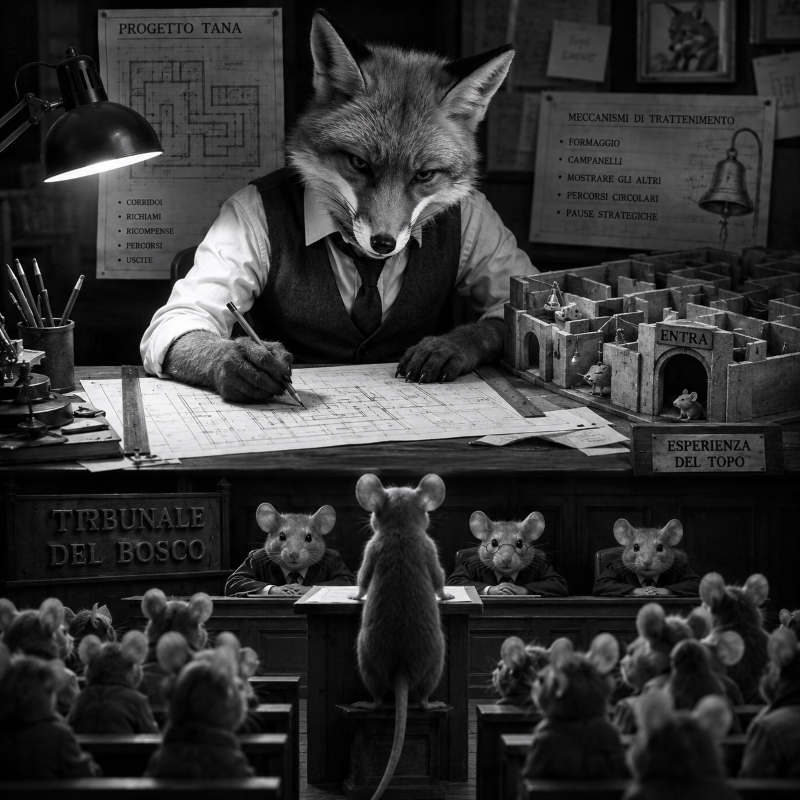
So he sat down at his little drawing table. With rulers, compasses and pencils, he studied corridors, rooms, cues and routes. Where to put the cheese. When to ring a bell. How to show each little mouse what the others were doing. Which passages made them stop, which made them turn back, and which made searching for the exit less appealing.
When he’d finished, the den was perfect: warm, cosy, full of things to look at. And, above all, it always gave him a good reason to stay a little longer.
The fox called it the ‘mouse experience’. Of course, the mice were free. Nobody was forcing them to go in, just as nobody forces a fish to take the bait.
It worked even better with the younger mice. They needed the other mice, they were curious and, above all, they didn’t have many ways of understanding why certain corridors had been designed in that particular way.
Then someone started asking questions, and the matter ended up before the Forest Court. There was talk of mice that were too young, of mechanisms designed to trap them, of risks that had now been established, and of the fox’s responsibility.
The fox denied it.
The den was safe.
The mice were free.
The wood was a maze.
In any case, the other foxes ate mice too.
Then she weighed up her options. She could wait for the ruling, risk being found liable, end up paying a great deal more and, above all, let the Forest Court decide how the den should be built. Perhaps someone might even have walked into her studio, looked at the drawings and said: ‘You can’t build this corridor any more. You’ll have to remove this doorbell. Move this door.’
Or he could have cooperated. And the fox, as it happened, immediately became very cooperative.
He agreed to pay with a little cheese – but just a little – even though it seemed like a lot to the mice. Compared to the cheese he earned each year, it was the equivalent of what he spent in a single day.
To the mice, it really did look like a mountain of cheese, but to the fox it was hardly anything at all, as long as it meant she could stop anyone from taking her drawing board away.
So the fox came up with a few new rules. Clocks to remind the mice how long they’d been inside. Fewer bells. Breaks. A few doors kept closed at night. A few more restrictions for the young mice.
After spending years trying to work out how to persuade them to stay, he would then use his own experience to remind them, every now and then, that they were also free to leave.
He called it ‘mouse safety’.
In return, however, he did not admit to having done anything wrong. No fault. No liability. No ruling establishing that the den had been poorly designed.
And, above all, no Forest Court would have redesigned the den for him.
The fox paid the fine and brought a few corridors up to standard. He put up a few signs. And he suggested that the same rules should apply to the other foxes.
Because the safety of mice comes first. Followed closely by the competition.
Meanwhile, the mice kept coming in. Mum Mouse and Dad Mouse thought they were safer that way. The forest court was satisfied. They had more warnings. More timers. More choices. Formally, they were completely free.
The drawing board, however, was still in the fox’s study.
The pencils were still in her paws. And she carried on drawing the den.
Not least because the fox had never admitted that there was anything wrong with eating mice. It was just that, from that moment on, he would try to do so responsibly.
