










Even the anti-vaxxers owe their lives to him
Let’s go back to the end of the 18th century: life expectancy did not exceed forty years, and maternal and infant mortality rates were extremely high. For those who managed to survive, infectious diseases became the new – and most feared – threats. Among these, smallpox was humanity’s greatest scourge: a devastating disease that killed around a third of those infected and left survivors disfigured by permanent scars. In Europe, throughout the 18th century, it caused hundreds of thousands of deaths every year and was by far the leading cause of death: it accounted for 20 per cent of all deaths from all causes. But smallpox was not the only infectious disease afflicting the population in those years: the plague, tuberculosis, various intestinal infections and other infectious diseases claimed just as many lives as those who had escaped the other scourges.
Doctors of the time were powerless: once the first unmistakable spots appeared on the skin, the patient was marked by smallpox. The only solution was to isolate them completely – which was far from easy – and to burn everything they owned or that had come into contact with their body. Faced with the certainty of their patients’ deaths, some doctors refused to accept their fate and tried everything they could, resorting to improvised treatments often dictated solely by imagination and lacking any scientific basis. After all, those poor souls were going to die soon anyway.
The most daring, having set aside amulets, magic powders and herbs that are consistently ineffective, go so far as to experiment with what happens if they cut into the flesh of a dying patient and insert into the wound some scab or a little pus from another patient suffering from a less severe form of the disease or one who is on the road to recovery. Such patients are sought out – those with enormous scars and deformities, yet still alive – a little organic material is scraped from their pustules and transferred to the wounds inflicted on the seriously ill patients.
Often, the remedy proves worse than the disease, but at other times the seriously ill patient manages to recover and get away with it. Whilst investigating this strange treatment, scholars discovered that this method had already been described in 1675 by Thomas Bartholin of the University of Copenhagen. However, it had in turn been borrowed from French and Welsh folk medicine. It was later discovered that as early as the 10th century, in China, the dying were made to inhale powders made from the scabs of patients who were on the road to recovery. In all cases, this managed to save a few patients from death, although they were left disfigured for the rest of their lives.
It is against this backdrop that Edward Jenner, the English doctor, emerges: through a stroke of insight and a now-famous experiment, he paved the way for the greatest revolution in medicine: the vaccine.
The infected cow’s intuition
Edward Jenner was born in 1749 in Berkeley, a small village in the English countryside. The son of an Anglican vicar, he soon showed an interest in nature and medicine. At the age of 14, he began his apprenticeship as a surgeon and, after studying in London, returned to his native countryside to practise as a country doctor. It was there, amongst farmers and livestock breeders, that he made the observations that would change his life.
In those days, a popular saying was doing the rounds amongst milkmen: ‘Once you’ve had cowpox, you won’t catch smallpox’. Intrigued, Jenner began to investigate and noticed that some milkmaids who had contracted a mild form of cowpox – which causes only pustules on the hands – subsequently appeared to be immune to the dreadful disease.
Jenner expands on his observations to see whether it is possible to transform that peasant belief – based on anecdotes and popular folklore – into a serious, well-documented and measurable scientific hypothesis.
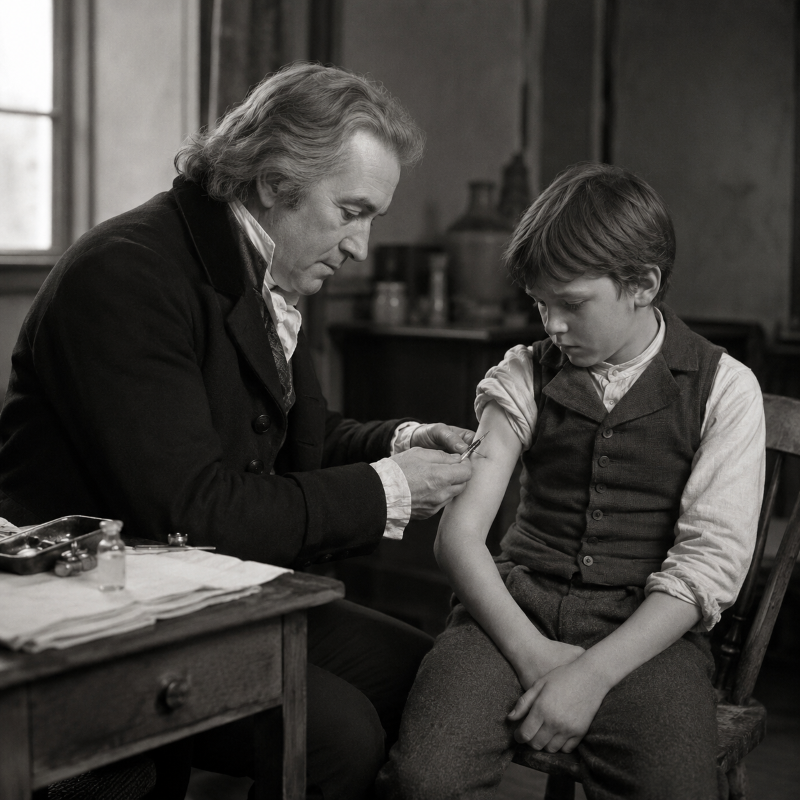
According to a letter written to a friend, it was on 14 May 1796 that he decided to put his hunch to the test: he took some pus from the sores of Sarah Nelmes, a milkmaid infected with cowpox, and inoculated it into the arm of James Phipps, an eight-year-old boy. In his letter, he carefully specifies that Sarah had contracted the virus whilst milking the cow Blossom and that James was the son of Jenner’s gardener. The situation deteriorated rapidly: the boy developed all the symptoms of smallpox and was nearly killed by a fever that kept rising. However, after a few days, the fever unexpectedly begins to subside and the symptoms appear to become less and less severe. After another couple of weeks, it is clear that the boy has pulled through. A few weeks later, Jenner plucks up the courage to deliberately expose him to human smallpox: James does not fall ill. A new cure is born, as yet unnamed. Jenner decides to call it ‘vaccination’, from the Latin word ‘vacca’, which he uses to recall the bovine origin of his discovery.
Science and scepticism
The result was revolutionary, but it was not received with enthusiasm by everyone. Jenner published his research in 1798, documenting 23 successful cases. Many of his colleagues mocked him, accusing him of playing with his patients’ lives. Some satirical pamphlets depicted him turning children into calves. But time would prove him right: the news offered a glimmer of hope and spread like wildfire across the continent. The method spread rapidly to England and then throughout Europe, saving tens of thousands of lives.
In 1802, the British Parliament officially recognised the value of the discovery and awarded Jenner first ten thousand pounds and then a further twenty thousand to enable him to continue and expand his invaluable research. He, however, preferred to return to Berkeley, where he continued to practise rural medicine and refine the technique of vaccination. He died in 1823, aged 73, but is remembered in history as the ‘father of immunology’.
Even Blossom the cow – who had unwittingly donated the infected pus – has earned her place in history: her hide now hangs on the wall of the library at St George’s Medical School in Tooting, on the outskirts of London. A completely unexpected honour for a benefactor of humanity… born a cow.
After Jenner: vaccines take the world by storm
Jenner’s discovery ushered in a new era. Throughout the 19th century, smallpox vaccination spread across the globe, eventually becoming compulsory in many countries. In 1979, the World Health Organisation declared smallpox officially eradicated from the entire planet: the first – and so far only – human disease to have been defeated by a vaccine. If you look at the forearms of people born before the 1970s, you may spot a strange circular scar: this is the spot where, in the early years of their lives, they were given the smallpox vaccination. We can think of that scar as a medal of honour for having fought in a war that the whole of humanity won.
The spark of hope kindled by Jenner has never been extinguished. In the mid-19th century, Louis Pasteur refined the concept of vaccination, extending it to other diseases. He discovered that weakened microorganisms could stimulate the immune system without causing the disease, and developed vaccines against rabies and anthrax. In the 20th century, Jonas Salk and Albert Sabin developed polio vaccines, which spared millions of children from the risk of paralysis. Meanwhile, vaccines against diphtheria, tetanus, whooping cough, measles, rubella and hepatitis B were introduced.
The principle behind all these vaccines is more or less always the same: to prepare the immune system to tackle the enemy before it arrives, to expose it to weakened or harmless fragments of the virus, and to allow it to train its own immune system. When the actual virus arrives, the immune system can recognise it and immediately mount an effective defence before it has had a chance to weaken the body.
Research and future developments
Today, the science of vaccines has entered a new era. Biotechnology has paved the way for the development of protein subunit, DNA and messenger RNA vaccines. Sophisticated techniques enable us to understand the molecular mechanism and produce the immunogenic target in the laboratory much more quickly than in the past.
Work is underway on vaccines against HIV, malaria and tuberculosis – diseases that still claim millions of lives today. Other studies are focused on developing therapeutic vaccines capable of stimulating the immune system to fight existing tumours, as in the case of melanoma. The challenge is enormous, but the path pioneered by Jenner has never been interrupted.
The race for a Covid vaccine
A striking example is provided by the SARS-CoV-2 pandemic. In 2020, the world suddenly found itself brought to its knees by a new and highly contagious virus. Never before in human history had there been such a frantic race to develop a vaccine: hundreds of laboratories, dozens of countries, billions of dollars invested.
Mass vaccinations with Sputnik V are set to begin as early as 5 December 2020. Developed by the N. F. Gamaleya National Research Centre for Epidemiology and Microbiology, the vaccine is being distributed across 71 countries.
In the West – just a few months later – the first messenger RNA vaccines from Pfizer-BioNTech and Moderna received emergency authorisation, followed by viral vector vaccines such as those from AstraZeneca and Johnson & Johnson. This is a testament to just how far science has come since Jenner’s first inoculation, carried out with a makeshift scalpel and a little bovine pus.
Vaccines and controversy
And yet, paradoxically, just as science is achieving unimaginable milestones, a fierce controversy has erupted. Conspiracy theories, mistrust of the pharmaceutical industry and fear of side effects have fuelled the anti-vaccine movement, which in many Western countries is managing to influence public debate and even political decisions.
Short memories can play nasty tricks: without vaccination, millions of people would not be alive today. The WHO’s figures speak for themselves: every year, vaccines save at least 4–5 million lives. The anti-vaccine movement itself – often vociferous and radical – is in fact a living paradox: even its supporters owe their lives, directly or indirectly, to Edward Jenner and his successors.
From the courtyard of an 18th-century English farm to the biotechnology laboratories of the 21st century, the history of vaccines is the story of mankind’s greatest victory over nature.
Jenner could never have imagined the impact of his insight, but his experiment with Blossom, Sarah Nelmes and James Phipps saved billions of lives.
Today, every time a child receives a dose of vaccine, every time an infectious disease is kept at bay, that age-old gesture is repeated. And this reminds us that true freedom does not lie in rejecting science, but in defending the universal right to live without fear of dying from an infection that we can prevent.