











From a revolutionary idea by Oscar Farinetti to a global brand present in over 15 countries: the story of a commercial success which, for almost twenty years, has struggled to turn a profit
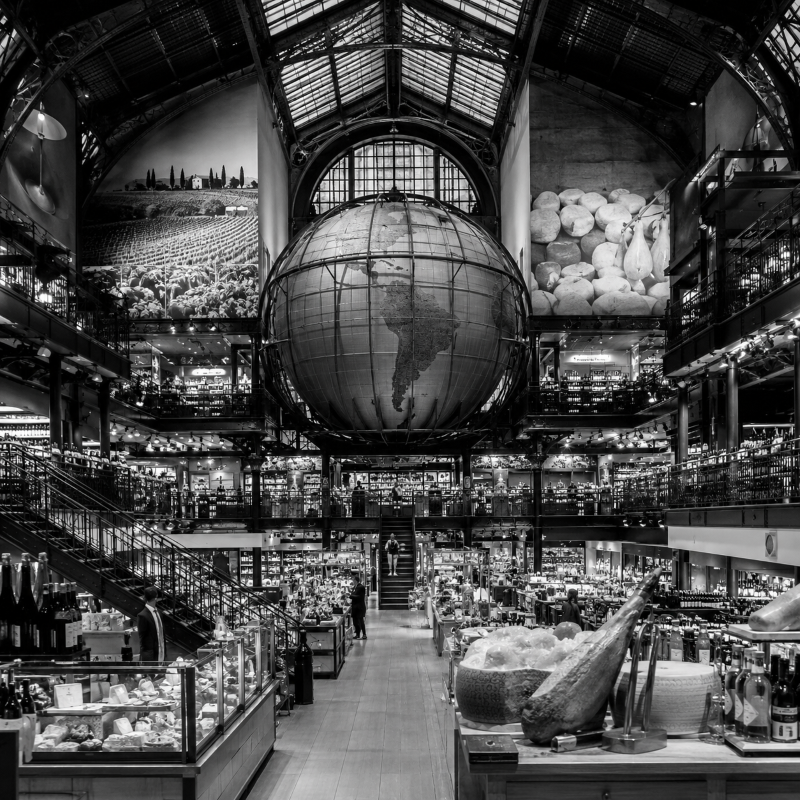
In 2007, you only had to step inside the old Carpano vermouth factory in Turin’s Lingotto district to realise that something had changed. It isn’t a supermarket. It isn’t a restaurant. It isn’t a food fair. It is all of these things combined.
The shelves reach right up to the ceiling, the chefs prepare dishes in full view of the customers, and the producers explain how cheese or extra virgin olive oil is made. You can do your shopping, have lunch, enjoy a glass of Barolo and take part in a tasting session without ever leaving the building.
That place is called Eataly.
Within a few years, it became one of the best-known Italian brands in the world. Following the Lingotto, Eataly’s second major expansion in 2008 saw it open on the exclusive Via degli Orefici in Bologna, just a few metres from Piazza Maggiore. Milan, Rome, New York, Tokyo, Dubai and Chicago followed. Thousands of people queued up to get in. International newspapers described Eataly as the temple of Italian gastronomy.
Behind that success, however, lies a very different story.
A sales assistant’s intuition
To understand Eataly, you have to start with its founder, Oscar Farinetti. He is not a chef. He is not a food connoisseur. Above all, he is an entrepreneur capable of selling ideas even before he sells products.
Having built up and sold the UniEuro electronics chain, he possesses the expertise required to design large retail networks: logistics, shop management, marketing and organisation.
The insight is as simple as it is powerful. Italian food is probably the country’s best-known product worldwide, yet nobody really tells its story. In supermarkets, it becomes just another commodity; in fine-dining restaurants, it is often expensive; in local markets, it is authentic but difficult for a foreign visitor to understand.
Farinetti envisages something completely different: a place where you can buy products, eat, learn and meet the people who make those products in person. A true ‘cathedral of taste’.
The idea took off straight away. The shops sprang up everywhere and were always packed; the press hailed Eataly as the symbol of a new ‘Made in Italy’, and Farinetti became one of the country’s best-known entrepreneurs.
The Conquest of the World
The decisive breakthrough came in 2010. Eataly opened in Manhattan, opposite the Flatiron Building, one of New York’s most iconic buildings. It was a resounding success.
For the American public – who are used to stuffing themselves with burgers, French fries and fizzy drinks – it’s not just a food shop: it’s an experience. A trip to Italy without having to catch a plane.
The expansion is gathering pace rapidly: Chicago, Boston, Los Angeles, Tokyo, Munich, Dubai. By 2018, the group had a presence in over 15 countries, with 55 outlets spread across the world’s major cities.
This enthusiasm has also spread to investors. Between 2015 and 2021, there was repeated talk of a stock market flotation. Some valuations put the group’s worth at between 1.2 and 3 billion euros.
It seems like the inevitable crowning success of a model destined to take the world by storm. But there’s a problem: hardly anyone looks at the financial statements.
The perfect car that costs too much
To customers, Eataly comes across as a welcoming place. To those analysing the accounts, however, it resembles an extremely expensive machine. Each shop requires vast floor space, qualified staff, kitchens, restaurants, educational areas, warehouses, events and a range of thousands of products.
Above all, Eataly always chooses the most prestigious and expensive locations.
Never the suburbs, never second-rate shopping centres – only locations right in the very heart of every city: if Farinetti could build an Eataly on the Monopoly board, he wouldn’t settle for anything less than the square corresponding to Parco della Vittoria.
A strategy consistent with the brand, but terribly costly. The Verona branch, one of the smallest in the chain, pays around 96,000 euros in rent every month. In just two and a half years, it racked up 4.5 million euros in losses before closing.
When, in your business, fixed costs are rising faster than your profit margins, it means you’ve got a problem. A serious one.
In 2023, the EBITDA margin stood at just 6.3 per cent, which was insufficient to sustain such a complex structure.
The geographical breakdown of the results also tells an unexpected story. In 2022, only North America generated a significant profit: $7.4 million. It seems that even wealthy Americans are beginning to appreciate the difference between their diet of assembly-line hamburgers and a plate of hand-rolled tortellini, cooked in free-range capon stock and stuffed with three different types of real pork, just as the God of Bologna commands.
Italy, the United Kingdom, Canada and Sweden, on the other hand, closed lower.
The paradox is clear. The brand, created to promote Italian food, is struggling precisely in its country of origin.
When the figures add up
Between 2021 and 2022, the situation deteriorated. Net losses reached €22 million in 2021 and exceeded €25 million the following year. Over time, the group accumulated losses of around €70 million and debt of nearly €200 million.
Of these, 105 million are bank loans guaranteed by SACE, the state-owned company that supports the internationalisation of Italian businesses.
Meanwhile, the prospect of a stock market listing has been ruled out for good. Institutional investors are noting the growth in turnover, but also insufficient profitability and rising debt.
In 2018, the group again recorded a loss of 17 million euros, whilst its debts to the banking sector exceeded 96 million. Expansion continues, but it is eating into cash reserves.
The FICO interlude
Meanwhile, Farinetti is embarking on another venture. In November 2017, he opened FICO – Fabbrica Italiana Contadina – in Bologna. I suspect he came up with the acronym first and then built the full name around it, but this too is a brilliant marketing stroke of genius. It is a huge theme park dedicated to the Italian agri-food sector.
The investment totals 140 million euros. The forecasts are ambitious: 6 million visitors and 90 million euros in annual turnover.
But the reality is quite different. The first financial year ended with a profit of just 19,000 euros.
In 2019, visitor numbers stood at around one million, far short of expectations. Losses exceeded 3 million euros, rising to 6.5 million in 2022, whilst debt grew rapidly.
In 2025, the balance sheet remained in the red by around 4 million euros, prompting the Farinetti family to step in with a further injection of 7 million. FICO was also forced to close. But Farinetti did not give up: he bought out all the shares from the other shareholders – including Coop Alleanza – and became the sole owner, reopening the park following a major rebrand: Grand Tour Italia was born, but this new food park also struggled to stay afloat.
Grand Tour Italia is currently undergoing a period of major reorganisation due to results falling short of expectations. Many of the original 20 regional restaurants have been closed, and the organisation has scaled back its offering, focusing more on families, event space and the large children’s area, the ‘Beautiful Gallery’. All this merely confirms just how difficult it is to turn a fascinating idea into an economically sustainable model.
The change of course
September 2022 marked a turning point. The Investindustrial fund, led by Andrea Bonomi, acquired a 52 per cent stake in Eataly. From that moment on, they were in charge. Farinetti, who had controlled almost 60 per cent of the company, saw his stake fall to 22 per cent. For the first time, he lost control of the company he had founded.
The transaction is worth a total of around 340 million euros: 200 million will be used for the capital increase and debt reduction, whilst around 140 million will be used to buy out the existing shareholders’ stakes.
The new management is rapidly changing its strategy. The least profitable outlets are being closed without further ado, expansion is slowing down, and resources are being channelled to where the model really works.
Why Eataly is particularly successful abroad
Experience shows there’s a fundamental difference: in the United States, customers go to Eataly to experience Italy – a thirty-dollar plate of pasta is seen as part of a cultural experience. Who cares if it costs six times as much as a fast-food meal? I’ll take a selfie whilst I’m eating it, post it on social media, and it’s all part of my personal branding!
In Italy, comparison shopping is inevitable: consumers know the price of mozzarella at their local shop, they know how much a bottle of wine costs at the shop next door, and they weigh up each product against the available alternatives. What’s more, they are surrounded by hard discount stores where ‘below-cost products’ are not a passing fad but a constant feature.
The magic of a high-class food and wine experience gives way to price comparisons, so profit margins are shrinking.
In 2024, revenue reached €684 million. The operating profit rose to €53 million, equivalent to almost 8 per cent of turnover, whilst the net loss fell to €13 million, roughly half that of the previous year. North America now accounts for over 60 per cent of total turnover.
In 2025, sales rose further to 706 million euros, but the weakening of the dollar and new US tariffs once again put pressure on profitability: profits continued to elude the company.
The value of an idea
The story of Eataly illustrates a rare paradox in the business world. Very few companies manage to build a global brand capable of changing the way millions of people perceive ‘Made in Italy’. Even fewer manage to do so by involving thousands of small producers, transforming a simple shop into a place where food becomes culture, storytelling and an experience.
This network of farms, dairies, charcuteries, pasta factories and wineries also helps to preserve traditional production methods, local varieties and artisan skills, which form an important part of Italy’s agri-food biodiversity. This philosophy aligns with several Sustainable Development Goals of the United Nations’ 2030 Agenda, ranging from the promotion of responsible production and consumption patterns to the protection of terrestrial ecosystems, whilst also supporting the work of local communities and agricultural supply chains.
But building an extraordinary brand does not necessarily mean building a profitable business. These ‘cathedrals’ of commerce come at an enormous cost, and keeping them open every day requires profit margins that the food market grants only very sparingly.
Almost twenty years after its inception, Eataly continues to be one of the most original business concepts to come out of the ‘Made in Italy’ movement. The vision conceived by Oscar Farinetti has changed the way Italian food is presented to the world and has opened up new markets for many small producers. It remains, however, a valuable lesson for every entrepreneur: a brilliant idea can win over a global audience, but only a sustainable business model can turn success into lasting value.