


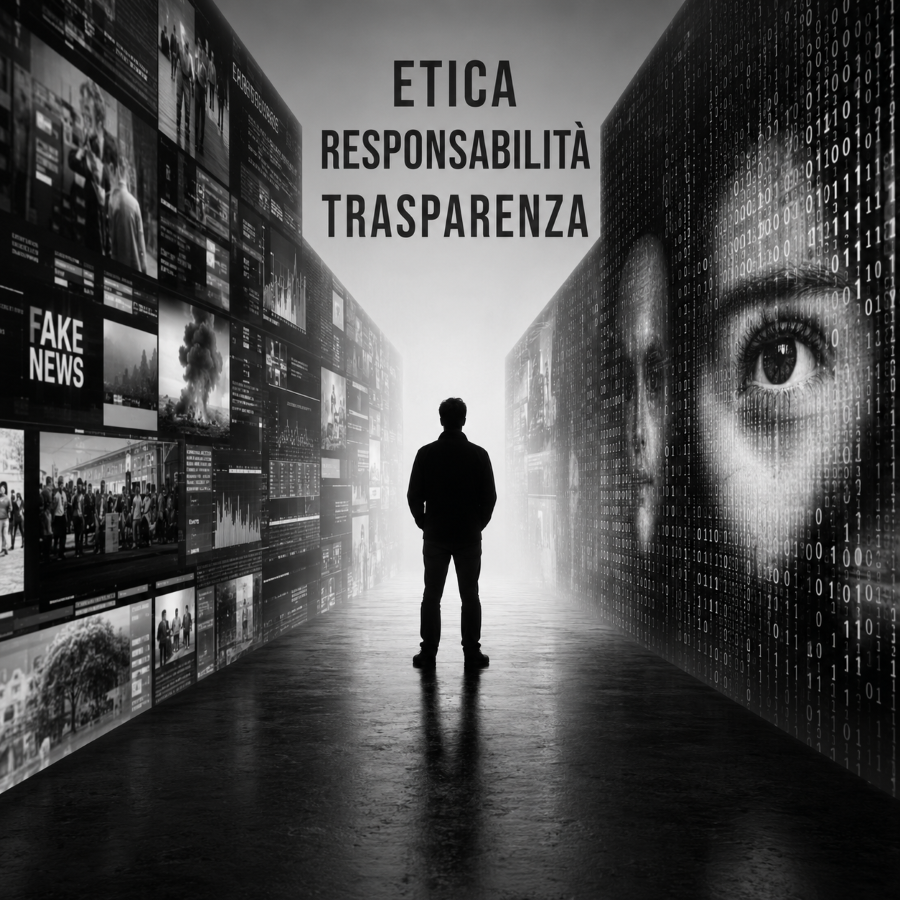

Ethics, accountability, transparency. We say them in that order, but they are built in the opposite way. Transparency comes first. Without transparency, there is no accountability. And without accountability, ethics remains a fine-sounding but empty word.
It is no coincidence that the Manifesto for Sustainable Digital Communication, drawn up by the Foundation for Digital Sustainability, devotes a specific section to these three concepts.
Today, more than ever, they must be at the heart of communication mediated by digital tools. It is a question of sustainability, in a world that is increasingly driven by algorithms.
From television to synthetic reality
Transparency is not a new issue. It was already being raised in research carried out in the 1970s and 1980s, when television was the cutting edge of communication. Even then, people wondered whether the images broadcast were concealing reality rather than revealing it. Editorial choices could transform the screen into a simulacrum: a copy without an original, an image that takes the place of the thing itself. This is the insight with which Jean Baudrillard interpreted our age. We no longer live between reality and its representation, but within the hyperreal, where the sign no longer refers to anything other than itself.
In the digital age, that problem has become enormous. Today, what we see may not simply be the result of an editorial choice: it may not exist at all. It may be the product of manipulation, of an algorithm capable of generating synthetic realities.
And if distinguishing truth from falsehood becomes so difficult, then we need to take on an extra measure of responsibility. That is to say, a willingness to subject what we communicate to democratic validation: a broad, open and equal exchange of views. This is precisely what Jürgen Habermas calls ‘communicative action’, which relies on an ideal discursive situation in which the strength of the best argument, rather than the power of the speaker, is what decides the matter. This is far from a straightforward prospect in the age of social media. Because the internet tends to trap us in bubbles of conformity, where each of us finds and reinforces our own ideas. Eli Pariser has called them ‘filter bubbles’: we do not choose them; they are constructed by the algorithm. The result is that opinions circulate, solidify into fixed positions, and are passed off as truths – without ever having been legitimised by any genuine debate.
That is why, today, we must once again ask ourselves what it means to communicate. The communicator must understand how the tools they use work. And they must let ethics guide them, to help create that ideal communicative situation in which people speak to one another to understand each other, not to win.
The risks of the algorithm
Understanding these tools means, first and foremost, understanding the risks they pose. This does not mean denying their potential – quite the contrary. Take artificial intelligence, for example: a valuable tool that we all now use in our work. But, like social media, it operates according to rules drawn up by private entities. Legitimately, for profit. Yet these rules are never publicly debated, nor are they ever democratically legitimised.
This is where the most serious risk to ethical journalism lies: not knowing why an algorithm works in a certain way, whilst that very algorithm selects content, shapes perceptions and influences our value judgements.
The current rules apply at a later stage: to the use of data and to privacy.
They skirt round the issue without getting to the heart of it. And it is precisely that heart that ought to be brought into the public debate.
The role of awareness
For all these reasons, awareness is the most important tool we have. When we use social media or an artificial intelligence model, we are handing over a huge amount of data to private companies. And we are relying on algorithms that feed us content based on criteria we are unaware of.
But awareness is not an end in itself; it is a starting point. From there, we can take action: help our audiences to use these tools more thoughtfully, choose the content we offer more carefully, and present a wider range of viewpoints. Presenting different viewpoints is the way to restore a degree of democratic pluralism to our communication.
Beyond technical skills: culture
However, this clarity does not stem solely from technical skills. Indeed, it is perhaps skills of a different nature – philosophical, sociological and ethical – that matter most today. Not that hyper-specialisation is unnecessary: it is needed. But faced with the complexity of recent years, those who communicate must be able to take a broader view. They must understand that, the moment they communicate, they are performing an action that alters reality and sets in motion an exchange of meanings with their audience.
None of this, however, should lead us to join the ranks of the doomsayers. Umberto Eco, with his distinction, contrasted them with the ‘integrated’: on the one hand, those who demonise the new media; on the other, those who embrace them unreservedly. There is another way forward. Communication is, and remains, one of the tools through which a society can grow and improve. We must simply remember that we are handling tools which, in recent years, have also demonstrated their potential danger to democracy and social cohesion. This is why the new generation of communicators cannot limit themselves to studying how the latest social media platform works. They must build a solid culture capable of ensuring its truly sustainable use.
Because a medium is never neutral. And whoever communicates, whether they mean to or not, does not merely describe the world: they change it.