









Increasing risks of droughts, floods, heat waves and other extreme weather events: climate change is one of the most urgent and complex challenges facing the world, and its impacts can be devastating on multiple sectors. One of the most vulnerable areas in this respect is undoubtedly food security.
The effects of this global phenomenon severely threaten agricultural production, compromising access to food and the nutrition of millions of people, particularly in poorer countries. Today, technological progress can provide the keys to addressing these problems, offering innovative tools that can help mitigate their negative effects and create more resilient food systems. The challenge is open, and confronts us with a clear reality: a safer future in a changing climate depends, and will increasingly depend, on the widespread use of new digital technologies.
The consequences of climate change
Already today, climate change is accelerating and bringing with it a series of extreme events that have a strong impact on global food production. And if eradicating world hunger is a huge challenge in itself – as well as the second of the sustainable development goals set out in Agenda 2030 – climate change can be said to have a ‘multiplier’ effect on it.
Recent projections indicate that, without adaptation measures, global warming could push millions of people into the grip of hunger by mid-century. TheIPCC estimates that the climate could put 8 to 80 million people at risk of malnutrition by 2050, concentrated in sub-Saharan Africa, South Asia and Central America. The World Food Programme takes the same view, predicting that the risk of hunger and malnutrition could increase by 20% by 2050 if the global community does not take immediate corrective action.
Without decisive action, phenomena such as desertification, dwindling water resources and loss of fertile land are bound to become more frequent and severe.
In addition, changes in weather patterns – such as rainy seasons becoming shorter or irregular – will further compromise the ability to farm in many areas of the world. These are all effects that, when combined, could lead to millions of people becoming more dependent on humanitarian aid, putting increasing pressure on the world’s food systems.
Precision agriculture and IoT for climate resilience
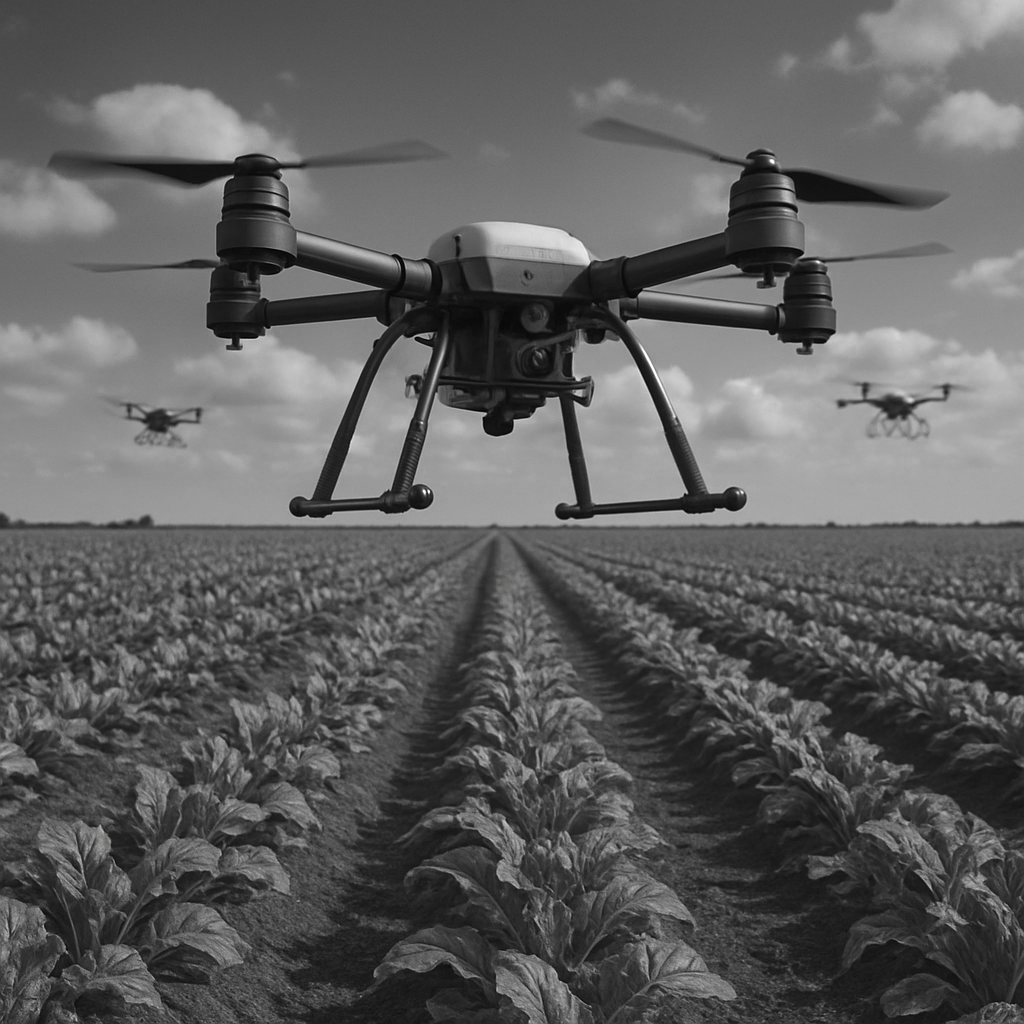
Change is still possible, however, if new technologies are driving it.Precision agriculture – supported by IoT sensors, satellite data and automation – is a clear example of this, already representing an effective response to adapt agricultural systems to the changing climate. This approach, specifically, involves the use of digital technologies and data analysis to manage crops in a more targeted way: for example, GPS systems, field sensors and drones allow real-time monitoring of soil moisture, nutrient requirements and crop conditions. This allows farmers to decide when to irrigate and how much fertiliser to apply with previously unthinkable precision, enabling reduced waste,optimised yields and overall making farms less vulnerable to drought, erratic rainfall and pest attacks amplified by climate change. This level of management therefore increases productivity while reducing environmental impact: such practices can improve yields and crop stability even in the face of extreme events, allowing farmers to flexibly adapt sowing and harvesting to actual weather conditions.
All these tools, now an integral part of the so-called 4.0 agriculture, combined offer important and advanced decision-making tools: for example, early warnings linked to weather data can suggest an earlier harvest in view of a heat wave, or decision-support systems can recommend crop varieties better suited to the local climate. In short, precision agriculture is a virtuous practice for making agricultural systems more efficient and reliable, and can help preserve food security in the face of growing climate challenges.
Artificial intelligence, the power of prevention
Artificial intelligence and Big Data analysis are also radically changing the way crops are managed and threats predicted, offering an important ally in addressing climate impacts on food security. Machine learning algorithms can process massive amounts of data from IoT sensors, satellite imagery and weather stations, providing growers with previously unavailable predictive insights: for example, advanced platforms analyse historical and real-time data to predict the optimal time for planting based on expected seasonal weather conditions, or to detect initial outbreaks of crop diseases before they spread through anomalous pattern recognition.
Through these analyses, artificial intelligence is able to anticipate problems and needs, enabling a proactive approach – based on predictive models – capable of transforming agriculture itself from reactive to preventive: in other words, producers can make appropriate decisions before any damage takes place.
The benefits on agricultural performance are, in this direction, far from indifferent: recent studies show how AI-driven precision farming techniques can increase crop yields by 15-20% while simultaneously reducing costs and input consumption.
Digital to support the livestock sector
Even in the livestock sector, digital technology can play a leading role in sustainability. On the other hand, while the agricultural sector in our country contributes 7.4 per cent of emissions, 5.8 per cent of these are accounted for by animal husbandry – of which meat-related emissions are 3.7 per cent. And although the meat supply chains are among those that could benefit most from a digitally oriented approach to sustainability, for various reasons – from infrastructural to cultural – these benefits are often not taken up.
This is analysed in the research ‘The Digital Transition of the Italian Meat Supply Chains’, carried out by the Foundation for Digital Sustainability with the scientific contribution of the Carni Sostenibili study centre: the first study that examines the role of digital technologies in making companies in the meat supply chain more efficient, with a view to environmental, economic and social sustainability. The study shows that in Italy there are just over 166,000 livestock companies and that, in terms of innovation, there is a substantial delay. In fact, just over 15% of these are digitised, with the percentage rising to 71% for the largest ones.
Yet, best practices in this regard are not lacking, demonstrating the real potential of digital transformation. To give an example, the companies in the beef supply chain involved in the study indicated among the practices adopted the use of controlled irrigation for cereals, for the production of fodder, greatly reducing water consumption. For some companies, in particular, the use of satellite systems to monitor both irrigation and slurry spreading equipment was important: the latter, equipped with NIR sensors, allow total control over the quantities dispersed. The new digital tools, therefore, enable an otherwise unthinkable management of resources, which, in a context of fragility aggravated by the effects of climate change, generates important advantages not only for the planet, but also for the economy of production realities.
Bridging the digital divide
Climate change thus poses a serious threat to global food security. A threat which, at the same time, highlights a range of digital solutions capable of mitigating its impact, and which are increasingly converging to make agri-food systems more efficient, sustainable and resilient. These, through optimisation in the use of resources, constant monitoring and intelligent forecasting, help to increase food production where possible, and above all to protect existing food production in the areas most at risk.
It is predicted that the extension of these practices to 40 per cent of the world’s farmland could play a crucial role in limiting climate change, strengthening the resilience of food production systems, and protecting both ecological diversity and the economic well-being of farming communities. In order to realise this potential, however, it will be crucial to invest in the accessibility of these technologies: that is, to bridge the digital divide by providing training, infrastructure and financial support to smallholder farmers in developing countries, who are often the most climate-exposed and, at the same time, the least technologically equipped.
Combining digital innovation with appropriate policies and local knowledge is the way forward to transform food systems and make them more robust in the face of the climate challenges we face. The challenge is complex, but concrete solutions already exist. Exploiting them on a global scale and in an inclusive manner is the most promising way through which we might hope to achieve a twofold goal: feeding a growing population and addressing the effects of climate change on food security.
