

















From automation to autonomy: when puppets cut the strings
Every civilisation has a moment when everything it knew stops working as expected. It is not just a change, it is like someone flips a switch and the past turns into a grainy old movie. Historians tell of epic moments: the birth of agriculture, printing, industry, the splitting of the atom. Those who were in it may have wrinkled their eyes, but today we see each event as an event horizon: that point of no return that rewrites the rules of the game
But with hindsight, we see the horizon of events: the point beyond which society itself has been rebuilt.
Today we are approaching another such frontier. It is not simply another technological cycle or economic recession. We are entering an era in which the relentless compression of costs, margins and human needs meets the exponential force of automation.
The result is an era of potential abundance, but also one of profound uncertainty – a time when the entire architecture of society, labour, wealth, and government must be reconsidered. I call this threshold the ‘event horizon of civilisation’.
What is the event horizon? It is an expression borrowed from physics, where it marks the boundary around a black hole: a line that, once crossed, allows no return. In Einstein’s general relativity, it represents the point of no return – beyond that threshold, not even light can escape. For us, it represents the moment when our old models of work, value, security and identity start to gravitationally collapse towards something new, and we have to invent new paradigms on the fly, without being able to go back to ‘before’.
The phantom traffic jams of modernity
We live in a world that blocks itself. Like in a phantom traffic jam: no accidents, no real obstacles, just the collective effect of small brakes. Imagine the crowd on the motorway: no accidents, no real obstacles, yet everyone brakes and no one accelerates. Yet we convince ourselves that it is inevitable:
– the economy of scarcity, when technology promises abundance;
– centralised hierarchies, when the network suggests decentralisation;
– jobs that survive only because of social inertia, not real utility.
Our Jiminy Cricket today is called Artificial Intelligence. And it keeps whispering to us : “What if everything was different than you think?”
The adjacent possible of anarchy
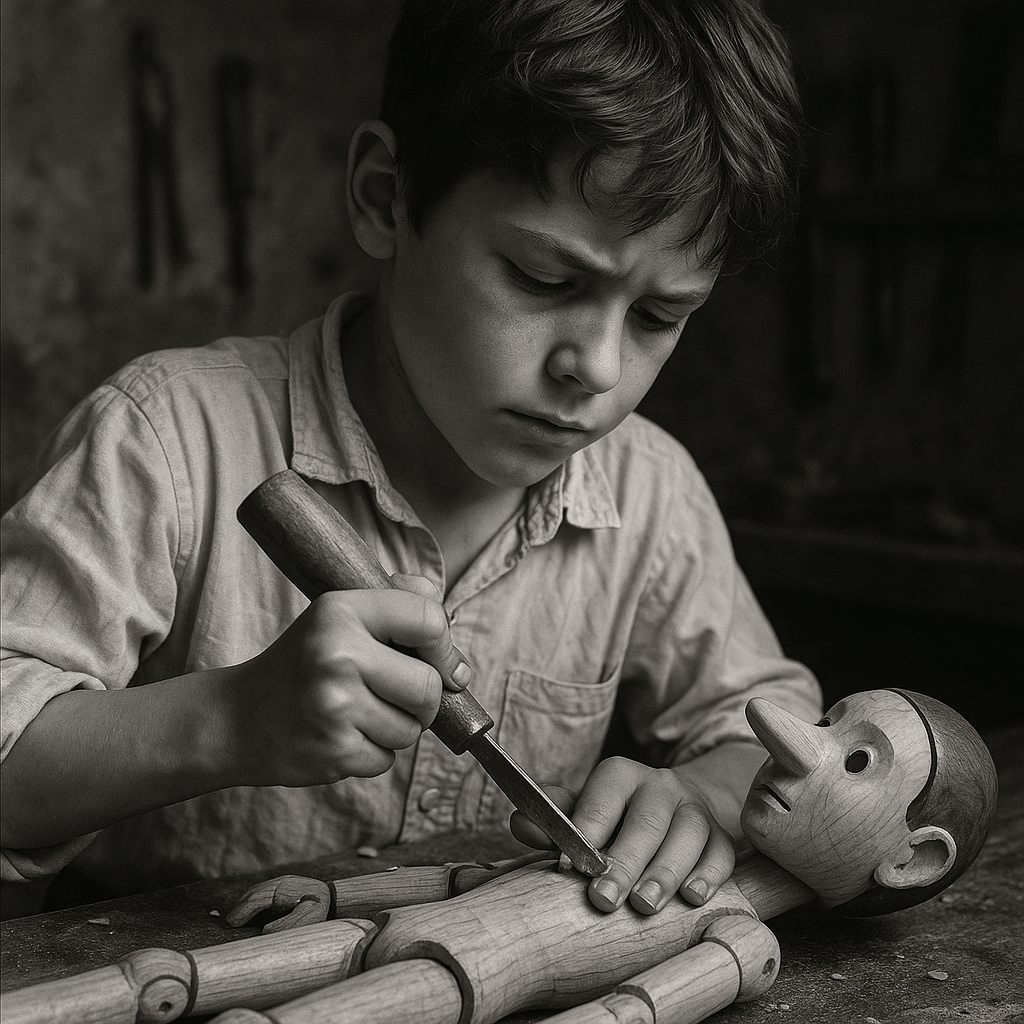
The real watershed will be when machines stop being mere automatons and become artisans of themselves. Not automation, but autogenesis. It is then that Pinocchio, having become a child, will also become his own carpenter.
And while we talk about autonomous replication, let us not forget that we are already experimenting with forms of computation that challenge our traditional paradigms: biological computers that use DNA as a memory and calculation medium.
If classical computing mimicked the brain with silicon circuits, we are now going back to the source – directly using the molecular mechanisms of life to process information.
This is not an industrial revolution: it is a planetary anarchist experiment. Not anarchy as chaos, but as the spontaneous flowering of new orders:
– Markets reorganising themselves without five-year plans.
– Algorithmic self-governing communities.
– Currencies that ignore central banks and sovereign states.
A world that is not planned from above, but written from below.
The paradox of control
Yet, the more we chase autonomy, the more we find control slipping through our fingers:
– The societies that were supposed to free us have created invisible cages.
– The AI that was supposed to be neutral multiplies our prejudices.
– The blockchain that was supposed to decentralise concentrates wealth.
We are astonished Geppetto, who sees his creature move without always obeying him. Sometimes (almost always) he does what even he had not foreseen.
The manifesto of this column
In these pages we will explore the tragicomic intersection between technological utopia and economic reality: from cryptocurrencies that promised revolution and ended up replicating Wall Street, to platforms that were supposed to connect humanity and have fragmented it, to AI that was supposed to free us from work and instead has made us eager to be replaced.
We will not seek definitive answers – the event horizon, by definition, conceals what lies beyond. But we will try to take a critical and desecrating look at the promises and contradictions of our technological times. Secure in the knowledge that every time a new technology comes onto the market, it sets the limits of previous ones but does not give absolute certainty of the development of the new. This is also why we will not speak of destruction or digital disruption but of construction and creative construction. Talking about destruction is not the way we will go about it.
Because while it is true that we are experiencing an epochal transformation, it is also true that often the most sensational revolutions begin with someone laughing at the absurdities of the present.
Welcome to the adjacent possible. Welcome to the anarchy of the digital economy.
“Artificial thoughts between anarchIA and economIA” is a column with an ‘anarchic’ cadence that will attempt to explore the contradictions, missed promises and unexpected opportunities of the artificial intelligence era, with an irreverent look at the ongoing economic and social changes.