

In the digital world, education is no longer a physical place: it is a flow in motion. A knowledge that moves, adapts, reinvents itself. In this article, we explore SDG 4 through the figure of Hermes to narrate an education that does not merely transmit, but includes, accompanies, transforms
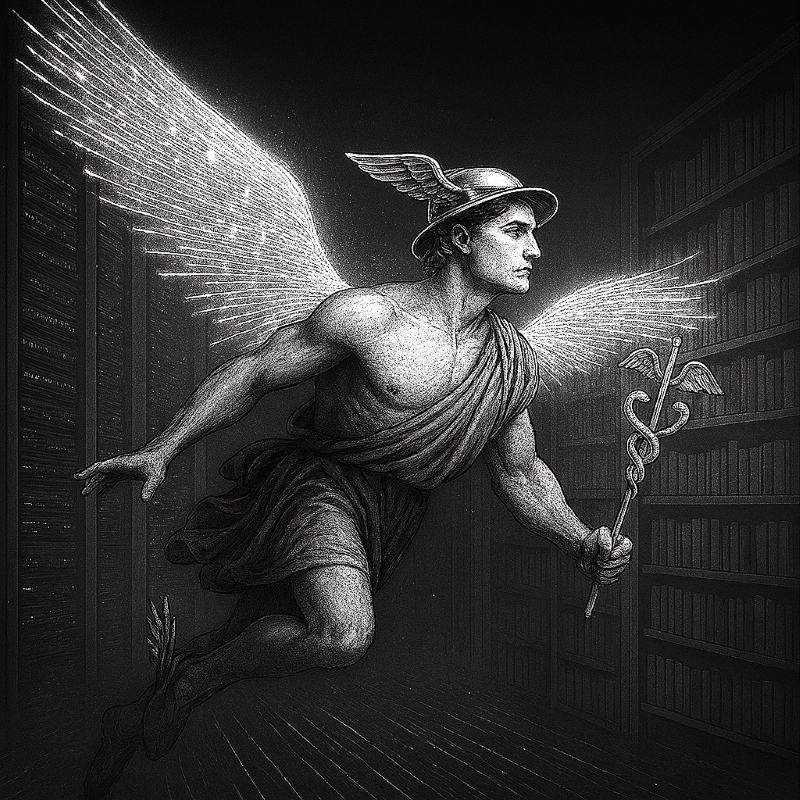
In the ancient world, Hermes was the messenger of the gods. He flew between Olympus and Earth with winged sandals, carrying words, insights and transitions. He was the god of communication, travel, trade – but also of thresholds, passages and transformations. Today, in a digital world that runs faster than light, Hermes returns to speak to us. And he does so with wings of fibre optics.
Knowledge as movement
Education is no longer a physical place, but a flow. E-learning platforms, digital libraries, open courses and virtual communities embody the hermetic principle of transmission: knowledge that travels, that adapts, that multiplies.
By 2025, more than 280 million students worldwide will connect to online educational content every day. E-learning is no longer a niche: it is growing by 14% every year, expanding even in the most fragile contexts thanks to initiatives such as the Global Partnership for Education and UNESCO’s Learning Passport, which take knowledge where it did not go before. In Italy, 60% of high school students used at least one digital platform to study in 2024 (source: ISTAT 2025 report on SDG4). But it is not enough to count the accesses: we have to look at the movement that is generated. Because in this scenario, SDG 4 is not just a promise of access to education – it is a revolution in the way knowledge moves, is transmitted, is transformed.
Education is becoming increasingly fluid, nomadic, interactive. No longer confined within the walls of a classroom, but capable of crossing borders, devices, languages. And Hermes, with its fibre optic wings, reminds us that knowledge is not a commodity to be guarded, but a message to be travelled by eliminating all geographical, economic or cognitive barriers.
Accessibility as ethics
The numbers speak for themselves. According to INVALSI 2023/2024 data, almost one third of Italian second grade pupils (32.8%) have not reached the basic level of competence in Italian. In the fifth grade, the percentage drops but remains high: 24.6%. These are not just statistics: these are boys and girls who struggle to understand, to express themselves, to participate. It is a structural fragility that digital education can help to overcome – but only if it is designed for equity, not efficiency.
In the horizon of SDG 4, accessibility is not a technical optional: it is a form of respect. It means recognising that knowledge, to be truly shared, must speak several languages – not only grammatical ones, but also cultural, sensory, emotional ones. It means building pathways that do not merely convey content, but that bend, adapt, open up. Because knowledge is never neutral. Either it is offered in such a way that everyone can access it, or it risks becoming an instrument of exclusion
Making information accessible becomes a political gesture, an act of justice: choosing words that include, forms that accompany, formats that respect different ways of learning.
It is not enough to make content available: it must be made usable. Because every barrier – be it linguistic, cognitive or cultural – is not just an obstacle to be removed, but a reality to be understood. And every opening, however small, can become a door to autonomy, participation, dignity.
Technology alone is not enough. We need a vision that puts people at the centre, not just platforms. It needs a Hermes that knows how to translate, adapt, accompany. Some paths show us that it is possible.
There are choices that speak louder than words. Khan Academy, for example, decided to translate its content into over 40 languages, opening the doors of learning to millions of students worldwide. It did not just offer lessons: it built bridges. It recognised that knowledge, to be truly shared, must be accessible, understandable, adaptable. It is a gesture of trust that everyone has a right to an education, it is a silent but powerful declaration that knowledge does not belong to those who possess it, but to those who seek it.
Coursera for Refugees has gone one step further. In contexts where schools have disappeared, books are no longer there and the future seems suspended, education becomes more than a right: it becomes resistance. Bringing free courses to over 100,000 people in emergency situations is not just about offering content – it is about recognising that the will to learn survives even when everything else fails.
In a changing world, educating also means being found. And those who design content, paths, learning environments have a profound responsibility: that of not leaving anyone behind. Because every piece of knowledge that does not arrive is a lost opportunity. And every piece of knowledge that opens up is a step towards a fairer world.
Quality education is not only that which teaches. It is the one that achieves.
It is an education that does not demand uniformity, but seeks fairness. That does not ask students to be ready, but prepares to welcome them. It is an education that bends, adapts, reinvents itself to leave no one behind. It is one that is not content to be available: it wants to be accessible, understandable, transformative.
Hermes, today, does not just carry messages: it carries possibilities. And it reminds us that every click, every content, every interface is an ethical choice. A choice that can include – or exclude. It is up to us to decide which side we are on.
Connected, not isolated education
Hermes was also the god of networks: he connected worlds, cultures, divinities. Today, education must do the same. It cannot be vertical, self-referential, closed. It must be connected: between disciplines, between generations, between territories. SDG 4 asks us to build bridges, not towers. And Hermes offers us the perfect metaphor: knowledge that travels, that is exchanged, that is renewed.
By 2025, 70 per cent of European universities have chosen to integrate face-to-face teaching with online teaching, activating blended learning programmes that mix classroom and network, relationship and autonomy. In Africa, initiatives like eLearning Africa are building regional digital training networks, with over 50,000 teachers trained in educational technology. These are not just numbers: they are signs of a profound change in the way we think, design and experience education.
Connection is not just a question of bandwidth. It is a question of meaning. A connected education is not measured in gigabytes, but in relationships. It is one that holds together scientific and humanistic knowledge, theory and practice, school and community. It is one that recognises that learning is not just acquiring information, but constructing meanings. Here technology is not the end, it is the means. It does not serve to replace, but to amplify.
Technology helps us make resources more accessible, pathways more flexible, educational relationships richer. But for this to happen, we need a vision that puts people at the centre, not platforms, and that uses technology not to replace, but to amplify.
Hermes, god of connections, reminds us that all knowledge is a journey. And that every journey needs maps, but also needs companions. Connected education is that which leaves no-one alone in front of a screen, but builds bridges between solitudes. It is the one that is not content to transmit, but wants to transform.
Ethical communication: the stick of Hermes
The caduceus, symbol of Hermes, is not just a stick: it is a declaration of intent. Two intertwined serpents, in perfect balance, coiling around an axis of dialogue. It is the very image of ethical communication: not a voice that dominates, but a presence that listens. Not a line that separates, but a bridge that unites.
We live in a time when information runs faster than our ability to comprehend it. Headlines, notifications, continuous streams pass through us every day, often leaving us disoriented. So, educating cannot limit itself to transmitting content: it must teach how to navigate. To distinguish, to interpret, to choose with awareness.
We forget that communicating is an act of caring. It means choosing words that do not hurt, but open. Formats that do not exclude, but accompany. Rhythms that do not overwhelm, but respect time for listening, understanding, relating. Educating also means teaching how to communicate. Not only to speak, but to construct meaning. To recognise the power of words, the responsibility of gestures, the depth of silences. It means accompanying people in becoming citizens capable of dialogue, of dissenting without destroying, of seeking truth without renouncing complexity. It means educating to coexistence, to responsibility, to critical reading.
In 2024,UNESCO launched the Media and Information Literacy for All programme, with a goal that is also a vision: to train 1 billion citizens by 2030 to be able to recognise disinformation, digital bias, narrative manipulation and to educate them in the ability to decipher what we are being told, to distinguish between what informs and what confuses, between what involves and what manipulates.
This challenge also concerns Italy. According to the most recent data, only 38% of high school students feel able to recognise a reliable online source. This is not an individual limitation: it is a collective signal. Because in a world where information reaches us before we can even understand it, educating also means teaching how to orient oneself. To doubt with intelligence, to search with patience, to construct meaning with awareness. It is a challenge that is not won with more content, but with more awareness. It is one that teaches one to dialogue, to disagree, to build together.
Hermes and education as a system
Thinking about education in terms of SDG 4 also means recognising its systemic dimension. It is not enough to digitise content: we need to rethink infrastructure, skills, assessment metrics. Hermes invites us to overcome fragmentation, to build an educational ecosystem that is coherent, inclusive, sustainable.
The ASviS 2024 Report shows that, in Italy, 40 per cent of teachers under 35 consider digital training resources insufficient. Yet, experiences such as Scuola Digitale Liguria and MIUR’s Futura show that investing in skills and networks can generate scalable impact. This implies investment in teacher training, in accessible technologies, in public policies that favour equity. It also implies a new culture of knowledge: less accumulation-centred, more sharing-oriented.
Conclusion: Hermes is us
Every time we design accessible content, every time we open an online course, every time we translate complex knowledge into simple words, we are wearing Hermes sandals.
SDG 4 is not just a goal: it is a posture, a vision, a responsibility. And Hermes, with his wry smile and light step, accompanies us on this journey.
In a changing world, educating means moving. It means listening, translating, connecting. It means being messengers of a knowledge that does not divide, but unites. And if Hermes has fibre optic wings today, it is because knowledge needs speed – but also care, ethics, beauty.