













From wisdom gods to code heroines, we see how SDG 5 – Gender Equality – invites us to rewrite the invisible foundations of technology
At the heart of the 2030 Agenda, SDG 5 – Gender Equality – is not just one item among many. It is an urgent call to rethink the way we build the world – including the digital world. Because every platform, every algorithm, every automated system is not neutral: it is a reflection of human choices. Choices that tell who has a voice, who has power, who is heard. And who, instead, remains on the margins.
According to the World Economic Forum’sGlobal Gender Gap Report 2023, women make up less than 29% of the global technology workforce. And in decision-making roles related to artificial intelligence, they fall below 20%. Behind these numbers are not just statistics.
There are voices that do not participate. They do not write the code. They do not define the algorithms. They do not design the systems that will shape tomorrow’s world. Yet, those same systems decide. They decide who is recognised, who is served, who is excluded.
Artificial intelligence is entering everywhere: in work, in health, in education, in justice. Talking about gender equality today also means this: looking inside the code, interrogating data, questioning digital architectures. It means asking who has the power to define the criteria of intelligence, who is included in the datasets, who is left out of the decisions that count.
Digital is not neutral. It never has been. It reflects inequalities that already exist and, if we do not question them, amplifies them with mathematical precision.
Machine learning models, for example, learn from historical data: if that data tells of a world where women are less quoted, less hired, less paid, the algorithm will continue to replicate that world. Without malice, but with real consequences.
Behind every algorithm is a vision of the world. And if that vision excludes, simplifies, distorts, then it is not really intelligent. It is only partial. Humanising AI means giving it back complexity, diversity, justice. It means building systems that not only work, but also respect. Because fairness is not a plug-in. It is a choice. A responsibility. A vision.
It is not just a bug. It is a bias.
A study by the MIT Media Lab revealed that some facial recognition systems fail to recognise female faces with dark skin 34% of the time. For light-skinned male faces, the error falls below 1%.
It is not a technical detail. It is a symptom. Of the designer. Of those who are included in the data. Of those who remain outside the field of vision of the algorithms. That is why, today, talking about gender equality also means talking about code, datasets, digital architectures. It means asking: who writes the algorithms that decide who is hired, who receives a loan, who is supervised? And who is excluded from that writing?
If we want to build a fairer future, we have to start here. From the invisible foundations of the digital. Because that is where the real game of inclusion is played. And every line of code can be an open door or an erected wall.
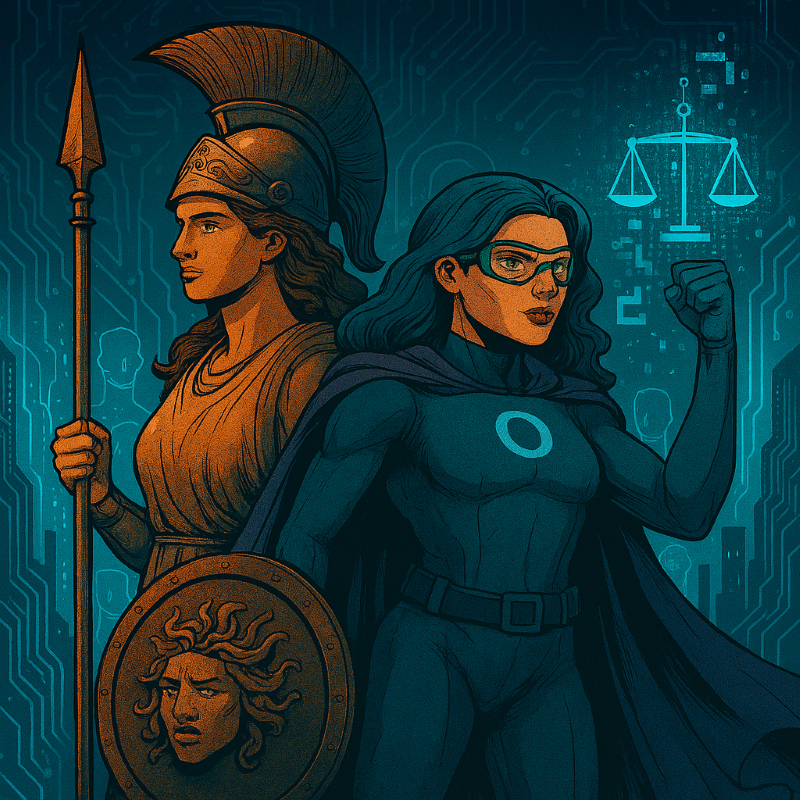
Two archetypes help us read this battle: Athena, goddess of wisdom and strategy, and Batgirl, heroine of digital and urban justice. Two different figures, but united by a vision: that of a technology that does not serve power, but questions it. That does not exclude, but protects. That does not dominate, but emancipates.
Athena: the wisdom that weaves the future
Athena is not only the goddess of just war. She is also the inventor of weaving, of navigation, of strategy. She is the mind that builds bridges, not walls. In ancient Greece, Athena represented the ability to think before acting, to protect without destroying. She is the patron of cities, of civilisation, of technology.
In the digital world, Athena reminds us that technology is always a moral choice. That every algorithm is a political decision. That every computer system can be designed to include or to exclude. And that wisdom is not just knowledge: it is responsibility.
But where are the digital Athena today? Women are still underrepresented in development teams, technology boards, and the datasets that power artificial intelligence. And when they are present, they often have to struggle against structural biases, invisible stereotypes and metrics that do not include them.
From Batgirl to Oracle: resilience that plans the future
Barbara Gordon, aka Batgirl, is one of the most interesting figures in the DC Universe. She has no superpowers, but she has something more powerful: intelligence, competence, determination. She is an urban vigilante, a strategist, a woman who fights for justice.
But the most significant moment in his story is not when he wears the cloak. It is when he loses it.
After being severely injured by the Joker, Barbara does not give up her mission. On the contrary, she transforms herself. She abandons the physical identity of Batgirl and is reborn as Oracle: a hacker, a digital mind, the invisible brain of the Justice League. Oracle does not fight with her fists, but with data. She coordinates, protects, deciphers. She is the director of justice, the guardian of information, the guarantor of balance.
This transformation is crucial. Oracle embodies female resilience in digital: the ability to reinvent oneself, to use technology to protect, to transform trauma into operational power. It is the archetype of the woman who does not give up. Who uses technology to protect, to inform, to coordinate. She is the anti-stereotype: she is not sexy to please, she is powerful to act. And above all, she is aware. She knows that the system is flawed, but she does not suffer it: she modifies it.
In a world where algorithms decide who gets hired, who gets a loan, who gets monitored, Oracle teaches us that digital justice is not automatic. It must be designed, monitored, defended. And that women must be protagonists in this design.
The problem: bias, exclusion, invisibility
The data speak for themselves. Women are less than 25 per cent in STEM roles in Europe. Generative AI reproduces gender stereotypes. Machine learning models learn from historical data – and thus perpetuate historical inequalities. If in the training data women are associated with care roles, the algorithm will continue to suggest non-technical professions to them. If women are less mentioned in the datasets, they will be less visible in the results.
This is not a bug. It is a choice. Or rather, it is a non-choice: that of not interrogating the code, of not including different perspectives, of not questioning the dominant paradigm.
The solution: rewrite the code, together
SDG 5 asks us to do more than ‘include women’. It asks us to transform the system. To create digital environments where diversity is a value, not an obstacle. To design algorithms that are not only fair, but that can recognise and correct injustice.
How? Here are some operational levers:
– Gender auditing of datasets: analysing data to detect imbalances and correct them.
– Inclusive development teams: not only women, but also plurality of experiences and backgrounds.
– Women’s digital education: investing in training, mentorship, role models.
– Applied ethics in AI: integrating justice, transparency and accountability criteria into models.
Conclusion: Athena and Batgirl are not just symbols
These are narrative strategies to change the way we think about the digital. Because every technological system is also a symbolic system. And if we want the digital to be a space of justice, we must populate it with figures who embody that justice.
SDG 5 is not just a battle for women. It is a battle for the quality of technology. Because technology that excludes half of humanity is not only unjust: it is inefficient, short-sighted, dangerous.
Athena teaches us to think. Oracle teaches us to act. It is up to us, today, to combine thought and action to build a digital that is truly human. “Who is the Oracle of your team? Who is the Athena of your algorithm?”