

















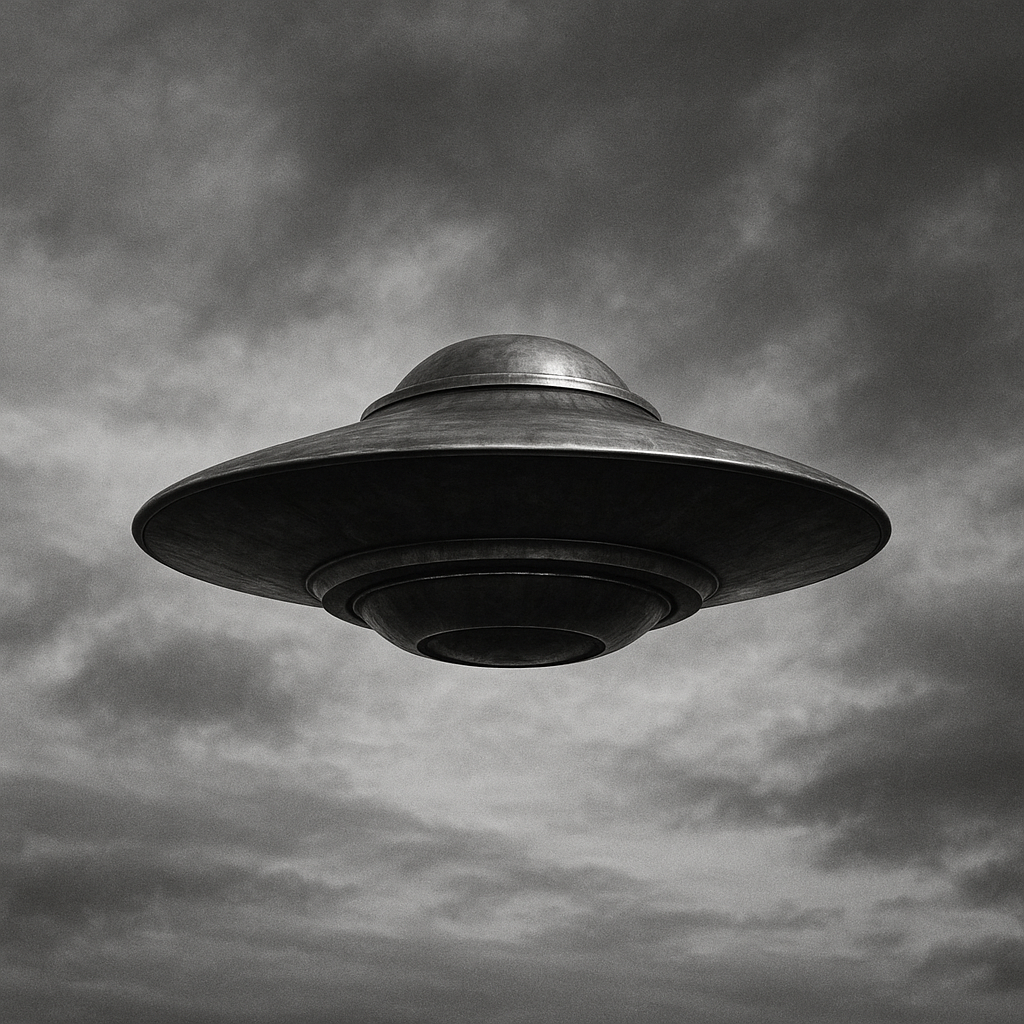

Between 1949 and 1957, tens of thousands of mysterious flashes appeared on the plates of the Palomar Observatory. Today, a new digital analysis – published in Nature and the Journal of the Astronomical Society of the Pacific – reopens the case: were they photographic emulsion errors or artificial objects in orbit before Sputnik?
There are times when science stumbles upon mysteries that resist any rational explanation. It is 1949: in the Californian desert, the Schmidt telescope at the Palomar Observatory captures images of the night sky that, decades later, will make astronomers all over the world debate. Small bright spots, thin lines, sudden flashes: phenomena that appear on one plate and disappear on the next. At the time, nobody paid too much attention. But today, with digital tools of artificial intelligence and image analysis, those photographs reveal something surprising.
Two recent studies, conducted by the international project VASCO (Vanishing & Appearing Sources during a Century of Observations), sifted through more than two thousand photographic plates dating back to the years before the space race. The results are astonishing: more than a hundred thousand transient light sources, some arranged in regular patterns, appeared in the skies well before the launch of Sputnik 1, mankind’s first artificial satellite.
What did the astronomers really photograph? And why does their frequency increase coinciding with nuclear tests and days when ‘unidentified aerial phenomena’ were reported?
It is a story that begins at the height of the Cold War, amidst the vapours of the dark chambers and the first space anxieties, and that today – thanks to the power of calculation and statistical analysis – forces us to look at the past with new eyes.
The sky above Mount Palomar
In the 1950s, astronomical photography experienced its golden age. At the Palomar Observatory in California, the Samuel Oschin Telescope – a 48-inch Schmidt reflector – takes thousands of long-exposure images of the sky.
The huge and delicate photographic plates are carefully archived: a wealth of observations covering almost a decade, between 1949 and 1958, which still represents one of the most comprehensive records of the pre-digital sky.
But something does not add up. In many of these plates, small bright spots appear that do not correspond to known stars or galaxies. Sometimes they form lines, other times they appear in groups of three or five, arranged almost geometrically against the background of the starry sky. When the same areas of the sky are photographed again, minutes or hours later, those objects are no longer there.
It is long thought to be defects in the photographic emulsion, specks of dust, or tiny imperfections in the developing process. After all, analogue photography is subject to a thousand tiny anomalies. But in 2021, a group of researchers led by Beatriz Villarroel of Stockholm University decided to systematically investigate the phenomenon.
The VASCO project and the mystery of the missing springs
The VASCO project was born with a simple objective: to compare the old astronomical plates of the Palomar Observatory Sky Survey with modern digital images of the sky. The idea is to identify objects that have appeared or disappeared over the decades – exploded stars, supernovas, but also lesser-known phenomena.
The team, consisting of astronomers, artificial intelligence experts and volunteer astrophiles, digitised and analysed more than 1,800 original plates. The results, published in Publications of the Astronomical Society of the Pacific and in Nature on 17 and 20 October this year, exceed all expectations: in dozens of images, clusters of bright spots – some arranged in almost perfectly straight lines – are found that do not correspond to any known celestial source.
The most striking case dates back to 12 July 1950: nine bright spots appear simultaneously in a single plate, spread over an area of about half a degree of sky. None of those dots are visible in the images taken a few minutes before or after.
The hypothesis of optical artefacts is quickly examined. But the regular arrangement, uniform brightness and spatial distribution leave doubt. If they were scratches or dust grains, they should not exhibit such precise symmetry.
UFOs, satellites or something else?
The VASCO project researchers never talk about UFOs so as not to arouse sensationalism, but the similarities with reports of the time are inevitable. Between 1949 and 1952, hundreds of sightings of unidentified flying objects were reported in the United States, many of them described as lights moving rapidly across the sky.
Yet, the first artificial satellites did not yet exist. Sputnik 1 was not launched until 1957, while the United States did not manage to put its first satellite – Explorer 1 – into orbit until the following year. If those lights had been satellites, they would therefore have appeared seven years before the official start of the space age.
Some scientists speculate that these are short-lived meteors, but the duration of the exposures – often 30 or 40 minutes – makes it unlikely that the phenomenon is repeated with the same shape and brightness on several plates.
Others suggest that they could be US military aircraft or experimental rockets, or simply sounding balloons with on-board monitoring instruments, launched from bases in the Nevada or New Mexico deserts to record atmospheric parameters during nuclear tests at the time.
There is no shortage of more speculative theories: reflections of suborbital rockets, sounding balloons, but there is no shortage of those who suggest that they are remnants of secret experiments conducted in the context of Project Mogul, the same one that allegedly fuelled the Roswell myth.
The digital eye on the past
To analyse this phenomenon, the VASCO team used machine learning algorithms trained to distinguish plate imperfections from real signals.
The use of artificial intelligence allows millions of pixels to be examined for statistical correlations invisible to the human eye.
In the course of the project, some researchers have even proposed using these same images to train automatic satellite recognition algorithms or to reconstruct the evolution of light and air pollution during the 20th century.
In a way, therefore, the mystery of the ‘missing points’ has generated a new form of research: no longer centred on the enigma itself, but on the use of historical archives as laboratories of artificial intelligence.
Within a few years, thousands of satellites and man-made debris would populate low orbit, making it almost impossible to distinguish what is natural from what is man-made.
The photographs of the Palomar Observatory therefore represent a unique window into the pre-space age, a snapshot of the ‘clean’ sky of that time. And because of this, they have become a valuable resource not only for astronomers, but also for historians of science, engineers and data scientists studying how the great analogue archives can still offer new discoveries.
When science meets mystery
The story of the ‘lights of Palomar’ reminds us that science does not advance in a straight line. All progress also stems from errors, anomalies and observations that are difficult to explain.
In the 1950s, astronomers simply recorded data without too many questions; today, the same data are re-examined with calculation tools that are thousands of times more powerful and force us to re-read the history of astronomy with new eyes.
It is possible that those flashes are simple photographic emulsion defects. But it is also possible that some of those lights happened to record the first artificial objects ever launched by man, military or technological experiments that remained secret for decades.
We will never know for sure, at least until archival documents emerge that can link those dates and coordinates with known human activities.
In the end, what remains is a broader reflection on the relationship between technology, memory and scientific knowledge.
The Palomar plates, designed to map the stars, turn out to be a multidimensional archive: they contain traces of our technological past, our fears and hopes during the Cold War.
And they also remind us how science, although based on data and method, is always influenced by the cultural context in which it operates.
In the post-war period, every mysterious light in the sky seemed like a potential signal ‘of them’: the Soviets or aliens, some more evil than others. Today, the same lights tell us how difficult it is to distinguish the real from the supposed, the objective from the interpreted – a lesson more relevant than ever, in the age of images generated by artificial intelligence.
An enigma that illuminates more than it conceals
We may never find out what really appeared on those plates at the Palomar Observatory between 1949 and 1957. But the real value of this story lies elsewhere: in the fact that science never stops questioning itself.
Every archive, every old photograph, every forgotten experiment can become – thanks to technology and human curiosity – a new frontier of knowledge.
And so, more than seventy years later, those little lights hanging in the dark tell us not so much about UFOs or cosmic mysteries, but about the human ability to look back in order to move forward.
A reminder that, even in the skies of the past, questions of the future can still lurk.