

















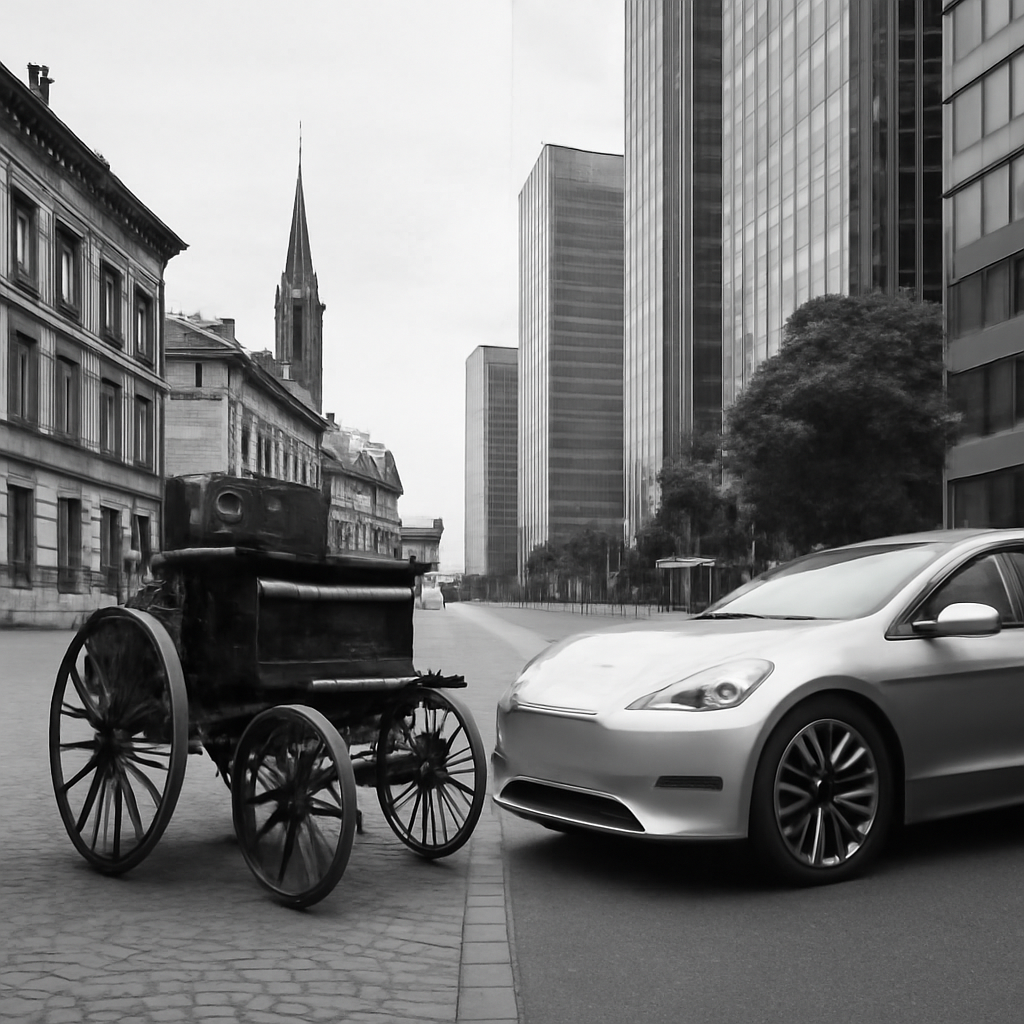

How it all started before the combustion engine, why today the electric revolution is not coming and we are still here talking about it
When we talk about electric cars, we always take it for granted that it is a recent technological innovation: for some it is a very cool (and very expensive, otherwise what status symbol would it be?) status symbol. But we all see it as a modern innovation to save the planet from global warming. Well, the reality is strikingly different: electric cars have been around for more than 100 years and, interestingly enough, came into being before petrol cars. You can take bets at the bar downstairs: before internal combustion engines made their roaring appearance, there were already people quietly driving around, just like that guy who just drove by in his shiny new EV.
The dawn of the electric car: who comes first?
The history of cars is largely linked to the evolution of batteries. These were quite rudimentary by today’s standards, but represented an incredible technological leap for the time.
In 1828, Ányos Jedlik, a Hungarian inventor, developed a rudimentary prototype electric motor; and a few years later, Robert Anderson, a Scottish inventor, designed the first vehicle powered by non-rechargeable batteries.
When the battery runs out, we don’t have to look for a charging station! It’s a nice advantage until it occurs to us that, if we want to start up again, we have to dismantle and throw away the spent battery in order to buy and install a new one.
The first real breakthrough came in 1859, when Gaston Planté, a French physicist, invented the lead-acid battery: the first rechargeable battery in history.
This uses lead plates immersed in a sulphuric acid solution, a system that allows for multiple charge cycles, storage of stored energy and discharge. Although rather heavy and bulky, the lead-acid battery became the basis for 19th century electric vehicles due to its ability to store and release energy in a controlled manner.
The end of the 19th century: the first real EVs
And so, in 1884, Thomas Parker, a British engineer, created one of the first working electric vehicles, powered precisely by lead-acid batteries. Although the range is limited and the speed is not exactly that of a Ferrari (think a slow walk rather than a race), the ability to recharge the battery makes these vehicles a promising alternative to horsepower or early petrol cars.
In 1890, William Morrison, a chemist from Des Moines, Iowa, built one of the first marketable electric cars. His vehicle, which can carry up to six people, reaches a speed of around 20 km/h, using a rechargeable lead-acid battery. This innovation marked the entry of electric cars onto the market due to their ease of use compared to the complicated combustion engines of the time.
The (brief) golden age for the electric car
Technology spreads rapidly, and in the early years of the 20th century, electric cars are preferred by big-city Americans over noisy, smoke-producing internal combustion engines. Well, let’s not forget that internal combustion engine technology is also only in its infancy. In addition, non-muscular drivers prefer these ancestors of our EVs because they do not require them to manoeuvre cumbersome levers to start petrol engines.
It is estimated that in 1900, about one third of all cars on the road in the US were electric. However, these early EVs still have major limitations: the range is short, the batteries are heavy, and the top speed is rather low. The dream of fast cars and long distances is still far away, but they are considered a perfect solution for city driving. Some brands, such as Columbia Electric and Baker Motor Vehicle Company, market models that become the status symbol of the American elite. Fossil-fuelled cars, meanwhile, suffer from several problems: besides the tiring and uncomfortable crank start, they are noisy and require hard-to-find fuels. Yes: there are no charging stations, but neither is there a service station every two blocks like a century later.
However, as we all know, the dominance of electric cars did not last long. The coup de grace came with the invention of the electric starter motor by Charles Kettering in 1912, which eliminated the need for the crank to start petrol cars. In short, it is a tiny electric motor that betrays the electric car…
Furthermore, in 1908 Henry Ford launched the famous Ford Model T, a combustion car mass-produced in a single model with no different accessories – a brilliant marketing idea that car manufacturers are only now trying to imitate – that cost much less than its electric competitors: less than half the price of a Detroit Electric. Electric cars end up being a luxury that few can afford.
The return of the electric car (with a few attempts gone wrong)
After the petrol and diesel car revolution, the electric car almost completely disappeared from the market for decades, but not without a few … comebacks. During the oil crisis of the 1970s, interest in alternatives to fossil fuels was revived. However, the batteries available at the time were inefficient and bulky – in fact, they were practically the same as in the previous century. The efforts of companies such as General Motors with the EV1 model in the 1990s are short-lived and, although acclaimed by some, fail to achieve the commercial success necessary to stay on the market.
The real renaissance of the electric car began in the new millennium. In 2008, a young company with the strange name of Tesla Motors, led by someone known as Elon Musk, launched the Tesla Roadster, an electric sports car capable of a range of 394 km on a single charge.
The Tesla Roadster not only redefined the image of the electric car – a dream sports car and no longer a slow and clunky vehicle – but also kick-started the electric revolution that we now see all over the world.
Today’s development and technological challenges
Today, almost all major automobile brands have launched electric models. Tesla, Nissan, BMW, Volkswagen, Stellantis and many others are pushing vehicles on the market with ever greater range, faster charging times and better performance. The Chinese market is literally exploding, not only with new electric cars but also with new electric car manufacturers.
In 2023, the penetration of electric cars continued to grow globally. According to the International Energy Agency (IEA), sales of electric vehicles account for about 14% of all new registrations worldwide, a significant increase from 9% in 2022. China dominates the market, followed by Europe and the United States.
These numbers show strong growth, driven by government incentives, improvements in battery technology and an increase in charging infrastructure. The penetration of electric vehicles in some countries, such as Norway, has reached record percentages: by 2023, more than 80 per cent of new Norwegian registrations will be electric. In Germany, the market share has also exceeded 20 per cent.
Despite a decline in the speed of growth, due to reasons we will see in a moment, a report by the International Energy Agency (IEA) predicts that global sales of electric cars will continue to rise in 2024, reaching a global market share of 18-20%, up from 14% in 2023.
The necessary charging stations are multiplying, but even here there is a challenge: fast charging is not yet widespread, and the time for a full charge varies from 30 minutes to 12 hours, depending on the available technology and infrastructure.
But how sustainable are they really?
We all agree that the electric car has the potential to drastically reduce greenhouse gas emissions. However, the issue of sustainability is not as simple as it might seem at first glance.
In use, electric cars emit noCO2: they don’t even have a tailpipe. But if one considers the entire life cycle – from production to scrapping – things get more complicated. Battery production, in particular, requires a significant amount of natural resources such as lithium, cobalt and nickel, the extraction of which can be devastating for the environment.
According to a study by the Massachusetts Institute of Technology (MIT), the production of an electric car generates between 15% and 68% moreCO2 emissions than a conventional car.
And let’s not forget batteries. The overall lifespan of today’s lithium-ion batteries varies between 10 and 15 years, but over time their capacity decreases more and more and their replacement and disposal present a problem. Technologies to efficiently recycle lithium-ion batteries are still being developed: at the moment, a large proportion of spent batteries end up in landfills, which has an environmental impact.
Moreover, the continuous improvement of on-board technologies – which require more and more frequent updates – accelerates the obsolescence of electric cars. A car that was considered state-of-the-art five years ago is now in danger of being overtaken by models with greater autonomy and more advanced autonomous driving technologies. This cycle of rapid obsolescence only increases the number of vehicles destined for disposal.
Electric cars: a promise to be perfected
The world’s leading research centres are developing projects to improve batteries. New technologies, such as solid-state batteries, could offer greater energy density, more range and a longer life cycle. In addition, the aim is to reduce the weight of batteries to improve the overall efficiency of the vehicle and reduce the environmental impact. However, we are still far from solving these problems on a large scale.
Electric cars are an essential part of a sustainable future, but they are not the panacea for all the planet’s ills. While they reduce emissions during use, their overall environmental impact is significant.
The industry must continue to innovate, reducing the ecological footprint of battery production, improving recharging infrastructure – even at home – and extending the life of vehicles. Only in this way can electric cars truly fulfil the promise of a greener, more sustainable future.