

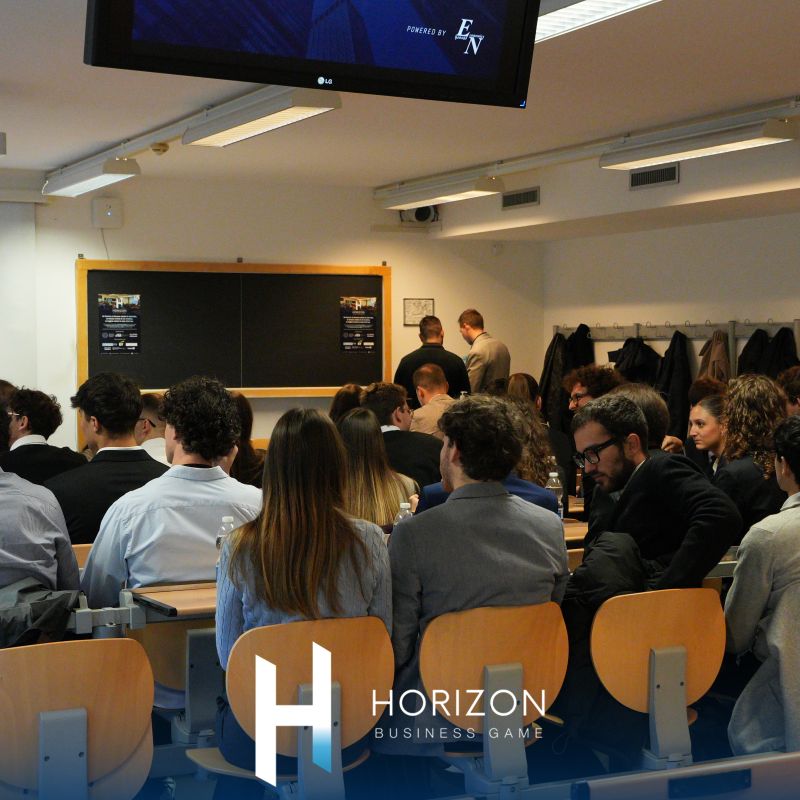


The “Horizon Business Game”, devised by the University of Padua’s Economics Network and realised with the support of the university and partners, in collaboration with the Foundation for Digital Sustainability’s Junior Fellows, makes its debut in Padua to connect education and work through real challenges.
A workshop combining academia and enterprise
The official debut in Padua of the “Horizon Business Game” project marks the start of a laboratory in which university meets enterprise without filters. Born from an idea of the student association Economics Network of the University of Padua, Horizon offers a two-month intensive course for 45 selected students, called to measure themselves against business challenges devised by three industrial partners: EY Italia, Stam Tech and Thera Capital. Since the kick-off on 18 October, the participants have been divided into multidisciplinary teams, each supported by a team mentor, with a clear objective: to work on authentic cases, bringing into the classroom the uncertainty, responsibility and rigour that characterise decision-making processes in organisations.
The chosen methodology is not just an exercise in style. It is an invitation to do, to take a managerial point of view, to set hypotheses, collect data, argue choices and defend them in front of demanding counterparts. The climate is avowedly immersive: challenges follow the pace of business, confrontation is continuous, feedback is an integral part of learning. Within this framework are experiences that broaden one’s outlook and consolidate transversal skills: a visit to LinkedIn’s Milan office to understand how professional languages evolve in digital platforms; workshops dedicated to artificial intelligence and digitisation processes to translate technologies into processes and impacts; methodological tutoring on the drafting of academic papers to bring order to objectives, sources, results and implications.
The project benefits from the support of the University of Padua and from the partnership of Next Leaders powered by Forbes Italia, LinkedIn Italia and Fondazione per la Sostenibilità Digitale (FSD), which have recognised its educational framework and its ability to generate public value beyond the confines of the campus.
The spirit of the initiative is encapsulated in its motto: ‘In Horizon you work like in a company, grow like in a master’s degree course and dream like in a start-up’. It is an ambitious promise, which will be measured at the end of December in the Pitch Final: the teams will present the results of their work to an academic-business jury and an interdepartmental technical-scientific committee, which will be called upon to assess its soundness, impact and vision.
Digital sustainability: the Foundation’s framework of meaning
Why should a business game ask about digital sustainability? The answer lies in the very nature of contemporary challenges. Digital sustainability, in the definition proposed by the Foundation for Digital Sustainability, is the ability to design and govern technological innovation in balance with people, the environment, rights and the competitiveness of economic systems. It is not a label to be affixed ex post, but a criterion of design quality, useful to discern what generates value over time from what merely shifts problems elsewhere.
In his opening keynote, Stefano Epifani offered an essential framework that guided the discussion of the entire day: ‘Digital sustainability is the balance between innovation, people, environment and rights: if we do not govern data responsibly, innovation does not create value. This is the trajectory that the Foundation promotes every day’.
It is in this key that the initiative takes on the profile of a ‘methodological gymnasium’: technical skills are trained together with the ability to assess social and environmental impacts, to reflect on the risks connected with the use of data, to imagine solutions where efficiency does not contradict the protection of rights. The partnership with the Foundation, in addition to giving scientific authority to the course, introduces in the teams the awareness that innovating also means negotiating trade-offs and declaring the criteria by which choices are judged.
Junior Fellows: ambassadors and weavers of dialogue
Within this design, a key role is played by the Foundation for Digital Sustainability’s Junior Fellows. Selected from among students and recent graduates, the Junior Fellows collaborate with the Foundation on a voluntary basis and act as ambassadors of the culture of digital sustainability in their respective universities and territories. Their presence in the project is not ornamental: it helps to hold together different languages and expectations, to build stable bridges between academia, institutions and businesses, to strengthen the quality of dialogue between actors who, while sharing objectives, often operate with different timeframes, metrics and priorities.
In Horizon, this role translates into cultural and relational support that helps teams to focus on the right questions, to give consistency to hypotheses, and to bring the discussion back to parameters of responsibility and the long term. It is a concrete way of living the values of the programme – proactivity, leadership, responsibility – making digital sustainability not a side issue, but a lens through which to read the entire learning process. The involvement of the Foundation for Digital Sustainability, in this sense, enhances the initiative’s capacity to generate legacies, leaving traces that survive the episodic dimension of the event.
Towards the Pitch Finale: a ‘workshop’ that looks far ahead
Horizon was conceived as a ‘workshop’, a place where one learns by standing next to those who do, observing and then trying, correcting, trying again. The Horizon Pitch Final at the end of December serves to keep the level of ambition high, but not to reduce the work to a showcase. What will remain, for the participants and the community around them, is the ability to formulate better questions, to recognise the implications of technological choices, to dialogue with companies and institutions on a more solid basis.
In this process, the voice of young people is not an ancillary element. When young people are called upon to plan, not just ‘participate’, the debate grows in quality. It is a perspective that reaffirms the value of responsibility as an ingredient of learning: being put in a position to influence, to make informed decisions, to be accountable.
The approaching final presentation is therefore not just a milestone. It is an opportunity to give back to the territory – to the University of Padua that supported the project, to the companies that proposed the challenges, to partners such as Next Leaders powered by Forbes Italia, LinkedIn Italia and the Foundation for Digital Sustainability itself – a result that has analytical depth and vision. If “working as in a company” means learning to keep quality, time and impact together, “growing as in a master’s degree” means refining method and language; “dreaming as in a start-up” means authorising oneself to think beyond the given constraints, while knowing how to measure each step.
In the coming weeks, teams consolidate analyses and recommendations, focus on implementation hypotheses, refine metrics and success criteria. It is not about promising miracles, but about building a responsible discourse on what is possible today and what, with conscious choices, becomes possible tomorrow. Here, digital sustainability comes in as a compass: a technology is sustainable when it empowers skills, protects rights, improves processes and produces measurable value over time. It is on this basis that the academic-business jury and the interdepartmental technical-scientific committee will assess the projects, inviting participants to clarify assumptions, demarcate risks, make trade-offs explicit.
Horizon Business Game is ultimately an alliance. Between students who demand responsibility and room for growth, lecturers who bet on the method, companies who accept the challenge of opening up real problems in training contexts, institutional partners who anchor the course to a long-term vision. If university education wants to live up to the times we live in, it needs places like this: where people learn by doing, discuss rigorously, make mistakes and improve, measure the impact and return it to the community.
The road to the Pitch Finale is a stretch of this journey. The greatest value, however, lies in the network of relationships, in the shared language that is built, in the habit of interrogating technologies with questions that hold efficiency and rights together. It is here that the alliance with the Foundation for Digital Sustainability shows all its usefulness: to remember that to innovate is to choose, and that to choose well requires method, responsibility and imagination. Tomorrow, when the stage lights go out, what will remain is the expertise of those who have learnt to see digital not as a shortcut, but as a means of designing the future.