







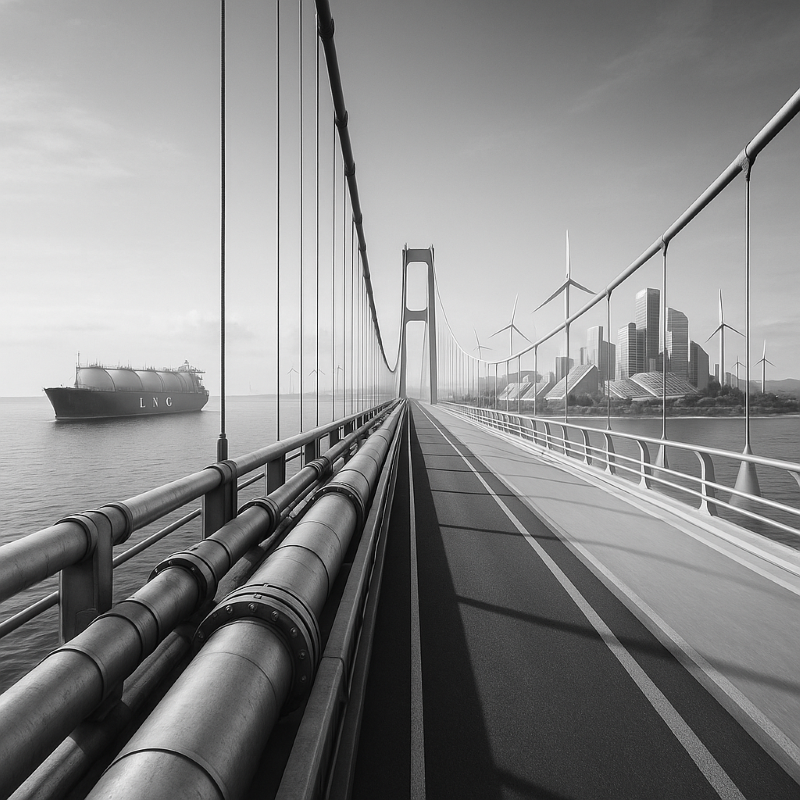

Natural gas is the third largest energy source in the world and, in Italy too, continues to play a key role, accounting for about one third of the national energy mix. It is a widely available resource – with more than 200 trillion cubic metres of global reserves against 4 trillion global annual consumption – and its ease of transport favours accessibility and security of supply. And this, together with its lower carbon footprint compared to other fossil fuels, explains its centrality, still relevant today, in the national energy system, even in a context of pushed energy transition: although, in fact, renewables are in strong expansion in Italy, their intermittent nature attributes to gas the role of the most suitable ‘backup’ source at our disposal, capable of flanking its growth and balancing and guaranteeing continuity and stability to the system. It is, therefore, what can be defined as a ‘bridge’ vector in the path of sustainable transition, which we cannot yet afford to give up: especially in the presence of technological solutions that today make it possible to further reduce its impact on the environment.
Help from innovation
Natural gas is mainly composed of methane, and its combustion generates about 50 per cent fewer emissions than coal. And if this makes it, compared to other fossil sources, ‘cleaner’, it does not mean that it is a zero-emission source: its combustion still releasesCO2, and methane itself, if dispersed in the atmosphere, is a potent greenhouse gas. And this is why, in order to reconcile its use with the achievement of long-term climate objectives, it is essential to continue investing in the development and dissemination of those solutions that, already today, make it possible to further reduce emissions linked to this source.
Among the most important – and whose effectiveness is reaffirmed by leading international organisations – areCO2 capture, utilisation and storage (CCUS) solutions, which are already available today for the decarbonisation of, in particular, the so-called hard-to-abate sectors. In short, these technologies make it possible to intercept theCO2 produced by gas combustion and then reuse it in industrial processes or store it in a stable form underground, thus preventing its release into the atmosphere. Italy is already taking important steps in this field, especially with the Ravenna CCS project: the first project for the capture, transport and permanent storage ofCO2 in our country, the result of the joint venture between Eni and Snam. In phase 1 of the project, which began in September 2024, the goal is to capture, transport and store 25,000 tonnes per year ofCO2 from the emissions of Eni’s natural gas treatment plant in Casalborsetti; with phase 2, scheduled to start up by 2030, the storage capacity will gradually increase, and Ravenna CCS will be able to take on the role of reference hub for Southern Europe and the Mediterranean. The project, among the most ambitious in Europe, demonstrates how the gas vector can continue to be used – while waiting for the emergence of more sustainable sources – while still moving towards the achievement of climate objectives: thus underlining the strategic role of innovation in supporting the complex path of energy transition.
Security of supply: the role of LNG
Security of supply is also a central issue when it comes to natural gas. Especially for a country like Italy, where domestic production is barely 5% and which is traditionally dependent on a few international gas pipelines.
In this context, it is LNG (Liquefied Natural Gas) that represents a strategic diversification tool: through the liquefaction process, which reduces the specific volume of gas by about 600 times compared to standard conditions, it is possible to transport, by sea with LNG carriers, large quantities of energy in very small spaces.
This type of transport offers far greater flexibility, allowing gas to be imported from distant geographical suppliers – not connected to Italy by pipelines – and thus greatly increasing the range of possible supplies. In other words, a hydrocarbon with an almost exclusively local or regional market – depending on the presence of pipelines connecting place of production and place of consumption – thus becomes a carrier potentially available worldwide.
Active in this area is Eni, which through its subsidiary LNG Shipping Eni S.p.A. coordinates the transport of LNG by means of a fleet of vessels chartered for varying periods of time: this direct control over transport allows the company to help guarantee gas supplies that adapt quickly to market opportunities and fluctuations in demand, both on the Italian domestic market and on the main global hubs. But that’s not all: the company has also entered into important international partnerships aimed at developing and disseminating this solution. Among these is the one with YPF, Argentina’s leading energy company, for the development of the Argentina LNG project (ARGLNG): the integrated, large-scale gas development project aimed at developing the resources of the ‘Vaca Muerta’ onshore field and serving international markets, exporting – in several independent phases – up to 30 million tonnes per year of LNG by 2030.
In short, because of its lower overall impact, as well as its versatility and security of supply, natural gas represents not only a ‘bridge’ vector to a renewable future, but also a backbone of national energy security in the present. The key, once again, is to invest in innovation: it is in this way that the use of this source can become more sustainable, consciously accompanying the crucial path of energy transition.
