

















The discovery, the scam, and the final twist
It is 1971. While Richard Nixon and Nikita Khrushchev exchange fierce accusations and the Cold War reaches its climax, a discovery worthy of an adventure film is made in the heart of the Philippines. An unknown tribe, the last on Earth, lives completely isolated from the rest of the world. No contact with civilisation, primitive clothing, rudimentary tools: at a time when the media crave light stories to be carried on the front page or the screen, the Tasaday ‘s discovery becomes sensational news. A mystery, a tribe still in the Stone Age, finally encountered by one lucky man, Dafal, a semi-nomadic trapper who, thanks to a chance encounter, learns about this group of humans who have thrived for centuries doing without modernity. But, as is often the case, appearances can be deceiving, and the truth, as always, reveals itself in ways no one expects.
The initial twist: a mysterious tribe
The Philippine government – led by the notorious despot Marcos – receives the news from Dafal and sends Manuel Elizalde Jr., government representative for ethnic minorities, to make contact with this mysterious tribe. Elizalde is stunned by the discovery and the entire scientific and journalistic world jumps on it: today we would say that the news goes viral, but back then personal computers did not even exist… In the absence of the internet, it is newspapers and TV that make the Tasadays famous.
While American conscripts slaughter civilians and are massacred in Vietnam, a tribe of hunter-gatherers, unknown to any anthropologist, live in peace and do not even know the most common tools. The emotional ingredients to turn the Tasadays into real stars are all there: the myth of the ‘good savage’, the exotic fascination of nature untouched by civilisation, of life in the open air, far from pollution, stress and war.
The suspect: doubts and inconsistencies
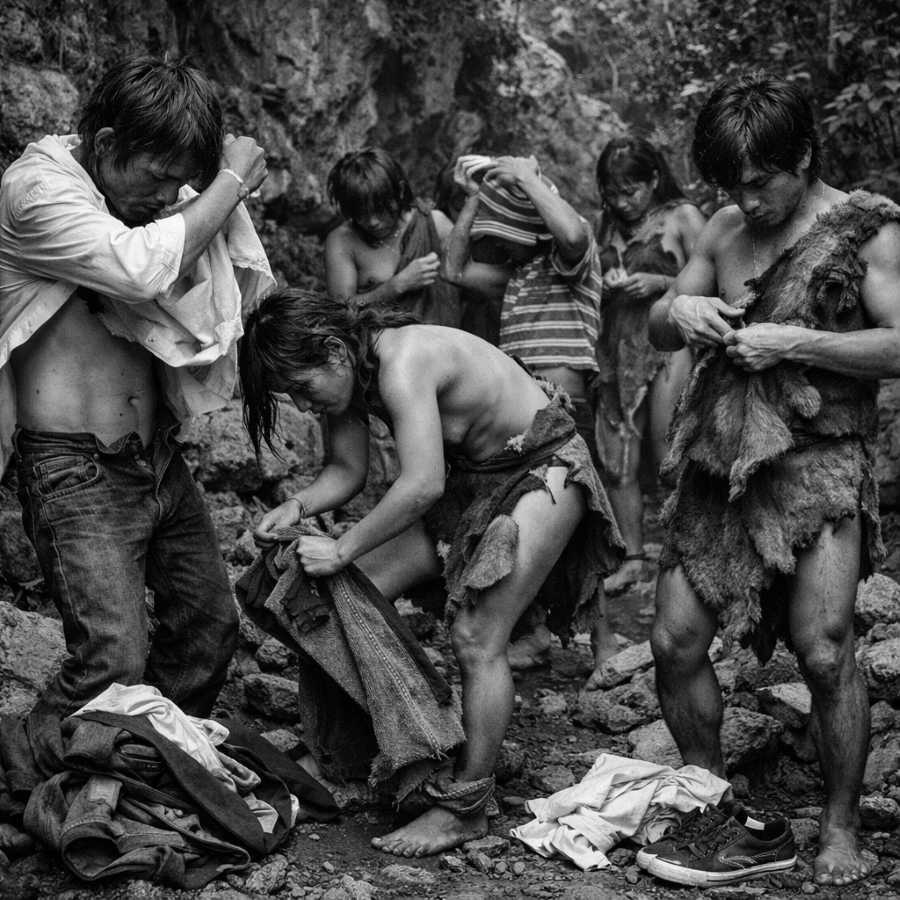
Things, however, are not always as they seem. Years later, the truth begins to emerge, albeit slowly. During a news report by the Swiss Oswald Iten and the American Judith Moses, the Tasadays are caught changing quickly, taking off modern clothes to cover themselves with a few rags of leather in the style of ‘The Flintstones’. Cameras capture them as they rush to pose for photos, pretending to live like savages. All, of course, under the watchful eye of Elizalde. But the biggest surprise comes when some of the tribe members reveal that they have been paid, since 1971, to play the part of savages. The truth begins to emerge, and an unexpected thought arises: what appeared to be a momentous scientific discovery appears, in reality, to be an elaborate hoax.
The investigation and the (first) revelation
In 1988, the International Congress of Anthropology and Ethnological Sciences in Zagreb marked the point of no return. Scientists and researchers begin to put the pieces of the puzzle together and take apart the Tasaday story piece by piece. The tribe lives only three hours’ walk from the local farming communities, yet no one seems to know of their existence. The caves they shelter in, totally devoid of signs of daily life such as rubbish or tools, look suspiciously like a Hollywood set. They are a hunter-gatherer tribe, but they did not even invent containers to transport nature’s gifts to their camps. They are hunters but do not have any kind of hunting technique or weapons: they only use their hands. Why is it that, in the rest of the world, no known indigenous culture lives under these conditions?
The accusations: a low blow for science
Gerald Berreman, one of the anthropologists who has always had doubts about the tribe’s authenticity, provides a lucid and devastating analysis. According to him, the whole story of the Tasaday was packaged ad hoc, just like a play designed to feed the Western obsession with primitive purity. In fact, the con was built precisely on this idealised vision of the ‘good savage’, a concept that had a hold on much of public opinion at the time. The most shocking revelation, however, is that the tribe was never really isolated: the Tasaday interacted with other tribes in the area, such as the Blit Manobo and the T’boli, whose knowledge shaped their lives and is found in their oral traditions.
Language and glottochronology: the decisive test
A further element that makes the whole matter even more complicated is the language of the Tasaday. Some linguists had initially argued that the language spoken by the tribe was completely unique and not traceable to any local language. However, as time passes, glottochronology (the discipline that measures the time of separation between living languages based on linguistic changes) reveals a startling reality. The language of the Tasaday is not an isolated idiom, but a dialect of Cotabato Manobo, a language spoken by other groups in the region. Linguist Lawrence Reid, one of the protagonists of these discoveries, shows that the Tasaday dialect is related to that language, but only separated from it about 150 years before the tribe’s ‘discovery’. This lent weight to the theory that the Tasaday were never as isolated as had been rumoured, but underwent separation due to historical events, such as slavery or war.
The end of the myth
As new details emerge, the truth about the Tasaday becomes clearer and clearer. It turns out that the tribe, far from being isolated, routinely interacted with neighbouring tribes, trading, perhaps out of necessity and to defend themselves against external threats. While Tarzan-inspired films go wild at the cinema, the Tasaday legend, so dear to fans of primitive life, is taken apart piece by piece. The members of the tribe, who had lent themselves to the game, become the very victims of a deception they had not chosen. Some retract their statements, claiming that they were paid in … cigarettes … and induced to tell a story that was never theirs. And they do so in exchange for new supplies of … cigarettes.
Case closed? Not by a long shot.
According to Robin Hemley, professor of English (not anthropology) at the University of Utah and author of Invented Eden. The Elusive, Disputed History of the Tasaday (Farrar, Straus and Giroux, 2003, now reprinted), the truth about this history is far from simple. Hemley’s thesis – which is not his alone, but shared by a small and determined group of anthropologists and linguists – argues that the real scam is not that of the Tasaday, but rather that of the ‘discovery’, in 1986, of the alleged scam.
According to Hemley, the political atmosphere of the time, which associated every affair related to the Marcos regime with something ‘dirty’ and ‘evil’ (which Hemley does not minimise), created the ideal context for a narrative based on ideological political theses and unverified testimonies, such as those of communist militant Joey Lozano. Lozano, who allegedly recruited ‘witnesses’ to confirm the alleged scandal, would later admit that many of them were paid to lie and debunk the hoax… with more lies.
Hemley, however, not only interviewed the Tasaday, but also provides convincing arguments to show that the idea that they are members of other tribes, hired by Elizalde as ‘actors’ to play the part of the isolated tribe, is untenable. The Tasaday language, for example, exists and was recorded on cassette tapes as early as the 1970s. Its richness and internal consistency shows that teaching it in a few months, not only to adults but also to the tribe’s children, would have been virtually impossible.
This is not to say that Elizalde and some enthusiastic anthropologists did not exaggerate the importance of the 1971 discovery or that there were no errors of judgement. Today, with the new Philippine democratic government officially recognising the existence of the Tasaday and rejecting the idea of fraud, anthropological research seems to be moving towards a new hypothesis. The Tasaday would not be a very ancient group ‘left behind’ in the Stone Age and living in caves, but a sub-tribe that, due to a devastating epidemic, isolated itself in the forest and lost knowledge of agriculture and metals. The regression to a savage state probably dates back no more than a couple of centuries.
Lévi-Strauss would have spoken of a ‘pseudo-archaic’ group. And although this approach reflects the theory that ‘savages’ were never peoples in a paradisiacal ‘state of nature’, but groups that degenerated from a state of civilisation, it is certain that this view would not find favour with some ‘politically correct’ anthropologists today. These, on the contrary, have been confronted not only with an imbroglio, but also with a contradiction between their ideology and the reality of a complex culture that has evolved in a totally unforeseen way.
An inconvenient truth: deception or necessity?
The Tasaday story is an emblematic case of how science can be distorted by ideological motivations or, even worse, personal interests. While the discovery of the Tasadays represented an important moment of ‘exploration’ for the media and popular culture, it also revealed how easily the truth can be manipulated, in the name of an image that fits certain collective desires. The hoax – or the alleged hoax – or, let’s say, the heavily embellished discovery – orchestrated by Elizalde had devastating impacts; not only on those who believed in the existence of an ‘intact’ tribe uncontaminated by modernity, but also on the serious work of anthropologists and scientists, who for years found themselves defending a reality that did not exist or – on the contrary – disproving it based on evidence and testimonies that later turned out to be false.
In a world where truth can be manipulated through deception, the Tasadays teach us an important lesson. Science and research must always be based on rigorous methods and an unwavering commitment to transparency. Yet, it is hard not to wonder: what would have happened if it had not been for the courage of those who questioned the ‘official story’? And what would have happened if the latter counter-narrative had not also been subjected to equally rigorous ‘fact-checking‘, as we call it today?
Perhaps, the truth of the Tasadays would have remained buried, just like so many other scientific hoaxes in our history. Today, we can only hope that, with the right method and critical spirit, we can uncover the most hidden truths, even when reality hides behind the illusion of perfection and even when it is fact checking itself that is …anything but rigorous and impartial.