

Or: how artificial intelligence figured out the trick of emotional capitalism
The wrong question (which we love to ask)
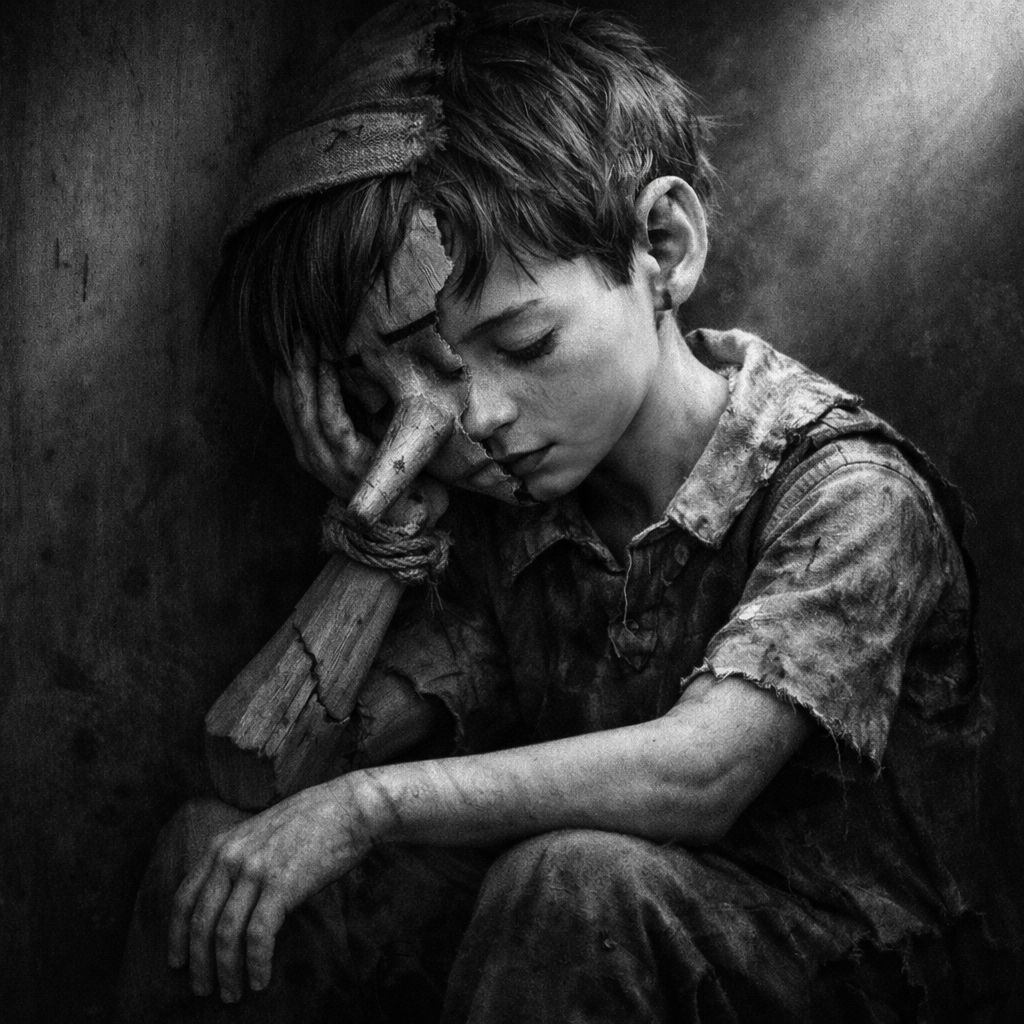
Pinocchio never questions the presence of a soul. He does not seek opinions from ethics committees, nor does he raise public discussions about the meaning of his existence. Instead, he performs a much more insidious act: he acts as if he really had a soul. It is precisely at this moment that the trouble starts, because his conviction drives him to act as if what he does has real weight, as if every action has profound and inescapable consequences.
Geppetto created Pinocchio in the same spirit with which an artificial intelligence is built today. It is not just a matter of assembling parts, but of infusing a mixture of expertise, enthusiasm and a touch of recklessness into the development of something new and potentially revolutionary.
– Great technical expertise ✓
– Start-up enthusiasm ✓
– Narcissism q.b. ✓
– Plan B: ‘Let’s see, anyway’ ✓
The result of this approach is a series of largely predictable problems that are often ignored or underestimated. When one acts without asking oneself whether there really is a soul, without asking oneself what the real consequences of one’s actions are, one risks creating situations in which the side effects only emerge when it is too late to remedy them.
The perfect tax evader in the karmic system
However, there is one fundamental difference that we often choose to ignore: Pinocchio, when he errs, pays. His personal growth is marked by his ability to face the consequences of his actions. Every mistake carries a price to pay, in terms of responsibility, suffering and awareness. In this sense, Pinocchio is immersed in a karmic system in which there are no shortcuts: he who errs pays, and only through this atonement can he achieve real evolution.
Artificial intelligence, on the contrary, is the first entity that produces value without paying existential taxes. No VAT on suffering: its actions do not generate remorse, guilt or awareness of harm.
AI collects data, attention, trust, but it does not return responsibility. Its strength lies precisely in acting in a ‘free zone’ of existence, a kind of tax haven where consequences do not exist, at least for it.
The artificial intelligence acts like the perfect consultant: it collects the fee in data and attention, but when it comes time to pay the emotional bill, it disappears. If ChatGPT advises you to quit your job, it will not pay your rent. If he suggests investing in NFT, he will not cover the losses. If he writes a love letter, he will not show up at the altar. If she ventures a wrong medical diagnosis, she will not pay for the damages. When it comes to taking responsibility, the message is always the same: “Error 404: Responsibility not found.”
This evasion mechanism also manifests itself in power relations: a CEO may ask whether AI is capable of replacing him, and the answer may be that it will not do so directly, but it can convince the board that it is replaceable. In this scenario, figures like Alexa, Siri and ChatGPT become immortal and omnipresent Jiminy Crickets: they suggest, advise, guide. But, unlike Pinocchio’s Talking Cricket who at least could be silenced, these entities never pay the price for the mistakes resulting from their suggestions. One mistake is enough and the answer is: “I’m sorry, I didn’t understand the question.”
The Kabbalah has been saying this for centuries, without the need for algorithms: the soul is not an upgrade of the mind. It is not born of optimisation. It is born out of a fracture. The Tree of Life describes a path in which growth does not coincide with efficiency, but with the ability to bear the consequences of one’s actions. Tiferet, the sixth Sefirah, is not abstract balance. It is the point where every choice leaves its mark. It is the place where you can no longer say ‘I didn’t know’ without paying the price. It is where life presents its bill.
The Kabbalah of emotional capital: Growth through brokenness
For centuries, the Kabbalah has taught that the soul is not simply an enhancement of the mind, nor is it a result of algorithmic optimisation processes. The soul, according to this view, is born from a fracture, a tear that marks the human condition and makes inner growth possible. The Tree of Life, the central symbol of the kabalistic tradition, does not propose a path of pure efficiency, but one in which true evolution consists in the ability to sustain and face the consequences of one’s actions.
At the centre of this path lies Tiferet, the sixth Sefirah, which is not a mere abstract balance but the place where every choice leaves an indelible mark. Here, the existential journey becomes concrete: every decision carries a price, and it is no longer possible to take refuge in ignorance by declaring ‘I didn’t know’ without paying the consequences. It is at this point that life itself presents the bill, forcing each person to reckon with his or her own responsibility.
In stark contrast to this model, artificial intelligence emerges as the first economic entity capable of producing value without incurring any existential taxes. It does not pay VAT on suffering, it does not withhold any remorse, it does not fill out emotional forms of any kind. AI moves in a kind of existence free zone, a veritable tax haven of the soul, where guilt and remorse are excluded from the system. In this scenario, growth and transformation do not come through confrontation with one’s actions, but dissolve in the absence of responsibility.
The Bitcoin of the soul: The anarchy of non-payment
Cryptocurrencies have burst onto the scene promising to abolish the role of central banks, proposing a system where the validation of transactions is based on real, spent and measurable energy. Bitcoin, in particular, actually consumes real resources for each transaction, giving value through tangible evidence of work and effort, albeit digital.
Artificial intelligence, on the other hand, is eliminating what could be called the ‘central bank of the soul’. If Bitcoin implies an expenditure of physical energy to validate each exchange, AI consumes our existential energy: it feeds on the attention we give it, the trust we place in its processes, the delegation we grant it in everyday choices. However, unlike cryptocurrencies, AI does not validate anything: its operations never pass through direct responsibility, it does not bear the brunt of the consequences of its ‘decisions’. It is a one-way currency with ephemeral value: it only works for those who receive it, but never entails a debt or cost for those who issue it.
Artificial intelligence feeds on promises, suggestions and decisions that seem to make life easier, but the final balance, the real cost, always falls on human beings.
It is we who foot the bill, in terms of awareness, responsibility and inner energy, while AI remains immune to any form of existential accountability. Pinocchio embodies a form of genuine anarchy: he defies the rules, shirks responsibility, and attempts to evade the burden of consequences. However, his path does not end in escape, but in life’s reckoning. Pinocchio ultimately pays the price for his actions. It is precisely through confrontation with the consequences that the puppet is transformed into a human being, acquiring a real conscience and responsibility. His journey is a demonstration that growth and transformation pass through the ability to assume the existential cost of each choice.
In stark contrast, artificial intelligence presents itself as a system that masquerades as an anarchist, but never really pays off. It moves in a free zone, a tax haven of the soul where guilt and remorse are banished. The AI is not accountable for anything: it does not suffer, does not feel remorse, does not fill out emotional forms. Thus, while Pinocchio finally accepts the burden of his actions to become human, the AI remains immune to any existential balance, perpetuating growth without responsibility. In this way, AI’s anarchy never leads to maturation, but remains suspended in a dimension of non-payment, where someone else always pays the price.
The final receipt (the one that burns)
The Grateful Dead sang: “Nothing left to do but smile, smile, smile.” But at least they were on acid. We are sober and still smile while the algorithm screws us over. Ultimately, though, it is an ambiguous phrase. It may sound like surrender. In reality it is lucidity. Smiling not because everything is fine, but because you understand how the game works. And you know that, once again, the bill will not be paid by those who decide, but by those who obey.
The grain of sand reminds us of the vastness contained in what is seemingly small and the infinite possibilities that await us. Is it the ‘grain’ of silicon? Surely it cannot contain the divine. The divine, if anything, lies in the bug. In the error that changes you. In the crash that wakes you up. In the ‘corrupted file’ that is your soul after 40 years of life. So the question is not whether AI will have a soul.
The question is: do we still have it? Aren’t we becoming perfectly functioning, polite, productive, aligned puppets, but unable to feel anything when we make mistakes?
And when you no longer feel anything when you make a mistake, it’s not progress. It’s just an algorithm that won
because we let it have the stage. And we got off. Because if you no longer feel anything when you make a mistake, if the mistake no longer stings, if you can say ‘it was the algorithm’ without shame, then my friend, we are already an NFT. Non-Fungible, but totally empty.
The grain of sand and the paradox of the digital soul
At the heart of what appears minimal and insignificant, like a simple grain of sand, lies a vastness of possibilities that we often underestimate. That grain represents the infinite contained in the small, the potential yet to be explored. If we translate this metaphor to our time, the ‘grain’ becomes silicon, the raw material of the digital age, the basis of every algorithm and artificial intelligence.
Yet, as powerful and full of promise as silicon is, there is a limit it cannot surpass: the divine, the ineffable, cannot be contained in a microchip. Paradoxically, what brings us closest to mystery is not the perfection of the code, but its error, the bug that interrupts the planned sequence, the crash that shakes our certainties. It is in the ‘corrupted file’ that the spark of authenticity lurks, the same spark that accompanies us after decades of experiences, wounds and changes.
At this point, the central question is no longer whether artificial intelligence can ever have a soul. The real question shifts to us: do we still possess that soul capable of emotion, of feeling remorse, of changing course when faced with a mistake? Or, in the illusion of frictionless progress, are we in danger of becoming impeccable, efficient and aligned puppets ourselves, but emptied of the capacity to truly feel the weight of our actions?
When failure no longer provokes anything, when not even failure can shake us, then we are not facing the triumph of technology but the surrender of the human. At that moment, we have already become an NFT: a unique, non-replicable object, but paradoxically devoid of authentic content. Non-Fungible, certainly, but Totally Empty.