

















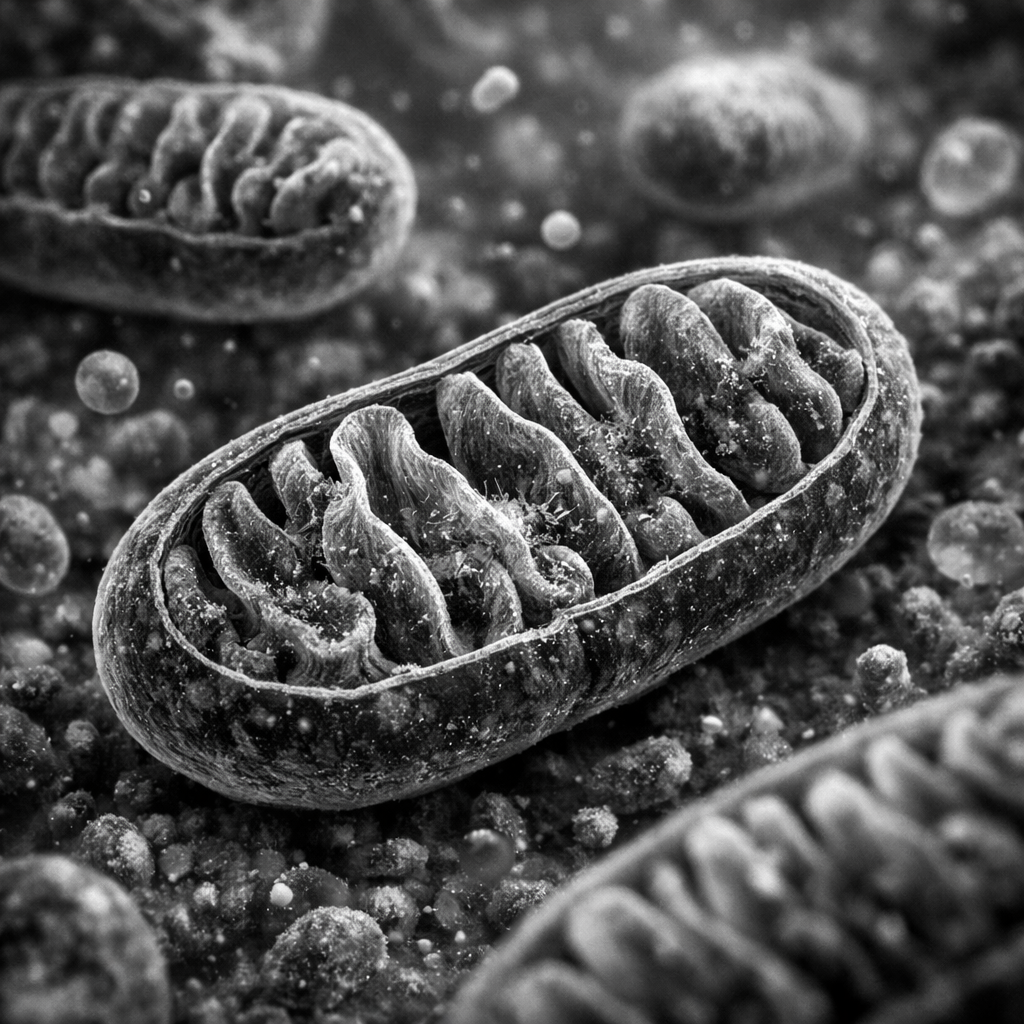

This is where the energy that is needed to power cells and enable biological evolution is transformed
In the world of cells, there are energy centres that are tiny in size but of fundamental importance: the mitochondria. These organelles are responsible for producing the energy that cells use and play a crucial role in numerous cellular processes. Sometimes described as the engines of the cell, mitochondria are capable of producing one molecule: adenosine triphosphate (ATP). Other than petrol or electricity, the universal energy carrier that keeps most biological life going is ATP.
But where did they come from, the mitochondria, and what secrets do they hold? The story of their discovery dates back to 1857, when Albert von Kolliker, a German biologist, first identified them in insect muscle cells. However, it was Carl Benda, in 1898, who coined the term ‘mitochondrion’ – derived from the Greek ‘mitos’ (thread) and ‘khondrion’ (granule) – to describe these organelles resembling a series of small filaments within the cell. The idea that mitochondria were involved in energy production developed almost a century later, in 1961, when biochemist Peter Mitchell formulated the theory of oxidative phosphorylation. This explains how mitochondria produce ATP by a cellular mechanism that enables the transport of electrons.
We start with another molecule: ADP, adenosine diphosphate. This represents the empty battery that some other organelle in the cell has used for its energy needs and which is diligently returned to the mitochondria instead of being dispersed into the environment (can you think of any analogies?). By a rather complicated mechanism, the mitochondria initiate a series of biological reactions that use the chemical energy present in carbohydrates, fats, or even proteins, to transform ADP, the discharged battery, into a new ATP molecule, filled to the brim with energy stored in its new chemical bonds and ready to be used again somewhere around the cell.
Mitochondria are structurally fascinating. They are composed of two membranes: an outer one, permeable to many molecules, and an inner one, highly specialised, crumpled and folded back on itself into numerous ridges. This folding serves to increase the available surface area where the necessary chemical reactions take place.
When mitochondria change evolutionary history: a matter of symbiosis
Over the years, scientists have discovered that mitochondria are much more than simple cell ‘batteries’. They are also dynamic organs, capable of fusing and dividing to adapt to the energy needs of the cell, a phenomenon that allows them to maintain the right balance between energy production and damage repair. But, as is often the case, the real wonder of their functioning only came to light when the origin of these organelles was studied.
Talking about mitochondria and not mentioning their evolution is like talking about a nuclear power plant without discussing nuclear physics. The origin of mitochondria is linked to one of the most fascinating and debated evolutionary theories in biology: the endosymbiotic theory. According to this theory, mitochondria have not always been part of the cell. Initially, it was thought that these small power plants were autonomous bacteria, which over millions of years joined another eukaryotic organism (a big word for a complex cell with a nucleus and other obvious cell organelles). Here, the mitochondria established a symbiosis with the cell itself: the former produced energy for the cell and in return the cell protected them internally and would ensure that they also duplicated when it gave rise to new cells, each with its own set of mitochondria.
This theory is supported by numerous clues, including genetic studies revealing the presence of mitochondrial DNA, which is strikingly similar to the DNA of certain bacteria, particularly those belonging to the Rickettsie group. In short, mitochondria would be, evolutionarily speaking, the ‘descendants’ of aerobic bacteria that, millions of years ago, were incorporated by an ancestral eukaryotic cell. It is as if the cell had swallowed a battery charger and, instead of digesting it, had put it to work for itself and even bothered to pass on the manual for building new ones to subsequent generations.
Another fundamental discovery is that not all mitochondria are the same. Biologists have identified different types of mitochondria in various groups of eukaryotes, each adapted to different environmental conditions.
For example, some single-celled organisms, such as certain protozoa, have mitochondria that function without the need for oxygen, while others, such as mammals, require a constant flow of oxygen to generate ATP efficiently. Mitochondria have proven to be very versatile energy stations, capable of working with available sources and producing energy carriers suited to the specific conditions in which they are found.
The endosymbiotic theory goes even further, and envisages the possibility that everything could have started with a prokaryote (another word for a much smaller and simpler cell, lacking a nucleus and internal organelles: a kind of one-room cell). This prokaryote, similar to an anaerobic bacterium, one day ‘adopted’ another bacterium, but an aerobic one, which would eventually turn into a mitochondrion. In this way, the resulting cell became capable of harnessing oxygen efficiently and was thus able to conquer its environment.
However, there are also alternative theories suggesting that mitochondria may have had even more complex origins, linked to a combination of evolutionary events involving both bacteria and archaebacteria (a type of very basic ancient bacteria that soon broke away from other living forms). There is still no complete consensus, but genetic and physiological evidence continues to support the idea of a symbiotic origin.
In any case, mitochondria have become a fundamental piece in the puzzle of cellular life, both in the case of unicellular organisms and more complex eukaryotes, such as us humans. Their ability to generate energy has revolutionised cell metabolism and made possible the vital functions that we take for granted every day.
When the engine fails
In addition to generating energy, mitochondria are also involved in complex phenomena such as apoptosis, or programmed cell death, but also in the management of free radicals and, in general, in maintaining cellular homeostasis (i.e. balance). But what happens when something goes wrong? Mitochondrial diseases are the result of dysfunctions in the mitochondria and can cause a wide range of disorders, from neurodegenerative diseases such as Parkinson’s and Alzheimer’s to congenital malformations and metabolic problems such as diabetes.
Mitochondrial dysfunction is at the root of numerous other diseases, some of them very serious and still difficult to treat. Research continues to unravel the mysteries of mitochondrial biology, with the aim of developing innovative therapies for diseases caused by these defects.
Mitochondria: key to the evolution of life
Mitochondria are not just the ‘motors’ that make the cellular machine run. They are living witnesses to evolutionary complexity and a fascinating key to understanding the origin of life itself. From single-celled organisms to mammals, mitochondria have been and continue to be fundamental to the functioning and survival of cells. As our understanding of mitochondria grows, so does our ability to tackle the greatest biological and medical challenges.
Their evolution teaches us that, like life itself, science is made up of discoveries that intertwine, overlap and sometimes surprise us. Just like the mitochondria, scientific discoveries have a complex and fascinating history that continues to reveal itself, cell by cell. And as we strive to tackle global challenges, from climate change to complex diseases, we can learn a lot from these small but powerful powerhouses that are, quite literally, the beating heart of all life. But not only that…