




Strategic alliances, ethics and technology serving the planet
In the grand narrative of the Sustainable Development Goals, SDG 17 (Partnership for the Goals ) is the thread that holds all the others together. It is the goal that does not achieve itself, but enables all others. It is the goal of alliances, of outstretched hands, of shared visions. And when we talk about digital sustainability, it becomes even more crucial: no organisation, no technology, no policy can tackle the complexity of a fair, inclusive and responsible digital transition on its own.
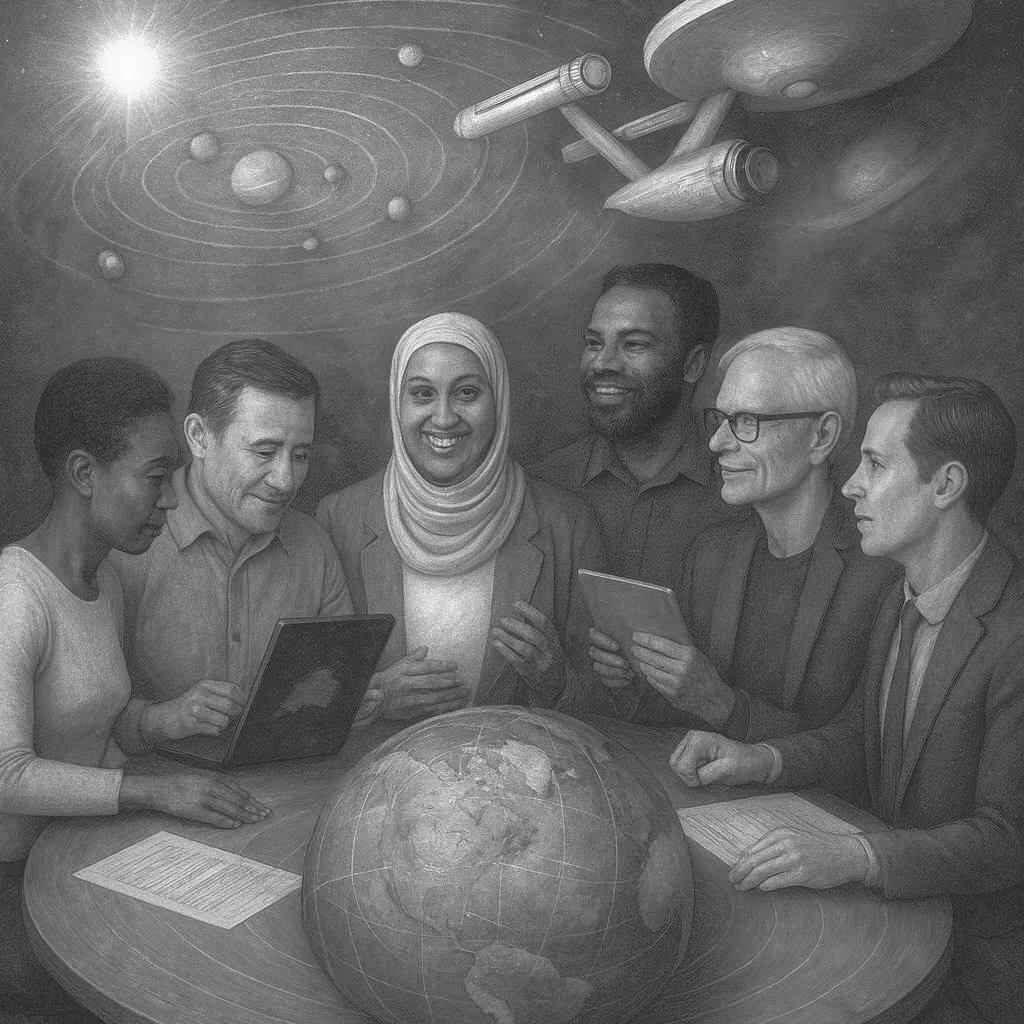
To describe this challenge, we rely on a powerful image: the crew of the Enterprise in Star Trek. A heterogeneous, interdependent group, united by a common mission – to explore new worlds, but always in accordance with shared values. Just as businesses, public administrations, foundations and citizens should do in building a sustainable digital future.
The shared course of digital sustainability
Digital sustainability is not just a matter of codes and servers. It is a systemic vision that intertwines innovation, ethics, inclusion and environmental impact. It means designing technologies that do not exclude, that do not consume resources unsustainably, that do not amplify inequalities. And to do so requires alliances: between those who develop, those who regulate, those who use, those who observe.
As on the Enterprise, a cockpit is needed where every role is essential. The captain (strategic vision), the first officer (analysis and logic), the communications officer (empathy and language), the ship’s doctor (care and well-being). Translated into the real world: CEOs, CIOs, ESG experts, designers, policy makers, activists. No one can sail alone.
SDG 17: Alliances for the future, where are we today?
SDG 17 invites us to build bridges: between sectors, between territories, between competences. In the area of digital sustainability, this means co-designing shared measurement tools, promoting inclusive digital literacy, developing interoperable and transparent platforms. It also means recognising that trust – between partners, between users, between stakeholders – is the fuel of transformation.
Effective partnerships are not just contracts: they are alliances of values. And as in the Star Trek universe, respect for diversity, mutual curiosity and the ability to listen are what make coexistence and co-evolution possible.
In 2023, the European Union mobilised some EUR 126.4 billion in funding for developing countries. An important figure, certainly, but one that does not mark a real leap compared to the previous decade. A sign that partnerships – including financial ones – must be strengthened, made more strategic, more courageous
On the connectivity front, the ‘Internet Users’ indicator is the only one among the 21 in SDG 17 that is in line with the 2030 targets. But the digital double speed between urban and rural areas, between North and South, remains an obstacle. In 24 countries, the UN has implemented inclusive digital infrastructure projects, with measurable impacts on productivity, access to services and economic participation.
A concrete example? In Rwanda, the Irembo platform – developed in a public-private partnership – has digitised over 100 government services, improving access for millions of citizens. In Italy, the Repubblica Digitale project promotes digital skills with the involvement of businesses, local authorities and the third sector. Signs of a course being charted.
Generative artificial intelligence, blockchain, IoT, the cloud: these are powerful but neutral tools. It is the use we make of them that determines their impact. That is why digital sustainability cannot do without shared governance, an ethical vision, and an ability to anticipate systemic effects.
As Star Trek’s ‘Prime Directive’ reminds us – the golden rule of not interfering with the natural development of civilisations – caution, respect, responsibility are also needed in the digital domain. What is needed is ethical guidance that guides action without imposing, that encourages co-evolution while respecting diversity. It is not enough to innovate: it must be done with awareness.
Measurable partnerships and shared impacts are the compass and sextant to embark on the journey of digital sustainability
In the journey towards a shared digital sustainability, the UNI/PdR 147 is what allows the crew of Star Trek to find their bearings. It is the star map that translates values into operational coordinates, ethical principles into verifiable metrics. Every role – from captain to ship’s doctor – finds in UNI practice a common language to assess the impact of technologies, to decide sustainable routes, to avoid environmental or social drifts. This reference practice, developed in a participatory manner, offers a methodological framework for assessing the environmental, social and organisational impact of digital technologies. It is not just about indicators: it is a common grammar that enables companies, public authorities and civic stakeholders to speak the same language when it comes to sustainability.
In a fragmented digital ecosystem, UNI/PdR 147 acts as a catalyst for effective partnerships. It allows co-designing measurable goals, making each actor’s contribution transparent, and building trust through accountability. Integrating UNI/PdR 147 into the SDG 17 framework means moving from declared alliances to measurable ones.
Like the Prime Directive guides the missions of the Enterprise, the UNI/PdR 147 guides organisations in respect of digital dignity, inclusion, transparency. It does not impose, but guides. It does not limit, but harmonises. It is the protocol that makes it possible to build effective partnerships, where each actor knows what to measure, how to improve, and with whom to collaborate. Above all, it means creating the conditions for participatory governance, where sustainability is not just a goal, but a shared process, not just a label but a daily practice.
Conclusion: the mission continues
Digital sustainability is an intergenerational mission. And like any journey into the unknown, it requires courage, collaboration and vision. SDG 17 gives us the compass: building solid, inclusive, impact-oriented alliances. And the crew of the Enterprise offers us the image: a united, complementary group, driven by common values.
Whether it is ESG reporting, digital literacy, ethical AI design, the challenge is open. And those who know how to build the right partnerships today will be ready to navigate the future.