

















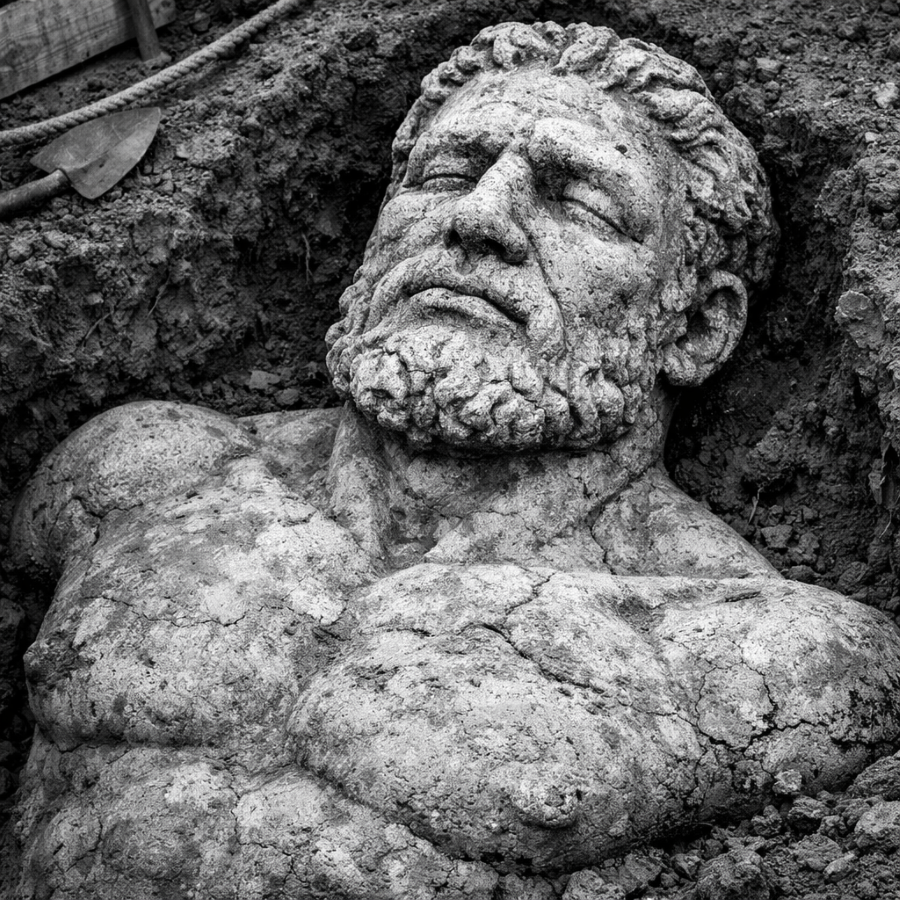

George Hull and the plaster statue he carved and buried in a mine
It is 1868, America is undergoing a phase of strong industrial and scientific growth, everyone is jumping with curiosity at the announcement of every new discovery. Everyone? No! Another half of America believes blindly in the Bible and the historical truth of every word of it. But, in this period of intellectual ferment, there are also those who are not afraid to challenge the system and ridicule the most entrenched beliefs. And so it happens that the greatest hoax in American history is orchestrated by one George Hull, who sets himself a very specific goal: to set up a hoax that would shock the whole country.
An atheist and a giant
George Hull, an unknown atheist tobacconist with a strong spirit of independence, is faced with a problem that has been nagging at him for some time. He is greatly annoyed by fundamentalist Christians, especially those who make the Bible a sacred text to be taken literally. It is not possible to argue with them: their convictions lead them to regard every word written in the Bible as real and irrefutable fact. Therefore, if you claim something that is not written in the Bible, you are either in error or you are in bad faith. Why? Because it is not written in the Bible! No further demonstration is needed.
Imagine the ever-increasing dialectical battles that raged at that time between supporters of the new scientific discoveries, on the one hand, and fundamentalists, on the other hand, who considered them to be deceptions of the devil and who, alternating sermons with threats of eternal damnation, tried to bring the lost sheep back to the right path.
Evolution of species? All nonsense: the book of Genesis speaks for itself. After falling into a heated debate with one of these believers, Hull – defeated dialectically, humiliated in public and cornered by a group of fierce fundamentalists – conceives an idea that would change the course of the history of jokes forever. The idea is inspired by verse 6.4 of Genesis: “In that time there were giants on the earth, and there were also afterwards, when the sons of God joined themselves to the daughters of men, and had sons by them.” But where did these giants end up? A great cue to create a giant ‘human fossil’ that could have fooled and confused even the most sceptical.
The engineering of the hoax: the plaster giant
With the money he earned from the tobacco trade, Hull decides to buy a chalk-rich piece of land in Iowa and has a huge block of stone quarried. Now comes the hard part: he has to find a way to bring a giant that looks authentic to life. This is where Edwin Burkhardt comes in, a skilled and penniless sculptor of tombstones and funerary busts whom Hull convinces – for a hefty fee – to participate in his secret project. Evidently, in those years, the tobacconist’s business was paying very well.
Each night, without arousing any suspicion, Burkhardt and Hull begin work on the sculpture. Hull, who is not only the financier but also the model, lends himself to the features of the statue, which measures approximately 4.5 metres in height. As a prank within a prank, they equip the giant with a penis that is not only as hard as marble but even more gigantic, other than the Bronze Statues of Riace! Once finished, however, the most ingenious part of the deception is yet to come. Hull and Burkhardt ‘age’ the giant using acids, oxidising agents and impregnating paints to give the stone a timeworn, almost fossilised appearance. They go so far as to simulate the pores of the skin so that it looks perfectly natural. Night after night, the sculpture is transformed into the body of a petrified human being, buried for millennia.
The discovery: a statue buried in the heart of America
With the sculpture now ready and the trick perfectly executed, Hull moves on to the last part of the hoax. Like a skilled magician, he decides to ‘discover’ the giant in the most casual and convincing way possible. He packs him up nicely and takes him to Cardiff, on the outskirts of New York. Here, with the help of an accomplice, his friend William ‘Stub’ Newell, he buries him in a hidden corner just behind his barn. The plan was simple: after a year of patiently waiting for the loose earth to recompose and all traces of digging to disappear, Stub felt the need to have a new water well built on that very spot. The workers, unaware and to the general astonishment, found and dug up the statue in the presence of more and more witnesses.
At this point, Hull and Newell, armed with a tent and an entrance fee, begin to charge 25 cents to the curious who come to see the ‘petrified giant’. Word of the giant found in Stub’s grounds spreads quickly, the influx of visitors grows by leaps and bounds, and the ticket price – in deference to the laws of capitalism – doubles to 50 cents.
The Cardiff Giant: the explosion of fame
Now not only neighbours, but intellectuals, politicians and academics come from all over the country to visit the site. To explain the enigma, the most incredible theories are proposed. Some claim that the giant is a Jesuit missionary from the 1500s, others are certain that it is the body of an ancient Iroquois warrior from the Onondaga tribe, as is evident from his features. But for many, the giant is proof that the Bible is always right: the giants described in Genesis are not only a spiritual truth, but also a historical one. Who could doubt this?
Burkhardt at this point wants his share, but – having been given the cold shoulder by Hull, who had already paid him handsomely for the sculpture – he decides to sing in the hope of scraping together some money from his revelations.
From Chicago comes a letter from the German sculptor in which he admits to having contributed to the creation of the statue. But after a quick appearance in the newspapers, the unpleasant episode is soon forgotten. The ‘fossilisation’ appears to be so perfect that the doubts raised by the letter are completely dismissed… like the attempt of a scoundrel to make money behind the backs of decent people. Some geologists declare that the statue has ‘the mark of time stamped on every limb and feature’, guaranteeing the authenticity of the fossil. The giant is moved to Syracuse and the ticket price rises to $1 round.
War of the Giants: Hull versus Barnum
Meanwhile, another character began to sniff out the deal. Phineas Taylor Barnum, the famous showman, immediately recognised the enormous earning potential of the hoax and tried to get into business with Hull, offering him as much as fifty thousand dollars to take the giant on tour for just three months. But Hull refuses the offer.
Barnum, however, is not stopped by the refusal and decides to act on his own. By bribing a night watchman, he manages to smuggle one of his craftsmen into the tent where the giant is kept. The latter manages daringly to make and bring out a wax cast of the statue, and once in New York, Barnum makes an identical plaster copy, displaying it in his famous museum. Thus was born the battle for the ‘real’ giant.
The tragicomic legal dispute that follows between Hull and Barnum becomes famous and increases the giant’s fame even more. Barnum plays fast and claims that his statue is the original, purchased directly from Hull, accusing Hull of having a fake. Hull responds, suing Barnum in court for libel. In court, Hull, in order to prove that his was the first giant, frames himself and confesses that the giant is a hoax, and the court, laughing, decides to … agree with Barnum. This, in fact, cannot be found guilty of declaring that Hull’s giant is a hoax, since … it is.
A curiosity: a statement by one of Hull’s collaborators appears in the trial record: ‘Every minute a new sucker is born’. A historical phrase which, for a change, was stolen and made Barnum’s own: he chose it as the subtitle of his own autobiography.
Paradoxically, the revelation that the giant is certainly a hoax only rekindles the interest of the public, who can now see two giants. Curiosity about ‘the great Cardiff giant hoax’ increases even further.
Two giants for the price of one
After the trial, the two giants continued to be exhibited in two different locations, and both made huge sums of money, both in Hull and Barnum. The original became a real attraction at the Farmer’s Museum in Cooperstown, New York, while the copy found a home at Marvin’s Marvelous Mechanical Museum in Detroit. Today, both giants can still be seen and the prank, which should have been forgotten, continues to make money for the managers of the two museums.
The story of the Cardiff Giant is not only one of the most famous hoaxes in American history, but a fascinating tale of how truth and fiction can mix so skillfully that the boundaries between what is real and what is fictional are blurred. Sometimes, reality surpasses fantasy, but in this case, fantasy got the better of reality, resulting in a legend that continues to amuse and intrigue visitors to this day. And if – according to the definition (falsely) attributed to Barnum – you know any ‘suckers’, offer them to set out on a journey to discover the giants… But warn them: don’t expect both to be authentic!