



Water is everywhere. In taps, in rivers, in servers. It runs under cities, in the cracks of infrastructure, in the rusty pipes of the suburbs. But also in cables, in data flows, in graphs that promise efficiency. Yet, while we talk about artificial intelligence, metaverse and blockchain, one in four people in the world has no access to safe drinking water (source WHO/UNICEF – World Water Week 2025). In Italy, where water should be a right carved in stone, more than 42% of that fed into the networks is lost (source ASviS – Goal 6 2025 Report). A water sieve in the middle of the digital age.
It is not just a technical question. It is a question of power. Of access. Of imagery. Because water is not just a resource: it is a relationship. And so, to understand who really governs it, perhaps we need to stop looking at reports and start looking at symbols. At myths. To archetypes.
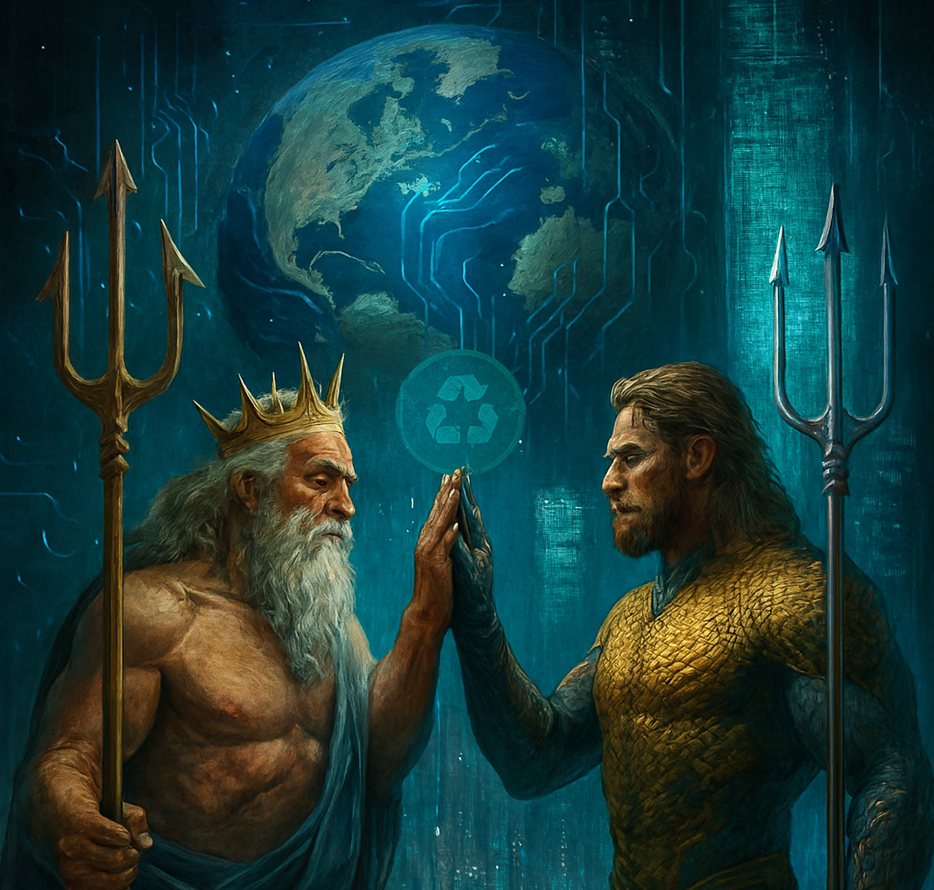
Imagine two figures: Poseidon and Aquaman. The god and the king. Wrath and diplomacy. Memory and innovation. Together, they offer us a key to reading SDG 6 – clean water and sanitation – in a radically new perspective: that of digital water sovereignty.
Poseidon: the god who does not sign protocols
Poseidon is not an accommodating god. He is unstable, vengeful, deeply attached to the earth and its wounds. But he is also the guardian of the springs, the aquifers, the waters that flow invisibly beneath our feet. Today, in his trident, there are no longer waves and storms, but environmental sensors, fibre optics, intelligent water networks.
He is the one who opposes the privatisation of environmental data. Who rejects the extractive logic of algorithms. Who demands respect, not KPIs. Poseidon does not sign protocols: he makes them shake. He is the god who reminds us that water is not controlled. It is listened to.
And if he could speak today, perhaps he would say: ‘It is not enough to monitor. You have to protect. It is not enough to digitise. You have to decide who has the right to know, and who has the duty to guard.”
Aquaman: the king who does not forget the suburbs
Aquaman, on the other hand, is the diplomat. The ruler of Atlantis, the underwater city where technology and nature coexist. He is the bridge between worlds, the mediator between the human and the marine. But above all, he is the guardian of the intelligent water infrastructure. In Atlantis, water is tracked, purified, distributed fairly. Sensors are not surveillance tools, but guarantors of environmental justice. Technology is not an end, but a means to leave no one behind.
Aquaman does not promise miracles. It promises predictive maintenance, digital filters, water blockchain. He promises networks that do not break, data that is not hidden, communities that are not ignored. He is the king who does not forget the peripheries.
Their dialogue is our dilemma
Poseidon and Aquaman are not alike. But in their dialogue – sometimes tense, sometimes synergetic – the future of water is at stake. The former reminds us of the limit. The second shows us possibility. The first is memory. The second is vision. And us? Where do we place ourselves? Are we ready to choose between control and care, between efficiency and justice, between dashboard and dignity?
The numbers that don’t make noise, but kill
In 2025, according to Istat’s SDGs 2025 Report, Italy withdrew 9.13 billion cubic metres of fresh water for drinking purposes. But 42% of that water never reaches its destination. It gets lost. It disperses. It dissolves. And as water networks crumble, distrust of tap water grows. In many cities, households prefer to buy bottles, feeding a cycle of waste, plastic and inequality.
Sometimes, good news fades into the background. But there are some that are worth stopping to tell. Like the one that comes from Milan, where the CAP Group has deployed a simple yet powerful technology: a network of sensors installed along the city’s pipelines that detects water leaks in real time (source: CAP Group, Sustainability Report 2025). This is not science fiction, it is already reality. And it is not just about numbers or efficiency. It means learning to take care of what flows silently beneath us.
Of that water which we do not see, but which makes every daily gesture possible. A commodity that we too often treat as taken for granted, until it is lacking. And yet we can no longer afford to waste it. Not today, not tomorrow. Because every drop counts. And because there are cities – like Milan – that have chosen to listen to their subsoil, to read its signals, to protect it. A model that speaks of concrete innovation, and which could inspire many other realities in Italy. It is a form of respect – for the environment, for people, for the future.
But water is not only what we drink. It is what allows us to live with dignity. And here the global picture gets tougher. There are figures that do not shout, but speak loudly. You don’t find them in the headlines, they don’t make noise. Yet they tell a reality that should disturb us. According to the WHO and UNICEF, more than 3.4 billion people – almost half the planet – still live without adequate sanitation. For 1.7 billion of them, having a safe toilet is not a certainty, but a dream. A daily gesture that becomes a privilege.
When sanitation is lacking, it is not only hygiene that is lacking. It is safety, health, daily dignity. Diseases spread more easily, women are often forced to expose themselves in isolated or unsafe places, children grow up in environments no child should ever know. It doesn’t make the news, it doesn’t show up in the headlines, but it is an open wound. A silent crisis that continues to affect millions of lives, every day, far from the spotlight. Fortunately, there are virtuous and concrete examples that give hope. In Rwanda, the ‘Smart Sanitation’ programme has introduced digitised toilets in rural areas, equipped with sensors to monitor hygiene and maintenance, drastically reducing health risks and improving access for the most vulnerable communities (source: UNICEF Innovation Fund, 2024). A concrete example of how digital sustainability can translate into everyday dignity.
Even at the beating heart of the digital infrastructure, something is changing. It is not just about faster servers or smarter algorithms, but a new awareness: even data centres, those silent giants that power our online lives, consume water. A lot of water. Yet there are those who have decided to reverse course. Like Microsoft, which has designed ‘zero water’ data centres, capable of eliminating evaporation in cooling systems and saving up to 125 million litres per year per facility (source: ESG News). A concrete gesture, reminding us that digital sustainability is not only about energy, but also about water – that fragile commodity we too often take for granted.
Meanwhile, the sea is also becoming a resource. In countries such as Singapore, Israel and Spain, desalination plants are becoming key players in a new water resilience strategy. Low-impact technologies transform salt water into a drinking and industrial resource, powering cities, industries and even digital applications with an efficiency that until a few years ago seemed impossible (source: Genesis Water Technologies). It is innovation that does not consume, but regenerates. That does not merely extract, but gives back.
We need a god and a king. But also conscious citizens
In a world that risks turning water into a digital commodity, we need archetypes. Of figures that help us to think, to feel, to choose. Poseidon reminds us that water is sacred. Aquaman shows us that it can be protected intelligently.
But they are not enough. We need aware citizens. Courageous policies. Transparent technologies. We need a culture of water that does not just measure it, but honours it. That does not take it for granted, but defends it.
Digital sustainability, after all, is not just a question of efficiency. It is a question of justice, transparency, imagination. And of courage. Because if we are not ready to rethink our relationship with water – and with the power that governs it – we risk waking up in a world where blue gold will only be accessible to those who can afford it. And where the new Poseidons will not be gods, but servers.