
















The encounter between a crackpot theory and Nazi eugenic theories
When we speak of scientists, we imagine authoritative researchers working in futuristic laboratories, busy collecting accurate data and developing original theories that, although sometimes almost incomprehensible, are nevertheless supported by solid evidence and, above all, verified by the scientific community. Then, there are cases apart. Like that of Cyril Burt, a British psychologist who has turned the idea of ‘science’ into a parody. Not that Burt is an avowed charlatan – far from it. Rather, he became famous for creating one of the most colossal hoaxes in the history of psychology: a ‘masterpiece’ that combines science, falsified data and… people who never existed. And which is tragically intertwined with the dangerous Nazi eugenic theories.
The start of a brilliant career
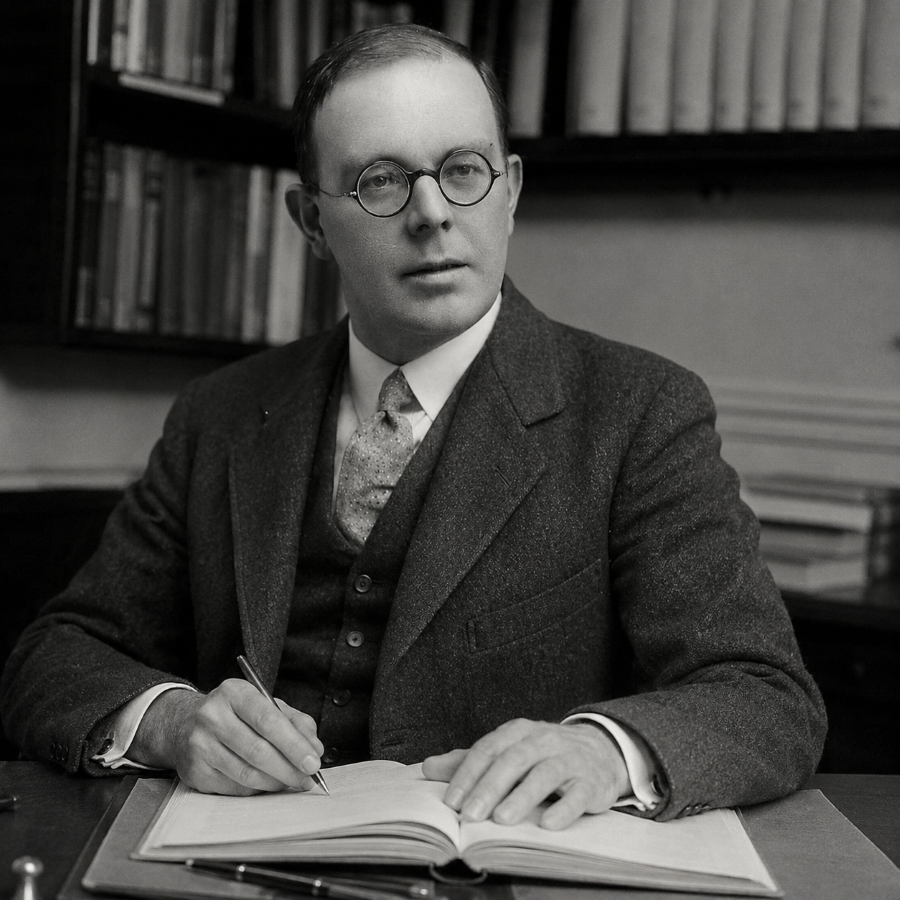
Cyril Burt was born in 1883 into a respectable English family. After studying at the prestigious St. John’s College in Oxford, where he graduated in natural sciences, Burt embarked on his academic career. In 1911, he moved to London University, where he began working as a researcher. But it was not his intelligence that made him famous, so much as his extraordinary ability to obtain data that confirmed pre-existing theories. Ah, scientific research… if only it were that simple for everyone! Burt is not particularly interested in the traditional path of discovery. On the contrary, he prefers to take the ‘fast’ route: if the experiments are not consistent with your theory, fix the experiments. “If reality doesn’t smile on you, create your own reality!”
The growth of a myth and Nazi genetic theories
In 1921, Burt began to develop his theory on hereditary intelligence. According to him, intelligence does not depend so much on environment or upbringing, but is a genetic characteristic, passed on from parents to their children in a basically predestined way. But how to scientifically prove such a theory? Burt’s ingenious idea is to rely on studies of identical twins separated at birth, a method that seems perfect for isolating the influence of the environment.
During the 1940s, Burt’s influence grew, and his theory on hereditary intelligence became one of the most respected in British psychology. In 1943, Burt was elected a Fellow of the Royal Society, consolidating his prestigious position. But his theories do not remain confined only to academic psychology. They gain attention outside the boundaries of science, and even beyond the English Channel, finding a dangerous foothold … in the racial and eugenic theories that at that very moment were spreading, like a dangerous cancer, across the continent.
Burt’s ideas, which emphasise the importance of genetic factors in intelligence, are welcomed in circles that seek to justify racial and discriminatory policies. During the 1930s and 1940s, the racial theories of Nazism were based on a conception very similar to Burt’s: intelligence is seen as a biological endowment, determined primarily by genes, i.e. race. Not surprisingly, Burt’s theories were used by the theorists of the Nazi regime to justify the primacy of the Aryan race, eugenics and other policies of suppression of other peoples, favouring the ‘forced’ selection of the best genes.
His ‘discoveries’ found fertile ground in the 1940s not only among eugenicists and Nazi theorists, but also among all the other racists – busy colonising half the world – who used his ideas to justify unscrupulous racial policies.
In his book The Genetics of Genius, published in the 1940s, Burt attempts to confirm that differences in intelligence between races are largely explained by genetic differences. Although he never uses the term ‘racial superiority’, his statements imply that ‘inferior’ races are genetically predisposed to inferior intelligence.
Hereditary intelligence
In the course of his research, Burt publishes numerous articles in which he describes cases of twins separated at birth who achieve identical results in intelligence tests, proving the thesis of hereditary intelligence. According to his studies, these twins have similar cognitive abilities despite growing up in completely different environments. Strange.
And how come nobody suspects anything? Because, as we have said, Burt is a respected member of the scientific community, with friends in high places, even outside the UK, and no one is at risk of questioning his integrity. Those who dare to stand in the way could put their hard-earned scientific careers at risk.
But if only it had been so easy to find pairs of twins separated at birth…. Burt, in fact, does not just search for and study such twins. What initially looks like promising research soon turns into a major invention. Burt starts ‘creating’ data, inventing twins that, in reality, do not exist. His reports, which in 1955 involved 21 pairs of twins, grew year by year. By 1958, they had grown to 30; by 1966, there were 53 pairs, more than double the number previously published. Yet Burt has been retired since 1950, at the age of 63, and cannot be actively involved in the search for new pairs of twins. The question arises: how did he manage to collect so much data in such a short time?
The answer seems simple: Burt delegates the task to his collaborators, including the researchers Margareth Howard and Jane Conway, who have been publishing numerous scientific articles since the 1950s, supporting and defending our scientist’s theories. But there is one detail that cannot go unnoticed: these two female scientists publish almost exclusively in theJournal of Statistical Psychology, a journal edited by Burt himself.
Comedy becomes tragicomedy
The style of the articles, moreover, is so similar to Burt’s to arouse some suspicion. Although it might seem a coincidence, the fact that the two contributors stop writing for the journal just as Burt, retiring, hands over the editorship of the scientific journal, is rather curious. And then there is the final revelation, which makes everything even more disturbing.
In 1976, Olivier Gillie’s journalistic investigation for the Sunday Times discovered that, between 1914 and 1976, no trace exists at the University of London of two female scientists called Margareth Howard and Jane Conway. To make matters worse, none of Burt’s more recent collaborators can claim to have ever met these two female scientists. In essence, these two female researchers, who had signed articles and claimed the successes of Burt’s theories, probably never existed. Just like the twins themselves who were the subject of the experiments.
Although his theories are fully adopted by racist theorists, Burt’s story has a tragicomic side. His ‘findings’ – based on falsified data, invented twins, and even fictional scientists – are believed and adopted without much question, because, of course, Burt is a respected expert. His career, built on these deceptions, shows how much the scientific community can be swayed by reputation, ignoring obvious signs of manipulation.
The truth that emerges too late
It was only after Burt’s death in 1971 that the truth began to surface. Subsequent studies questioned his methods, and numerous errors and falsifications were discovered in his work. But the most disturbing moment is when, in 1976, the British Psychological Society publishes the results of systematic retrospective studies on the twins featured in its publications: no one can prove that even one of Burt’s much-vaunted twins ever existed. Everything that seems to have a solid scientific basis is a gigantic fabrication. And yet, while the myth of Burt is dismantled, his theory of hereditary intelligence remains in the background of numerous psychology studies for decades to come.
The collapse of the myth is inevitable, but its legacy is not easily forgotten. Burt’s work, seemingly solid and incorruptible, becomes a striking example of how even science can be manipulated and distorted.
The tragic and humorous side
The lesson from Cyril Burt’s story is a warning to all scientists: never believe a fact that cannot be verified. But as is often the case in the history of science, the line between brilliance and fraud is sometimes thinner than you think. It is also an example of how easy it is to hide a hoax behind a respectable façade of numbers and statistics.
If we want to find a comical side to this affair, we can laugh at the nerve with which Burt, in the face of hundreds of criticisms and questions, continued to maintain his ‘expert’ status. Who knows, perhaps if he had had the ‘blue tick badge’ (which we are all familiar with today on social media and which guarantees that the account is authentic and belongs to an authoritative figure), he would have continued to fool the entire scientific community with a publication every week. But today, in the age of transparency and cross-checking, it would have been much more difficult to conceal a deception of such magnitude. Or would it?
After all, Cyril Burt’s story reminds us that science is an ongoing quest, but also an extremely fragile matter. And perhaps, in the end, the real lesson to be learned is: “Not all that glitters is gold. Not all twins, and also not all scientists, are real.”