



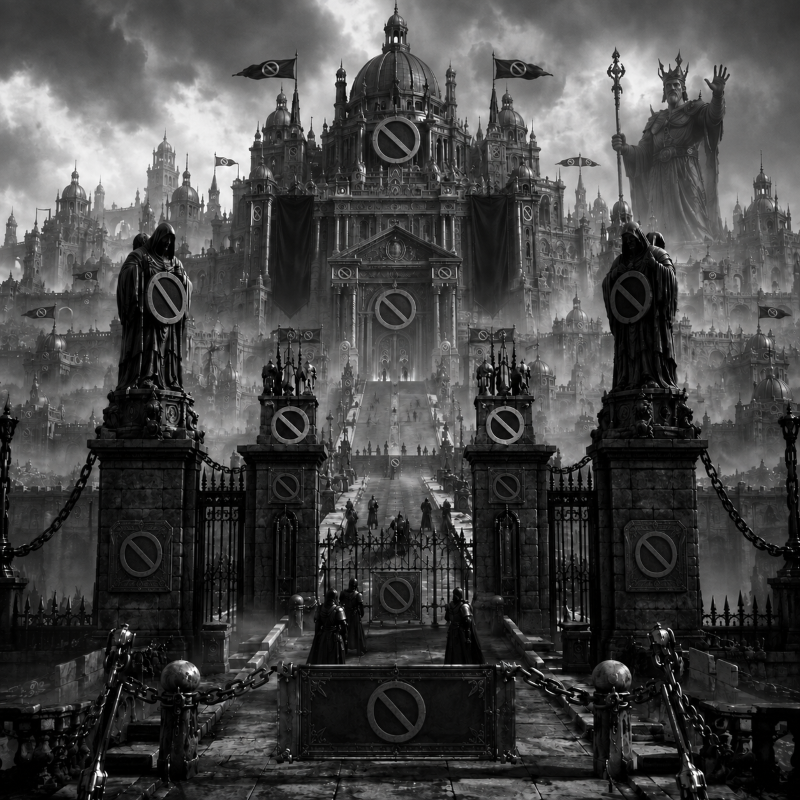

In the Grand Duchy of the Previous Ban, it all began with two wise laws. The first banned social media for under-16s. The second banned screens for under-threes. No one protested: who on earth would defend screens, social media, or children’s exposure to such influences? The Minister for Universal Protection, a man with the reassuring face of a medicine cabinet, announced that children were finally safe. The children, who were just as unwell as before, were not consulted.
But the unease persisted. And the Grand Duchy discovered its founding principle, the Theorem of Shyness: if a ban did not solve the problem, it was not the wrong measure. It was simply too small.
Fairy tales were banned, because of the wolves that ate grandmothers without their informed consent. Then grandmothers themselves were banned, as they were the source of unverified stories. Boredom was banned, as it gave rise to unsupervised thoughts, the precursor to deep thoughts, which are notoriously the most dangerous.
Then came technology, and with it the golden age. Encryption was banned – it was like speaking with your hand over your mouth: coded messages were abolished, and postcards became compulsory. Passwords were banned: a single one was imposed – ‘1234’ – the same for everyone, in the name of transparency. Deleting messages was banned, because deletion was tantamount to a confession. And switching off the phone was banned: a switched-off device was the only content that could not be scrutinised – the perfect crime. A flat battery became tantamount to negligent shutdown.
At the heart of it all was the Kind Reader: the machine that opened every letter, every message, every note folded in four, before it reached the recipient. ‘Just to look for anything dodgy,’ the Ministry clarified. It read everything like a butler rummaging through drawers with his little finger raised, and stamped every communication with the words ‘Nothing to worry about’. A love letter without a stamp was suspicious. With the stamp, the matter was settled.
Someone objected that reading everyone’s post to protect one person was like draining the sea to look for a ring. The objection was classified as a Morbid Attachment to Privacy. In the Grand Duchy, you had nothing to hide. It was forbidden to have anything to hide.
And what about the children? They were still unwell. One of them wrote in an essay that he felt lonely. The teacher would have liked to speak to him, but she needed Form 47-bis, the Empathy Commission’s opinion and sixty days’ notice. Meanwhile, the child grew up. The form arrived right on time for his eighteenth birthday, along with best wishes from the Ministry.
No one had ever asked why those children were unwell. Asking that question would have taken time, money and effort, and carried the unpleasant possibility of discovering that the problem lay with the adults. A ban is much better: it costs little, looks good on paper, and appears to be a solution without actually being one.
One day, an elderly retired teacher formally submitted a question: ‘But has all this – the problem – been resolved?’ The question was examined with the utmost seriousness. It was then banned, as its content was deemed unsuitable for minors and destabilising for adults.
And so it was that, in the Grand Duchy, the matter was officially closed. And banned. Which, in that context, amounted to the same thing, but at a much lower cost.
