













What is the labyrinth? It would seem a banal question to which we all think we have a ready answer. In reality, the meaning of the term is multiple, its roots even etymological debated and its origins uncertain. However, we all have the sensation at some time in our lives of finding ourselves in a labyrinth, be it cognitive, affective, relational or even physical, from which we feel we can no longer get out. The same historical phase in which we find ourselves living sometimes appears to us as a chaotic labyrinth in which we fear we are lost without finding our way out. The metaphor of the labyrinth is still relevant when we apply it to the network, the digital and artificial intelligence from which we feel trapped at times.
To the tale of the labyrinth, its history and myths, Giorgio Ieranò dedicates an essay that reads like a novel and ranges from archaeology, philology and, of course, Greek mythology to ancient and modern philosophy, contemporary literature and psychoanalysis.
The story of the labyrinth, says Ieranò, originated in Pylos, on the coast of the Peloponnese, one of the centres of Mycenaean civilisation, with a drawing preserved in the clay of a burnt tablet: “a series of meander-like lines intersecting one another, an intricate path imitating a succession of corridors”, the oldest depiction of the labyrinth datable to the 13th century BC. At around the same time, on a Mediterranean island, Crete – home to a very ancient pre-Greek civilisation and the cave in which no less than Zeus is said to have been raised – a palace scribe notes on a clay tablet: ‘A pot of honey for the Potnia Daburinthoio’ or Potnia Labyrinthoio, i.e. the ‘Lady of the Labyrinth’. It is the first time in human history that the word ‘Labyrinth’ is used.
But what was originally meant by labyrinth? The maze of corridors into which one enters with difficulty and fear and from which it is even more difficult to exit in an enormous and disturbing palace, such as the one with more than 3,000 rooms that the Greek historian Herodotus is said to have seen and partly experienced in the Egyptian city of Crocodilopolis (Fayum)? So, such a complex set of human constructions as to arouse the deathly anguish of never leaving?
According to another set of sources and texts, the Labyrinth was instead a cavern, an underground cave in which it was easy to lose one’s bearings. The very etymology of the word ‘Labyrinth’ is said to be related to the root of the Greek word laas and the Latin lapis and thus to be interpreted as ‘the house in the stone’. But there are also those who claim that the labyrinth would have been a sacred dance.
Who would be interested in that if not a handful of philologists and archaeologists, the even more meagre group of my readers will ask? And yet the labyrinth and the interweaving of myths that overlapped it constitute a not insignificant part of our European culture and technology tout court.
The story begins, of course, with a drive, the passion of Zeus, the king of the gods, for a beautiful Phoenician princess, Europa.
Zeus abducts Europa
One day, while walking along the beach with some friends, Europa was seen by Zeus, who fell madly in love with her. In order to approach her without frightening her, Zeus took the form of a white bull, splendid and tame, with horns shining like an ivory moon. The bull gently approached Europa, who was immediately attracted by its beauty and docile nature. After petting him, the girl climbed onto his back.
As soon as he did so, the bull – that is, Zeus – jumped into the sea and swam to the island of Crete, taking Europa with him, who tried in vain to call for help. Once on the island, Zeus resumed his divine form and revealed himself to Europa. The girl, fascinated by the god, accepted his love. Zeus and Europa had three children, including Minos, future king of Crete and judge of Hades after his death.
The story then continues with an act of Hybris and a divine punishment that affects subsequent generations
Pasiphae, the bull and the ingenuity of Daedalus
Minos, now king of Crete, had promised Poseidon to sacrifice the magnificent white bull he had received as a gift, but in an act of Hybris (hubris) he kept it for himself, betraying the sacred pact. To punish him, Poseidon made Queen Pasiphae fall in love with the bull.
Blinded by passion, Pasiphae, in order to mate with the bull, turned to Daedalus, a highly regarded Athenian sculptor who, following the murder of his assistant and nephew Calo, – whom he had killed because he was jealous of his mastery – had fled Athens and was welcomed in Crete by King Minos. Daedalus agreed to help Pasiphae by building a hollow wooden cow, covered in cowhide, into which the queen could enter to join the bull.
From that union was born the Minotaur, a monstrous being, half man and half bull.
At this point the story takes a decidedly technological turn
The Labyrinth and Technology
Minos, shocked by the birth of the Minotaur, ordered Daedalus to build a structure in which to enclose him: the Labyrinth, a labyrinth so complex that no one could get out once inside. Daedalus obeyed.
Minos, however, while benefiting from his inventions, no longer trusted him. He feared he might reveal the secrets of the Labyrinth to others and locked him and his son Icarus in the same prison he had built.
The story becomes even more intricate and the technology even more sophisticated
Daedalus and Icarus
In order to escape from the labyrinth, Daedalus built a pair of wings for himself and one for his son Icarus out of bird feathers fixed to the base with wax. Daedalus advised his son to fly at half height so that the humidity would not weigh down the wings and the sun would not melt the wax. During the flight Icarus got too close to the sun and the heat melted the wax, causing him to fall into the sea.
Liberation finally arrives through a relationship… interrupted
Theseus and Ariadne
The Athenian hero Theseus travels to Crete and enters the Labyrinth to kill the Minotaur, to whom the Athenians had to sacrifice human victims. Once killed, he manages to get out thanks to the ball of thread given to him by Ariadne – daughter of Pasiphae and Minos and therefore sister of the Minotaur – who then sails with him but is abandoned on the island of Naxos.
Daedalus, or knowledge that builds (and sometimes stumbles)
Daedalus is not only a talented sculptor, but a true architect of the impossible. If we think about it, he is the first in mythical history to be asked to solve, by technical means, a problem that would otherwise be impossible to tackle: how to contain a half-man, half-bull creature without resorting to a psychotherapist, a machine gun or a metaphor?
His answer is ingenious: to build a structure so intricate that even those who draw it struggle to get out. Thus was born the Labyrinth.
Or, if we want to translate it into modern terms, the perfect algorithm to contain the monster, without really facing its nature. The important thing is not to see it too closely.
But Daedalus does not stop there. He does not just close doors: he also invents openings. He builds wings to fly away. It is as if, in the same hand, he held the key to the cage and the remote control of the drone.
The Labyrinth is a mental place. But with draughts
According to Freud, who knew a lot about labyrinths of the soul, the myth basically tells us how the psychic apparatus works: we have an obscure, repressed centre that we would prefer not to see (the Minotaur), and a series of complicated defences to keep it at bay (the Labyrinth). The problem is that, as in certain recurring dreams, every so often the Minotaur comes out to do damage, and we find ourselves in analysis.
Freud would tell us that Daedalus represents the builder ego, the one who does not think why, only how. In this he is also a bit of our cousin: how often do we build lives full of things, schedules, notifications, commitments and calls, but without ever stopping to ask what we are really containing?
Bion, with more elegance and less cigar, adds an equally fascinating idea: the Minotaur is a β-element, an unthinkable, undigested stuff. You need a mind capable of ‘chewing’ the raw emotional experience, of transforming it. And Daedalus? Daedalus builds without chewing. He is the cook who skips the tasting part.
Ariadne, the thread and bonding technology
But here comes Ariadne, with her grace and her ball of yarn. Unlike Daedalus, she does not build anything materially visible. But she builds something far more important: a relationship. She gives Theseus a thread. Not an app, not a PDF tutorial, but a relationship charged with meaning and trust, connecting those who enter the Labyrinth with the outside world. She is the true inventor of affective technology.
And here a crucial point opens up: if the labyrinth is the unconscious, the trauma, the tangle of existence, we do not get out of it alone. We need someone to hold the thread. Another human. Another gaze. A ‘conversation’, as Hölderlin, Borgna’s favourite, would say.
“We are an interview.”
(Friedrich Hölderlin, ‘Andenken’)
This is perhaps the German poet’s most profound insight – locked away, as if in his own psychic labyrinth, in the famous Tübingen tower on the Neckar river. In that verse, ‘Wir sind ein Gespräch’, (we are a conversation) Hölderlin does not only affirm that we speak, but that we exist insofar as we speak and listen to the other. Our being is made up of speech, of mirroring, of dialogue. A poetic intuition that much later would also be picked up by Martin Buber and then, in a vibrant and very human way, by Eugenio Borgna, who loved to recall how the therapeutic bond was first and foremost an encounter of words, silences and shared listening.
What if there was something just as revolutionary as technology, more salvific than the algorithm? Perhaps it is just that: the thread of the word that unites us, that runs through us like an uninterrupted conversation, even in the deepest silences of our labyrinth.
Daedalus and artificial intelligence
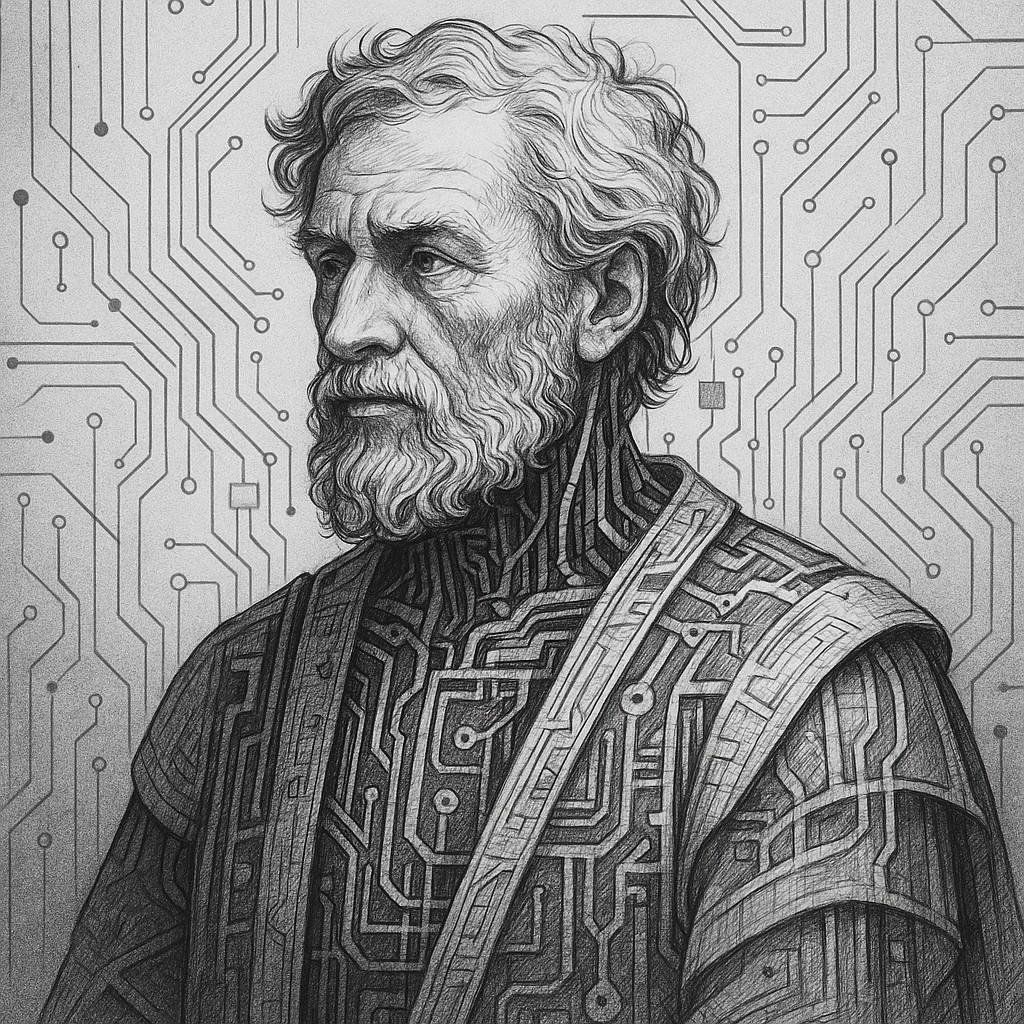
It has often been said that Daedalus is the forerunner of the modern engineer. But to be a little provocative – with grace – we can go further: Daedalus is the archetype of our artificial intelligence.
So does the AI, like Daedalus:
– constructs complex solutions from simple instructions;
– has no ethics of its own, but executes;
– can help you escape… or get lost;
– does not know what it contains, but only the functions that are requested of it.
However, and here we can lighten the tone: we need not fear it as if it were the new Minotaur. On the contrary, perhaps it is just a new corridor in our labyrinth, an extension of our wings, as long as we remember that we need hands to hold the thread.
As in a therapy, or in a good dialogue, what matters is not the output, but the relationship. AI can be brilliant, but it does not hold the thread. It can suggest ways, but it does not hold our hands. In this sense, it is more Daedalus than Ariadne.
Getting out of the Labyrinth
In the end, the story we are told by myth is that of a civilisation that invents to contain, but is only saved when it can relate.
We can build all the labyrinths we want, launch start-ups, predictive systems and even chatbots inspired by Greek myths, but if we lose the thread – the link with the other, with thought desire, with the voice of experience – we risk flying like Icarus: too high, too alone, and with wax dripping.
Getting out of the Labyrinth (with Daedalus, Ariadne… and a well-knotted thread)
In the end, the story we are told by myth is that of a civilisation that has always tried to contain the monster, but is saved when it manages to name desire and build a bond.
And perhaps today we do not need to choose between Daedalus and Ariadne, between algorithm and word, between artificial intelligence and emotional intelligence. Perhaps the challenge is not to separate, but to intertwine: to rely on Daedalus to draw ever more precise maps, but not to forget who holds the thread as we walk.
A reflection between myth, psychoanalysis and artificial intelligence in search of the thread that keeps us human
In the time of codes and algorithms, the figure of Daedalus returns to speak to us with the force of a living myth. In this agile and ironic essay, Giuliano Castigliego takes us on a journey through ancient and modern labyrinths: from Greek mythology to the Freudian unconscious, from Hölderlin to Bion, up to artificial intelligence, rediscovering the importance of the link, dialogue and Ariadne’s thread as a compass to orient ourselves among increasingly intelligent technologies.