





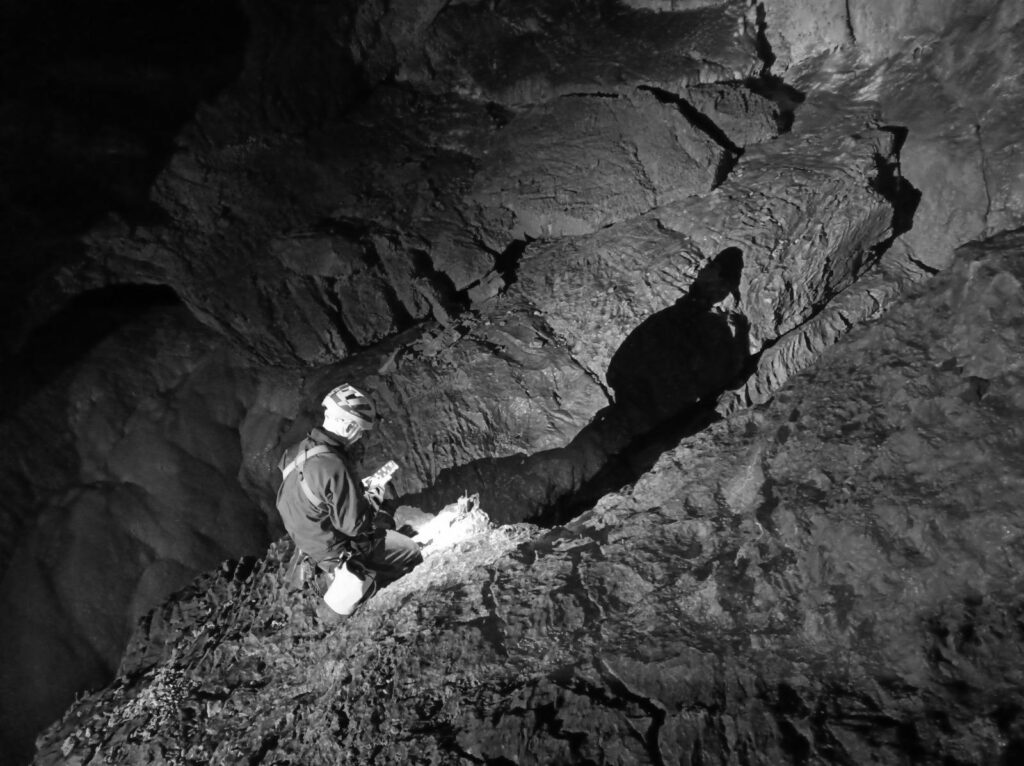

A significant exercise by the Speleological Technical Commission (CTS) of the Corpo Nazionale Soccorso Alpino e Speleologico (CNSAS), which took place in the Antro del Corchia, in the municipality of Stazzema (LU), has come to an end. The activity, scheduled to take place from Friday 11 to Sunday 13 July, was aimed at field testing two innovative wireless communication systems in the cave, designed to guarantee a connection between the technicians in action underground and the management of operations outside even in the absence of a cable telephone line, which is purposely positioned along the evacuation route in the early stages of intervention.
For decades, in fact, the CNSAS has been using cave telephones connected by telephone cable, manually laid along the meanders and underground shafts. This reliable and well-established system meets the need to overcome the natural barriers of underground cavities, which prevent radio waves from propagating beyond a few metres. However, in certain critical phases of rescue operations – such as in first intervention or during disruption activities that require the removal of the cable – it is essential to have alternative solutions.
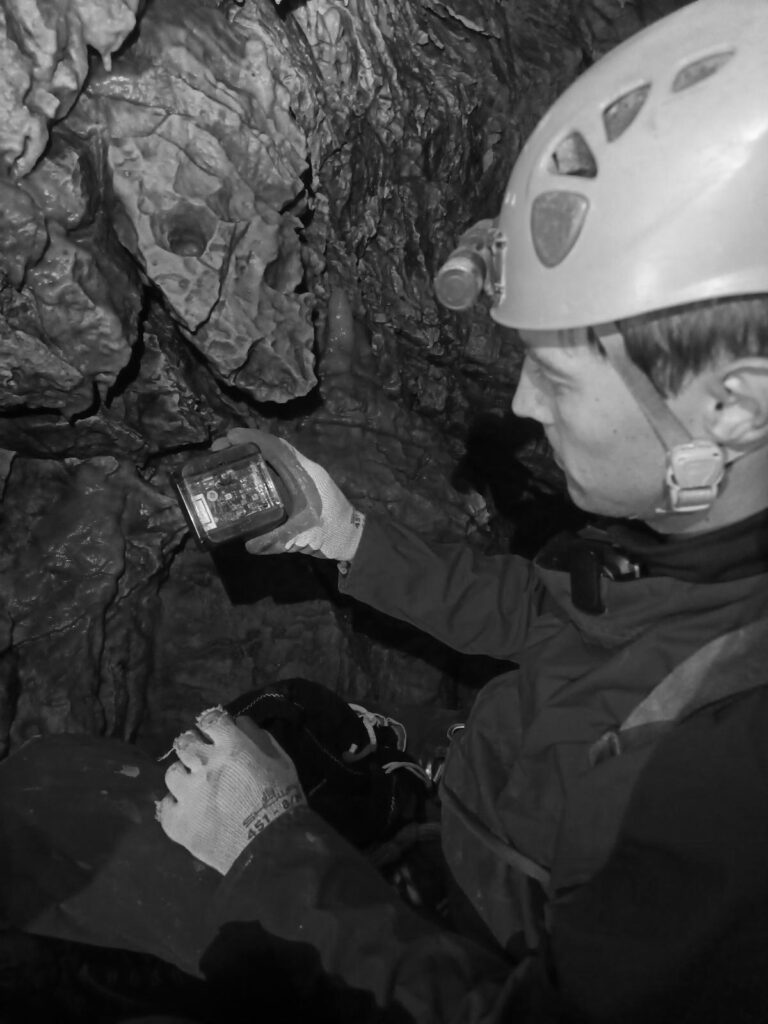
It is with this in mind that CTS developed and tested two systems based on mesh technology: ‘SARA WaveExtender’ and ‘Thumbelina’, both designed to create an autonomous chain of transceiver units capable of transmitting the signal along articulated paths, enabling communication even in complex conditions.
The tests took place along the Ramo del Giglio and Ramo dei Tre, two sections of the Antro del Corchia with different morphological characteristics and rich in concretions, chosen precisely to test the reliability of the systems under extreme conditions.
The SARA WaveExtender transmits text data packets, entered from the keyboard or converted from a voice message with a smartphone connected via Bluetooth to the system. Each message, together with the time of transmission, is archived and is available to CNSAS technicians for subsequent consultation. In the configuration tested – consisting of a coordination unit, three operator devices and seven repeaters – the system stably covered the two sections of the cave: the 250 metres of the Ramo del Giglio with three repeaters, and the approximately 150 metres of the much narrower Ramo dei Tre with only five repeaters. The system proved to be effective and stable for about six hours of operation, with only 250 milliwatts of power used for each unit.
Thumbelina, on the other hand, enables the direct transmission of voice communications, which are digitised, compressed and retransmitted along the mesh chain until they are converted back to analogue and reproduced through the loudspeaker of the target device. The system requires closer positioning of the mesh nodes due to the increased complexity of the audio signal. During the six-hour exercise, three operator terminals with microphone and loudspeaker and twelve repeater units were deployed. The first section was covered with five repeaters while for the second section, 11 repeaters with a power of 31 milliwatts each were deployed.
In both cases, the tests confirmed the effectiveness of the adopted solutions: SARA proved to be a reliable and very low-power system for the transmission of text messages, while Thumbelina ensured adequate voice communication even in the presence of strong natural obstacles.
The goal, indicated by the CNSAS National Management on which the Caving Technical Commission is now working, is now to further develop both systems. In the future, these technologies could become decisive tools during cave rescue operations, both in the very early stages – when the cable telephone line is not yet available – and at times when boulders and stones are being broken up, where it is necessary to temporarily remove the telephone line.