

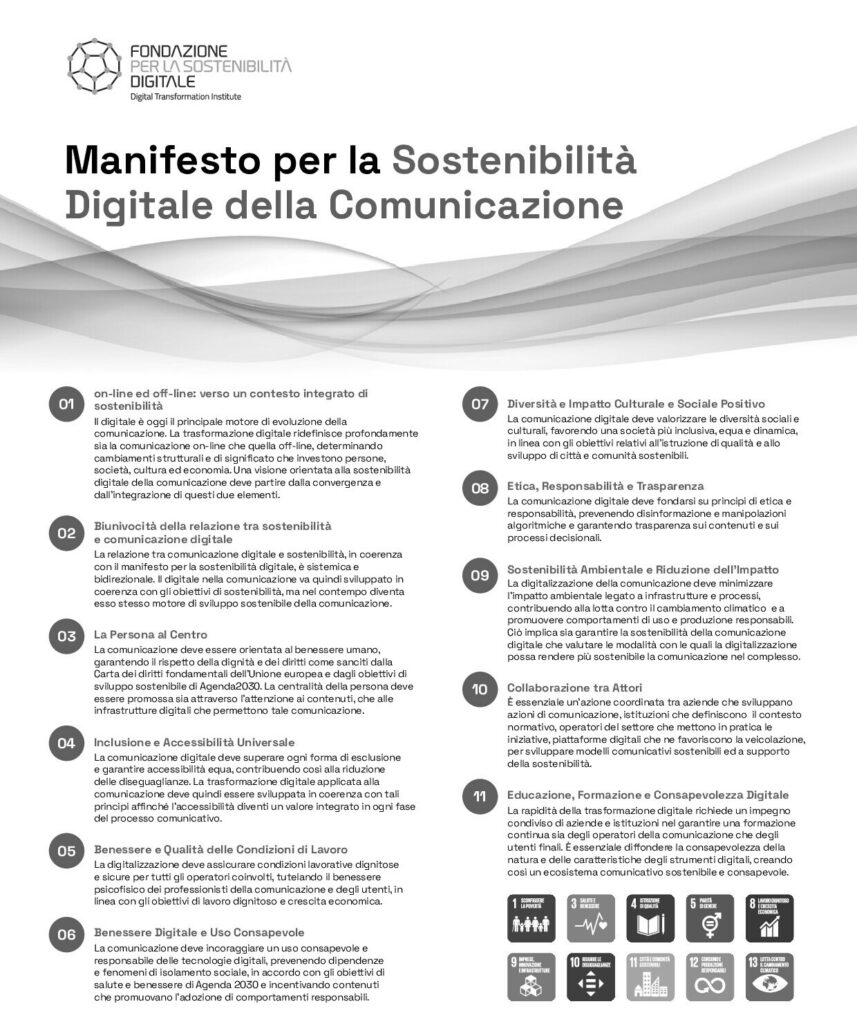

The presentation at the Press Room of the Chamber of Deputies, on 17 July, of the Manifesto for the DigitalSustainability of Communication by the Foundation forDigital Sustainability – which drafted and illustrated it during the meeting – was an important opportunity for discussion and sharing on a topic that is also close to the heart of theAssociation of Public and Institutional Communication, which has been mobilised since the mid-1990s on the front of communication in PA, including in the challenging, promising but sometimes ‘dangerous’ relations with digital transformation.
Reflections and arguments from professionally different – but converging – points of view on the common goal of combining innovation and inclusion, digital ecosystem development and sustainability in its broadest sense, as an open and plural system, a place of freedom of expression and information and protection of people, bodies and digital identities, as the terrain of a proper democratic dynamic.
A Manifesto indicating the guiding principles of a sustainable Digital Communication acted by public and private, academic and associative actors is a valuable and important guide for the design, realisation, evaluation of products, services, contents and relational processes – public and private – that are increasingly polymorphous, ubiquitous and multichannel, digital presences and interactions that this new ‘public sphere’ has made less and less a ‘set of tools’ and more and more a ‘world’, to use a philosophical lexicon (Heidegger, dasein). On the other hand, philosophers enjoy a new and unexpected topicality, due to the cultural and social need to interpret, and thus to communicate – not in a dual ‘analogue and digital’ way, but rather as a continuum (in fact, one speaks of seamless communication) – the onlife society, according to a systemic and multidisciplinary approach, rethinking categories, boundaries and domains of knowledge.
There is certainly a need for new skills – humanistic, technical-scientific, managerial – and the ability to read phenomena and processes in a transversal manner, to manage their evolution and impact, with communication choices that broaden the ‘traditional’ perimeters and explore new devices and models, according to the principles and values underlying a public communication ethic in a broad sense, not only institutional, that focuses on people, fundamental rights and their declination in the European trajectory.
It is a dimension, the digital one, that is mature, in which new ontologies and systems of formal rules and social agreements are necessary – Floridi would say much more authoritatively than I – but in which the Public Administration and its communication – digital and otherwise – are perceived by citizens, and very often are inadequate in facts and results.
Different and to some extent unexpected paradigms have emerged with the Net and digital ecosystems, ways of generating and functioning alien to sylos and verticality, to which PAs have reacted with varying successes and results, best and worst practices, with uneven capacities to adapt to innovation, often manifesting improvisation and fideistic enthusiasm in adopting sic et simpliciter – online environments and platforms, in themselves not automatically resolving the organisational and communicative complexities of hierarchical and barely permeable ‘machines’.
The disintermediation and immediacy in the relationship between citizens and PA need functional redesign and organisational coordination , as well as clarity of integrated communication objectives, have instead resulted in frequent encroachments by political communication, which easily (and somewhat understandably) slips into personalisation of messages and propaganda, self-celebration, to the detriment of information and communication as a service.
In this scenario of lights and shadows – which the digital transformation also highlights in the positioning of our country in the European rankings – as the Italian Association for Public and Institutional Communication – Compubblica – for almost 35 years we have been committed to affirming and consolidating a culture of communication pivotal to relations with citizens and communities as a fundamental lever for the long-awaited change in PA. Change that can only come about through listening and empowerment of people and stakeholders; multi-channel access to services and procedures; transparency of policies and choices; participation in decision-making processes and planning.
Public and institutional communication has citizens – and their associative expressions – as its priority clients , and as an association we have as our main statutory purpose the creation of measurable and accountable public value through tools, channels and practices that promote open government in all its multiple dimensions, making the right to knowledge and explanation effective.
Communication is strategic thinking and design, both internal and external to public institutions, and the digital communication of public institutions, in order to be sustainable, must/should have the skills and capacity to consider ex ante and ex post the social and environmental impacts of the technological and media choices made, in harmony with the Plan for IT, and according to indicators made explicit in planning documents and published for civic monitoring; reporting on public activities and policies is an essential part of communication, as well as an obligation for PAs.
It is essential to think of digital as an opportunity to make services for communities more widespread, accessible, usable and simple and, at the same time, to accompany and facilitate with all available digital resources the contacts that also take place in physical touch points, where interaction takes place in person, sometimes the only moment of dialogue with more fragile and less equipped segments of the population.
It is to be hoped that more and more widespread public policies, together with private initiatives, will be put in place to sensitise and empower people/users to an informed and ‘critical’ use of platforms and applications, which are free of charge but extractive of data, opaque and closed black boxes, operating on the basis of potentially discriminatory and manipulative algorithms.
Another central aspect is the training of personnel to interact with suppliers (many activities are now outsourced) of technologies, an activity generally delegated almost entirely to the PA Information Sisters: drawing up specifications and defining rules and conditions for a service, an activity, a tool or a digital environment for communication is not a merely administrative or ‘technicians’ job, but a skill that guides us in the market of options and highlights conscious communication styles and non-subservient approaches to supply. The issue of reuse and digital commons is also among the options in the field.
As Compubblica, we think that fully implementing the substance of Law 150, which is 25 years old and in some parts could benefit from evolutionary ‘maintenance’ like many other laws, but has been and is largely disregarded, and applying it even if it does not provide for sanctions would be an indication of awareness and non-rhetorical attention on the part of the PA, for a function that is essential to the exercise of citizenship, a function that is amplified and strengthened with digital technology and enriched with newresponsibilities, including deontological ones .
In this sense, this spring we have rewritten our Code of Ethics , which dated back to 2003, with particular regard to the duties and commitments of PA communicators – civil servants in the changed social and technological context – and the key words that guide the Foundation’s Manifesto are in full consonance with what our members subscribe to. Therefore, collaboration and synergy with the
Foundation for Digital Sustainability are of great interest and value to Compubblica, and the concrete willingness to design and work together natural and necessary.