













“Man has become a kind of god-prosthesis: when he makes use of all his auxiliary organs he is truly magnificent; but he does not carry them with him and often cannot use them without difficulty.”
Sometimes we are frightened ofartificial intelligence as if it were an autonomous power ready to rebel, and at the same time we seem distracted by the concrete uses that governments and companies make of it on a daily basis. This is the real contradiction of our time: not the machine itself, but the way we use it or, worse, let others use it for us.
The investigation that unveiled the use of Microsoft’s cloud and artificial intelligence services by the Israeli Unit 8200 for mass surveillance of Palestinians is a glaring example. The contract dated back to 2021 and allowed for the storage and processing of millions of phone calls, with an impressive capacity: up to one million conversations per hour. All this went on for years, out of the public eye, until the scandal broke. Only then did Microsoft discontinue the services of its Azure system – which seems to want to convey even in its name calm and tranquillity, like a pension fund – when the data had already been collected and used. A classic case of the stable being closed when the horse has bolted, which highlights the disproportion between the speed with which technology creeps into our lives and the slowness with which we react when its abuse is revealed.
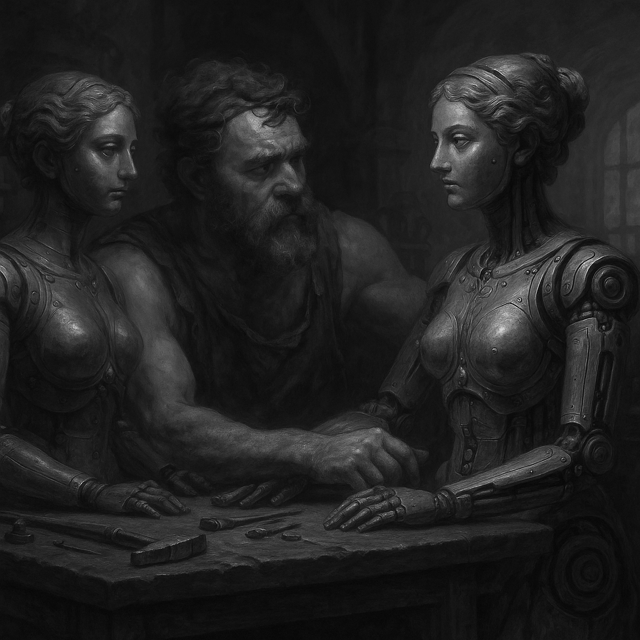
The theme, however, is not new. Already the Greeks had sensed that the téchne, the art of making, was not an unlimited licence but a form of substitution, a way of filling our fragility. Let us think of Daedalus, whose inventiveness gives wings to his son Icarus, but cannot prevent his fall when the pull of excess brings him too close to the sun. Or the bronze automaton Talos, created by Hephaestus to watch over Crete, half wonder and half menace. In these tales, technology appears as an ambiguous gift: an extension of our capabilities and, at the same time, potential excess, hýbris against the gods.
Box 1 – What téchne means (and the myths that tell it)
In ancient Greek, téchne was not ‘technology’ in the modern sense, but art, craft, practical skill. It was distinct from epistéme (theoretical knowledge) and indicated knowing how to transform an idea into an action or object.
The myths show us its ambivalence well: Daedalus, a brilliant inventor, builds the wings that enable Icarus to fly – but excess leads to a fall. Hephaestus forges metal automata capable of moving and serving, extraordinary and disturbing ancestors of our robots. The lesson remains relevant: téchne fills a lack, but when used without measure it becomes hýbris.
These myths remind us that the issue was never technical, but always ethical and political. We see this even today, in the hypocrisy with which we judge certain platforms and tolerate others. TikTok, for example, was treated as a threat to national security in the United States, to the point of forcing its sale to protect democracy. But the same lucidity does not apply to American platforms like Meta or X, which daily shape our information bubbles and influence political opinions without raising equivalent alarms. We condemn ‘foreign’ propaganda and get used to domestic propaganda, even when its reach is no less invasive.
Those who control algorithms, after all, control access to information and with it the very fabric of social relations. This is where technology stops being a topic for engineers and becomes a node of power. If the public debate remains limited to slogans and generic fears about ‘good’ or ‘bad’ AI, we lose sight of the central point: we allow private, often foreign, actors to establish the invisible rules of our informational democracy. The systemic risk lies not so much in the origin of a platform, but in the concentration of power and the lack of transparency with which it is exercised.
This is where politics, or rather its absence, comes into play. If technology is a stage actor, who writes the script? Who decides the limits, the rules, the consequences? We can no longer be content with belated reactions, like Microsoft’s. We need clear rules and instruments of democratic control that minimise the possibility of violating the principles of our civil and constitutional codes with impunity. Without this, we will continue to chase scandals after the game is over.
And finally, there is a misconception worth debunking: the idea that artificial intelligence has its own ‘inherent ethics’. It is a reassuring narrative, shifting the problem from our responsibilities to the machine. But, as Stefano Epifani reminds us in his latest book The Theatre of Thinking Machines, AI has no ethics: it has instructions, constraints, data and goals that we define. Ethics belongs to the people, societies, and governments that decide how to use it. To delude oneself that the machine can somehow replace this task is to repeat, in a digital version, the same hýbris that the Greeks had already warned about in their myths.
Box 2 – Three priorities for policy
1. Transparency: opening up data and algorithms to independent scrutiny.
2. Symmetry: equal rules for all platforms with systemic impact, not just ‘foreign’ ones.
3. Effective legislation: rules capable of minimising the possibility of violating the principles of our civil and constitutional codes with impunity.
Between Prometheus and Azure, the message remains the same: it is not technology that makes us more or less right. It is we, with our choices, who give it direction. And if we want to prevent our prostheses from becoming chains, we must take full political and ethical responsibility for their governance.