

















When 10% of the machines do 90% of the work (and the horses disappear)
In 1963, Derek J. de Solla Price discovered some ruthless mathematics: in any human field, half of the significant results come from the square root of the total number of participants. In a group of 100 people, only 10 produce 50 per cent of the value. A natural law of productive concentration that seemed to describe only sociological curiosities.
Today, as our machines begin to replicate and optimise themselves, Price’s Law is no longer an academic statistic. It has become the driving force behind what Erik Brynjolfsson of MIT calls ‘universal compression’ – the relentless cost-cutting of everything, everywhere, at the speed we know: that of haste.
The Scam of Historical Analogies
The ‘good guys’ – those who are already doing well and leading their own technological revolts – like to tell us the same reassuring story: “When the transformation from agriculture to industry took place, millions of jobs were created that were unknown.” This is nonsense.
People were leaving the countryside but the factories were already there. They were not leaving for nowhere hoping someone would build a factory. The alternatives existed, with capital invested, infrastructure ready, business networks functioning. The transition was possible because the new support network had been built before, not after.
Today’s phantom traffic jam is that they tell us the same story while destroying the present jobs without having built the alternatives. “Don’t worry, in ten years…” But the ten years never come, and in the meantime those who lose their jobs today what do they do?
The Silent Extinction: The Lesson of the Horses
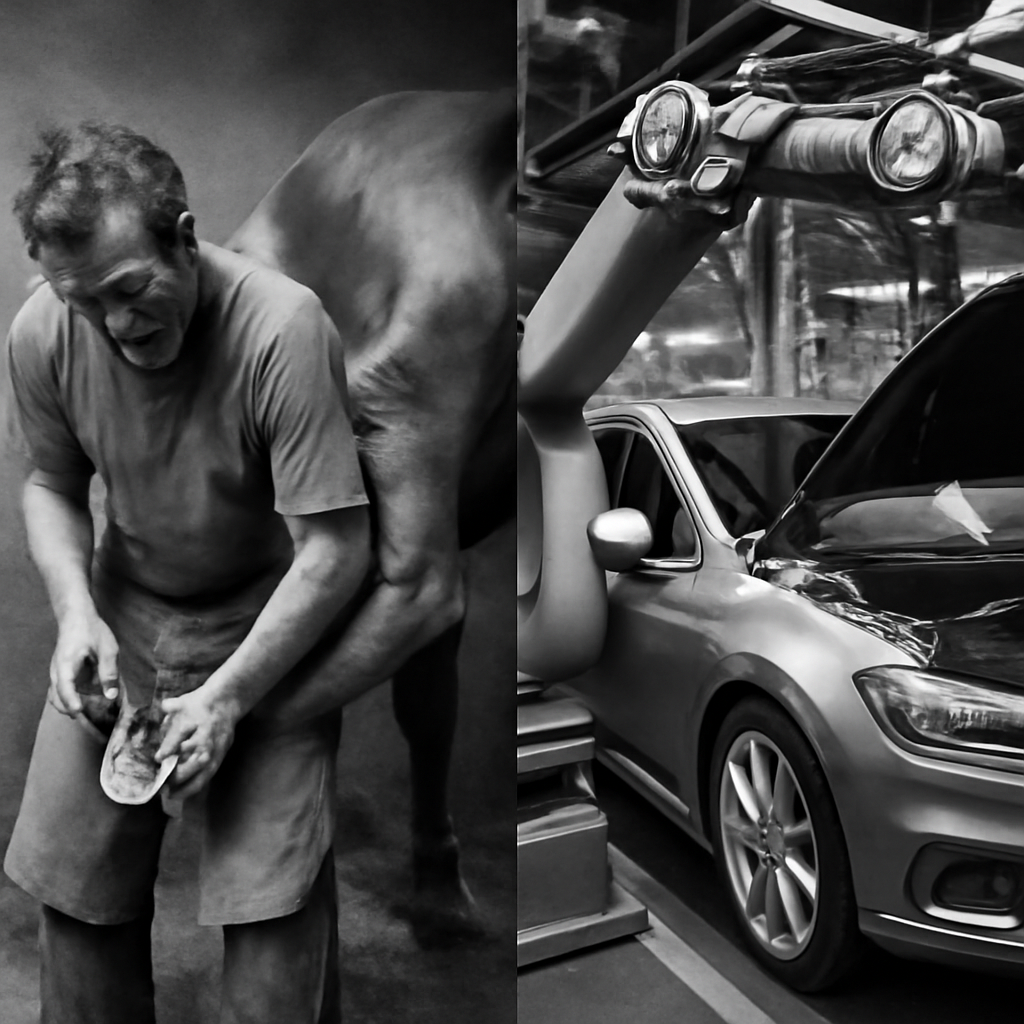
Let us take an even more enlightening example: the transition from the horse to the automobile. When the horse was the key element in logistics processes, it had its own support network: troughs, farriers, veterinarians, fodder, sorting centres. Along came the automobile and it took years to spread because there were no rules, no distributors, no mechanics, no training schools. A new support network was being created from scratch.
Today’s ‘good people’ describe this transition as the ‘liberation of horses from fatigue’ – a poetic vision. But if we look at the numbers: since the arrival of the automobile, the horse population has declined by more than 70%. Not liberation – mass extinction.
Here is the possible adjacent that no one wants to see: when they talk about ‘freeing humanity from work’, perhaps we should ask ourselves whether we will end up like horses.
The Adoption Time Scam
Another rhetorical deception by the ‘good guys’: they show how the car took 50 years to reach a considerable number of users, the plane just as long, then they show how the various media reach hundreds of millions of people in a few hours.
Why do they not say that these last numbers are within the same support network? From the horse to the car there was a whole new network to be created. From Instagram to TikTok it is the same network: internet, smartphones, data centres, payment systems. It’s like saying that changing TV channels is comparable to inventing television.
What’s more, back then, the population was illiterate and had no money – let alone the problem of booking a plane ticket or buying a car. The barriers were not technological but socio-economic.
The Algorithmic Aristocracy
In a data centre handling thousands of artificial intelligence tasks, the 10% of models – GPT, BERT, DALL-E, AlphaFold – handle 80% of the world’s computational traffic. The rest is marginal, destined for digital oblivion. We have created a computational super elite that concentrates productive power as never before in history.
The difference with human elites? This one has no ego, does not go on strike, does not ask for raises. It works round the clock, it self-improves, it replicates. It is the perfect aristocracy for the culture of haste: efficient, silent, unstoppable. But above all: it does not need a new support network. It uses what already exists, optimises it, concentrates it.
The Mathematics of Abundance Without Alternatives
When Elon Musk cut 80% of Twitter’s staff by brutally applying Price’s Law (“only 10% really makes a difference”), he was experiencing what will become normal: fewer people, more automation, same results.
But the crucial question is: where do the 80% laid off go? In the agriculture-industry transition, they went to existing factories. In the horse-carriage transition, farriers could become mechanics because there was a new network to be built. Today? Automation uses the existing network, concentrates it, optimises it. It does not create new support networks that require human labour – it eliminates them.
The Phantom Engorgements of Deflation
As Fei-Fei Li of Stanford says: “We are not just automating repetitive work, we are automating skills. The cost curve is shifting across the board.” The result is what Mariana Mazzucato calls the paradox of the age: “We are on the brink of abundance, but our institutions are built for scarcity.”
ChatGPT allows a junior programmer to do in a day what used to take a week. But instead of freeing up time for more creative activities, it squeezes wages, eliminates middle positions, and concentrates power in the few who control AI. It is a phantom traffic jam on a planetary scale: technology promises abundance, but distributes it according to the logic of scarcity.
The Deflation You Don’t Expect
For generations, policymakers have feared inflation. Today, the real threat could be the opposite: persistent deflation driven not by a crisis, but by relentless advances in technology. As AI designs factories, robots assemble themselves, and networks repair themselves automatically, the marginal cost of production approaches zero. But this does not mean that everyone will have access to the benefits – it means that whoever controls the most productive 10 per cent of the machines will control 90 per cent of the wealth.
As Ben Bernanke warned: “Deflation can be as dangerous as inflation, because it is self-perpetuating.” When consumers expect lower prices tomorrow, they delay purchases today. When workers expect lower wages tomorrow, they reduce consumption today.
The 10% that governs 100%
Price’s Law in the age of autogenesis poses a question we can no longer put off: do we want a world where 10% of machines replace 90% of people, or an ecosystem where 10% of machines empower 100% of people?
The markets will not give the answer – concentration is mathematically inevitable. We will give the answer by deciding how to distribute the benefits of algorithmic hyper-productivity.
The Possible Adjacent of Post-Scarcity
Perhaps the real revolution lies not in resisting the concentration of production, but in imagining new forms of value distribution that do not depend on human labour as a bottleneck.
If an algorithm can diagnose tumours better than a thousand radiologists, the problem is not the algorithm – it is how to ensure that everyone has access to that diagnosis. If an AI system can manage global logistics with superhuman efficiency, the problem is not the logisticians’ unemployment – it is how to redistribute the value created.
But to get there, we have to stop telling ourselves fairy tales about ‘jobs of the future’ and face the reality of the numbers of the present. Price’s mathematics is on the move, and does not wait for our historical analogies.
Creative Construction in the Age of Autogenesis
We are not talking about creative destruction – we are talking about creative construction: building value distribution systems that do not depend on selling human time.
Technological anarchy is not the chaos of mass unemployment. It is the opportunity to rethink work, wealth, the very meaning of the economy. But only if we stop waiting for the factories of the future to build themselves.
The horses had no choice. We did.
The numbers that matter today: By 2050, according to the OECD, artificial intelligence could reduce the cost of most goods and services by 50-70%. The global wage share of GDP could fall by 7-15 percentage points in advanced economies.
We are not talking about the distant future. Maths is already on the move. And this time, there is no new support network waiting for us on the other side.
Welcome to the era where Price’s numbers meet the speed of haste. Welcome to autogenesis without alternatives.