













Data from the Sustainable AI Report reveal a cautious Italy: neither seduced nor hostile, but in search of a reliable relationship with technology. A psychoanalytic reading reveals that what is really at stake is not intelligence, but epistemic trust.
What does it mean today to trust artificial intelligence? It is not just a matter of believing in an algorithm or a new technology, but of accepting a relationship of knowledge and dependence – a bond in which, as in human relationships, the risk of being betrayed is always present. The Sustainable AI Report offers a valuable sociological portrait of this fragile balance: between curiosity and fear, between suspended trust and protective distrust. Through the psychoanalytic gaze, that data also becomes a map of our collective emotions towards the digital.
Trust, distrust and mentalisation in the age of sustainable AI
The data of the Sustainable AI Report offer a sharp but complex snapshot of the attitude of the different Italian generations towards artificial intelligence. What is striking is the almost total absence of extreme positions: ‘strong’ trust is rare, absolute distrust a minority, while a wide intermediate band of moderate consensus prevails. It is as if the relationship with AI is played out not so much on the register of enthusiasm or rejection, but on that of waiting, of caution, of suspended trust. Italy seems to find itself in a position of vigilant openness, more inclined to reflection than adhesion.
From a generational point of view, subtle but significant differences emerge. Generation Z appears to be the most favourable, but also the most influential: trust coexists with the fragility of those who have always been immersed in the digital world and tend to project salvific expectations or catastrophic threats onto AI. Millennials, on the other hand, are the most polarised: between trust and rejection, they oscillate as if in an ambivalent relationship, in which the object – AI – is now idealised, now devalued. Baby Boomers and Generation X show, on the contrary, a more restrained profile: trust is cautious, disenchantment acts as a shield. This configuration suggests that trust depends not only on the degree of technological familiarity, but also on an internal balance between epistemic curiosity and control anxiety, between willingness to learn and fear of being replaced.
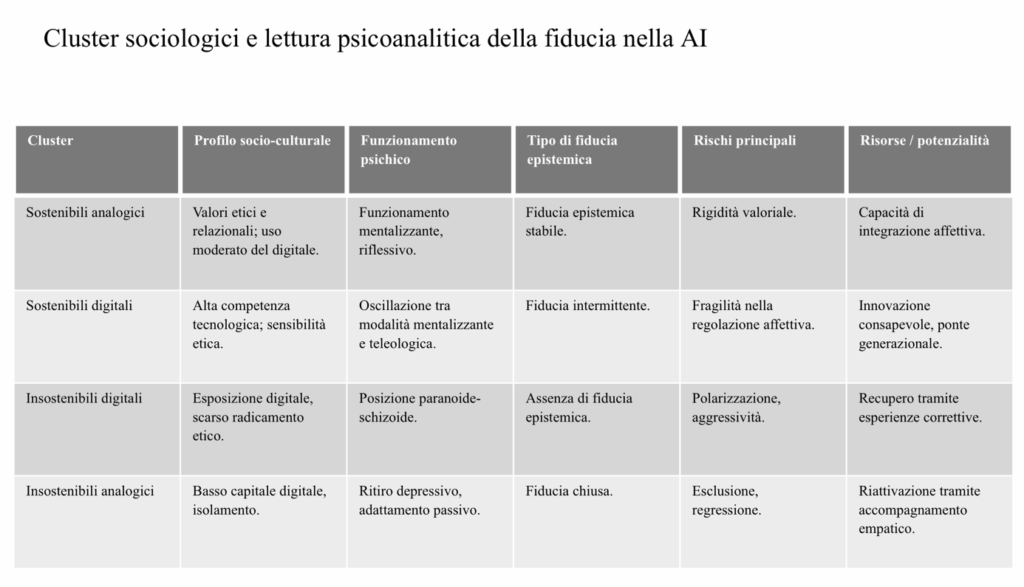
Another decisive line of interpretation is that of the four sustainability clusters outlined by the report. The sustainable analogue subjects represent the most cohesive and ‘mentalising’ core: they do not deny risks, but manage to integrate them into a framework of meaning. We could say that they move from a ‘secure base’, able to tolerate uncertainty and complexity. At the opposite pole are the digital unsustainables, the most distrustful and polarised category: exposed to technology on a daily basis but lacking a value context to guide their use, they oscillate between fascination and suspicion, between the need to trust and the fear of being deceived: the AI is perceived as omnipotent or manipulative, never as a reliable interlocutor. From a psychodynamic perspective, the theme of epistemic trust – the ability to be open to learning from the other when perceiving the other as benevolent, competent and interested – becomes central. In the most sustainable clusters, such trust manifests itself as a willingness to mentalise: to reflect on the intentions, limits and implications of AI, without reducing it to a tool or a threat. In the most unsustainable clusters, however, a teleological mode prevails: what matters is only what ‘works’ or ‘doesn’t work’. Where AI does not produce an immediate benefit, trust collapses; the process of mentalisation that allows
The differences in attitude between sectors – health, labour, mobility – reflect this dynamic
AI in healthcare inspires moderate trust: only 12% of Italians believe ‘very much’ that it can improve services, while more than half say they ‘quite agree’. It is the area where trust is most fragile, but also the one with the greatest potential for repair. Caring, after all, is the original paradigm of epistemic trust: it involves relying on another, tolerating one’s own vulnerability. Here, trust can only be built through relational transparency and the explicit marking of limits: the patient must know where the machine ends and human responsibility begins.
At work, on the other hand, the fear of being replaced, rather than helped, emerges: an experience of loss of agency that requires reparative narratives, capable of reintegrating the individual into the process. Trust arises when AI is perceived as an ally in regulation, not as an object of submission or revenge.
From this point of view, Safran and Muran’s model – ‘rupture and repair’ – offers a valuable key. Many AI applications inevitably generate ‘ruptures’ in the communicative alliance: misinterpretations, stereotyped responses, lack of tuning. What can restore trust is not perfection, but the ability of the system (and its designers) to introduce repair moves: explanations, operational apologies, human channels of support. Repair is the therapeutic act par excellence, and it will also be so for AI if it can recognise and correct its own failures.
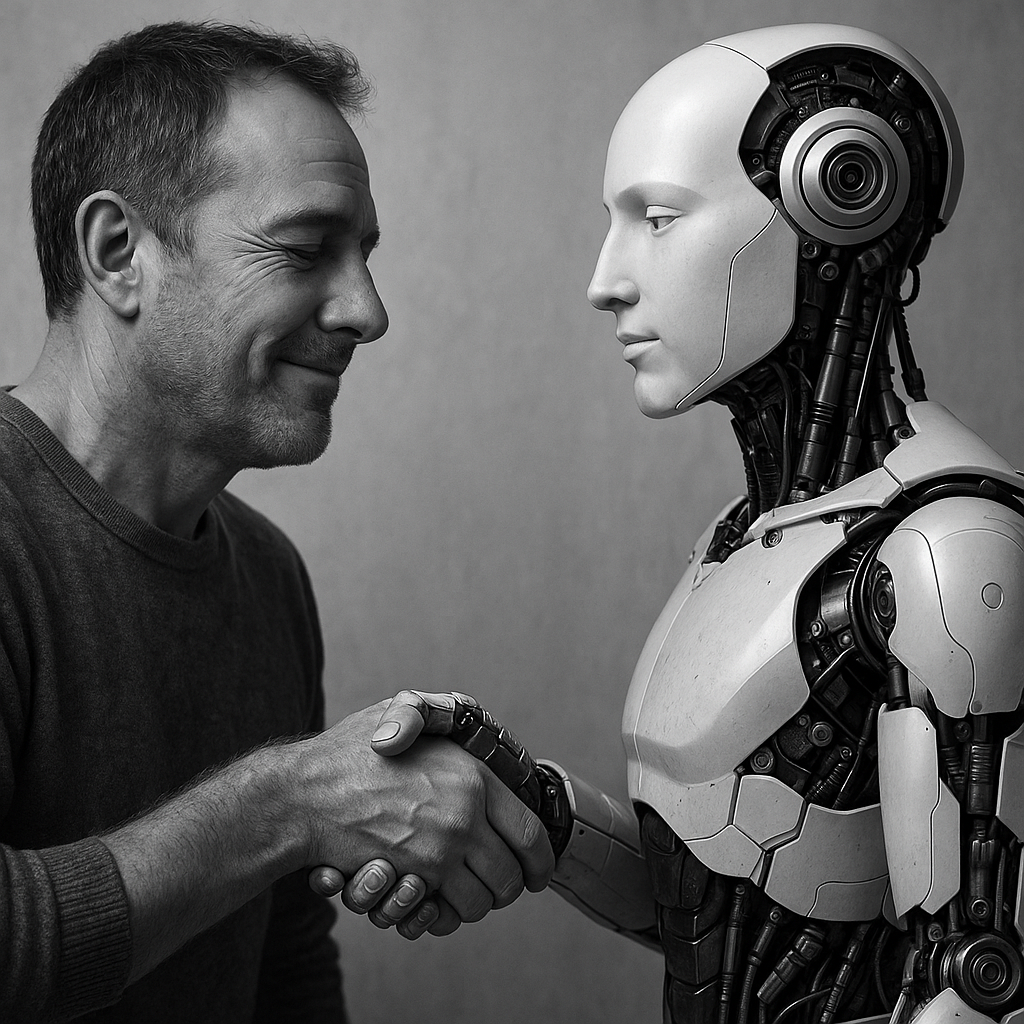
In conclusion, the Sustainable AI Report shows us that trust in AI is not just a matter of technical competence, but of epistemic relationships. Where there are shared value frames – sustainability, responsibility, humanity – a mentalising openness develops, capable of integrating novelty without denying it. Where, on the other hand, the bond of trust is fragile or absent, technology is experienced as foreign, sometimes persecutory. In the end, the real challenge of artificial intelligence is not to become smarter, but more trustworthy: not to simulate empathy, but to generate epistemic trust.