

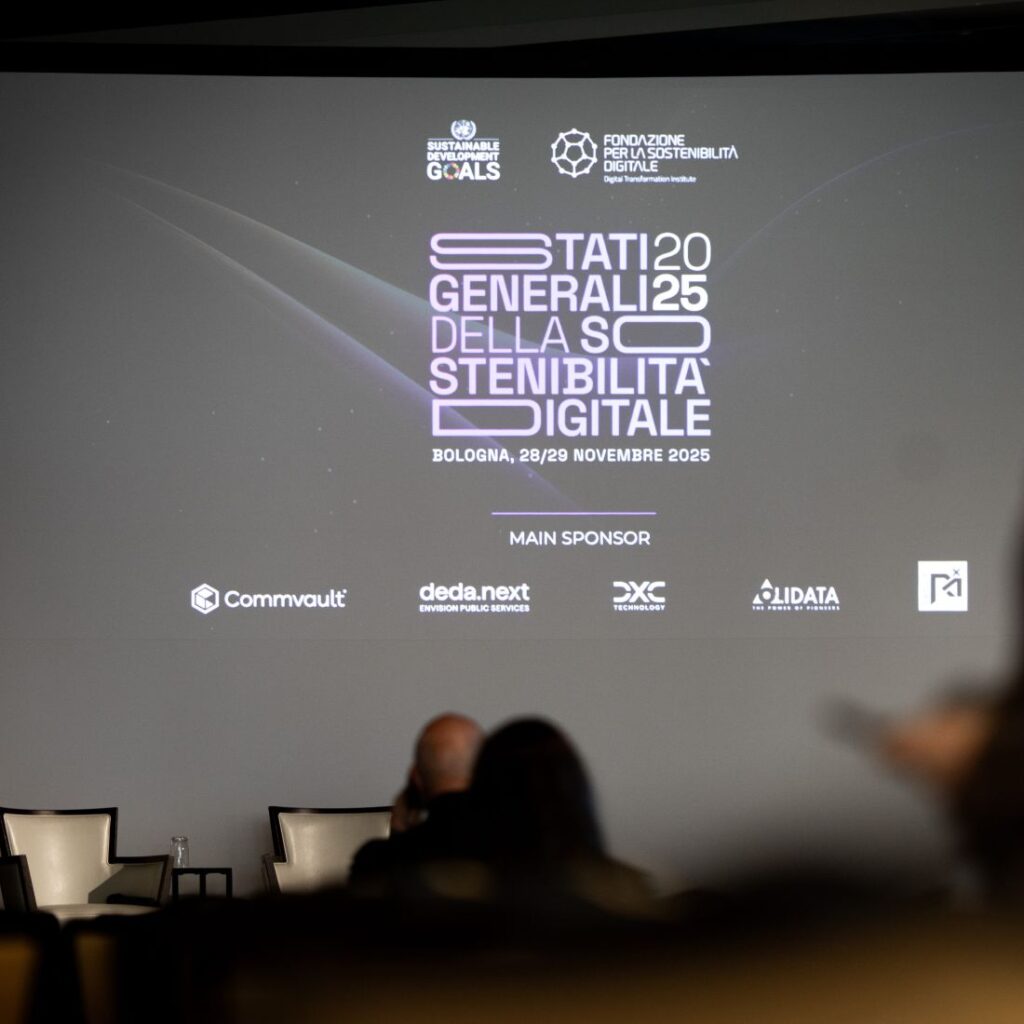

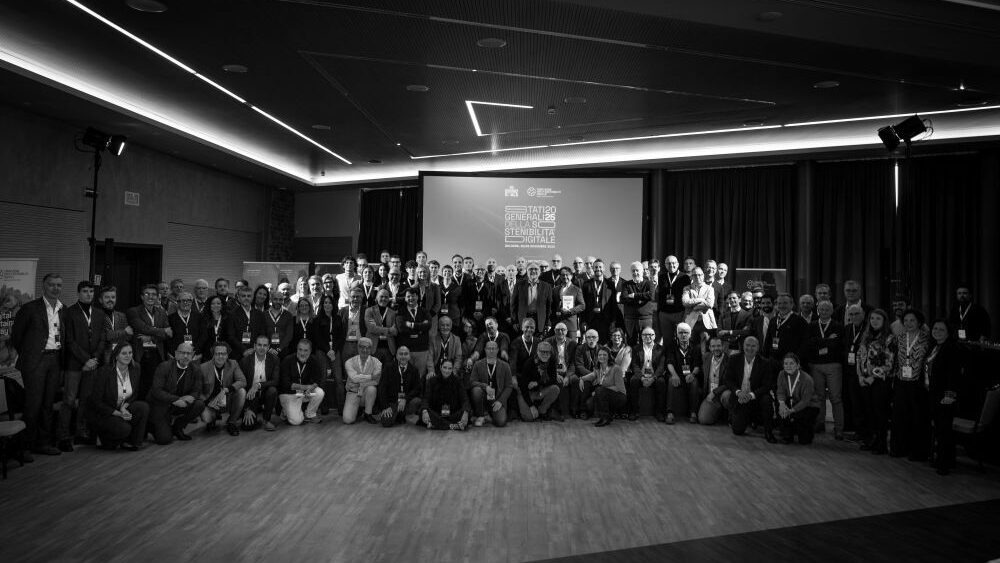
Two days of gathering and sharing, but also and above all of dialogue and open discussion on issues of strategic importance. Two days dedicated to reasoning on how best to address a disruptive change, which is already underway. Two days from which, once again this year, important ideas emerged on which to work to help shape our future with a view to sustainability. All of this represented the fourth edition of the Stati Generali della Sostenibilità Digitale (General States of Digital Sustainability): the event that brings together the Community established by the Fondazione per la Sostenibilità Digitale (Foundation for Digital Sustainability) – which now numbers over 100 c-levels of the country’s most important public and private enterprises – supported for this edition by the main partners Commvault, Deda Next, DXC Technology, Olidata and R1 Group, and which, once again this year in the setting of Palazzo di Varignana, was dedicated to an in-depth examination of the main themes of digital sustainability, from digital sovereignty to artificial intelligence.
The meeting takes on even greater importance in a historical context in which, as President Stefano Epifani pointed out in a deliberately provocative manner in his opening keynote, ‘sustainability is dead‘, just as the Agenda 2030 sustainable development goals are seriously behind schedule – and perhaps unattainable by now – with the world only 18% of the targets in line. A picture that makes it clear, in no uncertain terms, that in order to get back on track and win the challenge we now need new ‘allies’: and the digital transition, if well directed, is today the best ally at our disposal.
Six Strategic Directions for Digital Sustainability
“The Stati Generali della Sostenibilità Digitale is an event that over the years has consolidated its role as a place for discussion, analysis and vision on the country’s digital future,” said Stefano Epifani. “We note with satisfaction how our community continues to grow, even welcoming new professionals from different corporate functions. This evolution enriches the dialogue, broadens perspectives and allows us to respond more effectively to the growing need for multidisciplinary practices. It is only by bringing together different skills that we can put digital sustainability at the service of the innovation of the entire corporate system, contributing to a more responsible, ethical, competitive and future-oriented development model‘.
Through a rich and diversified programme, with parallel sessions on specific topics, round tables between industry experts and focused groups aimed at defining operational strategies, the participants thus placed digital sustainability at the centre of the debate as an ally for overcoming the great challenges that organisations are facing. And from the discussions, the most urgent points emerged – broken down into 6 strategic directions – that the c-levels will have to take into consideration as early as 2026 in order to govern and make sense of sustainable digital-supported innovation:
– Ensuring energy security and access to sustainable energy: AI requires increasing volumes of electricity and water resources. Access to stable and competitive renewable energy becomes a critical business continuity factor, directly impacting the cost, resilience and sustainability of digital infrastructures;
– Strengthening corporate infrastructure sovereignty and control of the technology supply chain: dependence on a few countries for semiconductors, cloud and supercomputing is a systemic risk. Companies need to diversify suppliers, evaluate sovereign infrastructure options and integrate geopolitical risk into investment strategies;
– Protecting and enhancing data capital: data is the key strategic resource of the 21st century. Governance, quality, security and flow control become decisive levers for innovation, competitiveness and regulatory compliance in an increasingly fragmented international framework;
– Investing in talent and advanced technology skills: the global skills shortage in AI, cloud, semiconductor and cybersecurity requires aggressive corporate policies on training, attraction and retention. Human capital becomes the enabling condition for technological sovereignty;
– Linking energy strategy and digital transformation: it is impossible to develop AI without a solid energy base. For companies, integrating green transition and digital transformation means reducing costs, mitigating risks and gaining competitive advantages in regulated markets;
– Prepare for technological multipolarity and the new global innovation order: India, Brazil, Indonesia, Nigeria and Saudi Arabia are emerging as new technology hubs. C-levels must rethink supply chains, partnerships and market strategies in a world where innovation is no longer centred on the US, Europe and China alone.
“The six strategic directives that emerged from the Stati Generali della Sostenibilità Digitale represent the framework that guides our commitment to Italian companies,” commented Vincenzo Granato, Country Manager of Commvault Italy. “At Commvault, data protection and operational resilience are not just technical priorities, but pillars of the country’s digital sovereignty.”
“Our presence at the Stati Generali responds to a concrete urgency: cyber attacks are growing in frequency and power, the surface of exposure is expanding, and automation is accelerating the cycles of offence,” emphasised Cristiano Rufini, President of Olidata. ‘We have to protect today what could be deciphered tomorrow. For Italy, this means putting data sovereignty and the operational continuity of infrastructure at the centre.”
A group for sustainable digital communication
Also new this year was the session dedicated to Communication Directors who set up the Group for the Digital Sustainability of Communication, with the aim of guiding the sustainable transformation of corporate communication. “The working group was born ahead of its time: I believe that today the sustainability of digital communication, in fact, is not a priority in the agendas of communicators,” explained Roberto Ferrari, Promoter of the Group.“However, as is the Foundation’s style, we have tried not to look only at the urgency of the moment, but at the future. And if these issues are still somewhat in the background, they will become increasingly central‘.
Through collaboration and research, the group aims to make digital communication an enabling factor for sustainability and innovation by defining guidelines and operational tools to improve the impact of digital channels and activities, as well as to promote responsible communication practices, capable of countering misinformation and fostering inclusion. But that’s not all: the group’s objective is also to set up a permanent community, capable of fostering dialogue between experts from companies, institutions and the academic world.
mySMART Diary, AI at the service of sustainability
During the event, there was also talk of the mySMART Diary project: the first international web app developed to support therapists and patients in the management of eating disorders. This was an important moment, as the project was born in the context of the Stati Generali della Sostenibilità Digitale (General States of Digital Sustainability) within Digital4Aid: the Foundation’s initiative that aims to develop and donate to the community projects that, thanks to digital technology, address issues and problems related to the SDGs of Agenda 2030.
mySMART Diary represents an important innovation in the field of mental health. Using artificial intelligence and mentalisation models, it enables therapists to obtain detailed information on the eating habits and emotional states of patients and, by collecting data in real time, allows them to monitor the progress of therapy more accurately. For the first time since the project’s inception, the DXC team that worked on the web app demonstrated – live to the audience – how it works, highlighting how its ease of use and the entire structure of the platform is capable of revolutionising the relationship between therapist and patient, representing a tool capable of accompanying and supporting the healing process. “Sustainability is an opportunity to reinforce the social value of technology, but it requires a structured approach that always puts the person at the centre,” commented Nicola Mangia, CEO of DXC Technology Italia Group. “mySMART Diary, the web app developed with the Foundation, is a concrete example of this: it shows how AI can become a tool for inclusion and human support.”
Support is the key word: in fact, mySMART Diary is not intended to replace the therapist in any way, but rather to provide him or her with all the tools they need for more effective patient care. ‘It is a very useful tool for therapists,’ explained Giuliano Castigliego, Scientific Director of the project, ‘because it provides us professionals with a great deal of medical and psychological information at a glance, freeing up time and resources for better patient care.
The winners of the Digital Sustainability Award 2025
But the Stati Generali was not only round tables, working groups and parallel sessions. This fourth edition, in fact, was also the occasion to host the awarding of the Digital Sustainability Award 2025, the initiative promoted by the Foundation to valorise projects capable of combining technological transformation and environmental, social and economic responsibility, in accordance with the principles of the Manifesto for Digital Sustainability and the UNI/PdR 147 Reference Practice.
The winners of the 2025 edition – aimed at companies, public administrations, start-ups and training organisations – were 10: Bludigit, Doxee, Informatica Alto Adige, Rai and Trentino Digitale for the Foundation Member Award – aimed at members and partners of the Foundation – and Digital Innovation HUB Piemonte, INAIL, INPS, Poste Italiane and Sky for the Open Award – aimed at organisations and individuals outside the Foundation’s network. These were also joined by four merit mentions, for Apuana SB S.r.l., SiWeGo S.r.l., MM Spa and Technis Blu S.r.l. “We are very satisfied with the great participation in this first edition of the Digital Sustainability Award, a participation that we verified not only in the quantity of organisations that competed for the award, but also and above all in the quality of the projects presented,” commented Stefano Epifani. “It was not easy to select the 10 most deserving, because the level found by the jury was generally high, which not only testifies to a strong interest in the topic of digital sustainability, but also suggests that we are on the right track.”
A community with a mission
“The Stati Generali della Sostenibilità Digitale (States General of Digital Sustainability) are for us the natural place to be: here, discussion becomes a shared vision and innovation finds direction and responsibility,” commented Fabio Meloni, CEO of Deda Next. “For years we have maintained that digital and sustainability cannot proceed on separate tracks: it means designing solutions that reduce waste, simplify processes and generate measurable value for territories and communities“.
Open confrontation between different actors, collaboration towards a common goal, are elements that have always animated the Foundation, as well as the birth of this community. And they represent, in fact, the fundamental elements for steering a change as important and complex as that of digital sustainability. “Being a sponsor of the Stati Generali represents, for R1 Group, a choice of responsibility and vision,” stressed Giulio Morandini, CEO of R1 Group. “We are convinced that only by actively collaborating with institutions, companies and stakeholders can we create concrete solutions with a high impact for the community“.
The growth of the community, the commitment and the results expressed in these four years indicate that the path is the right one. The goal is clear: to make digital sustainability a lever of progress. Because the sustainability gap can be closed, but it requires a common vision and immediate action. With digital being the enabling tool in building a better future.