














That is: how artificial intelligence convinced us to slow down where there is no accident
“When vessels break, sparks fall trapped in the shells. Tikkun is not to repair the vessels, but to free the light that thought it needed a container.”
– Free interpretation of the Shevirat HaKelim by a digital junkie who read too much Isaac Luria at 3 a.m.
Dedicated to all those who still believe that technological unemployment is the problem
The Chicken Brake (the one we all do)
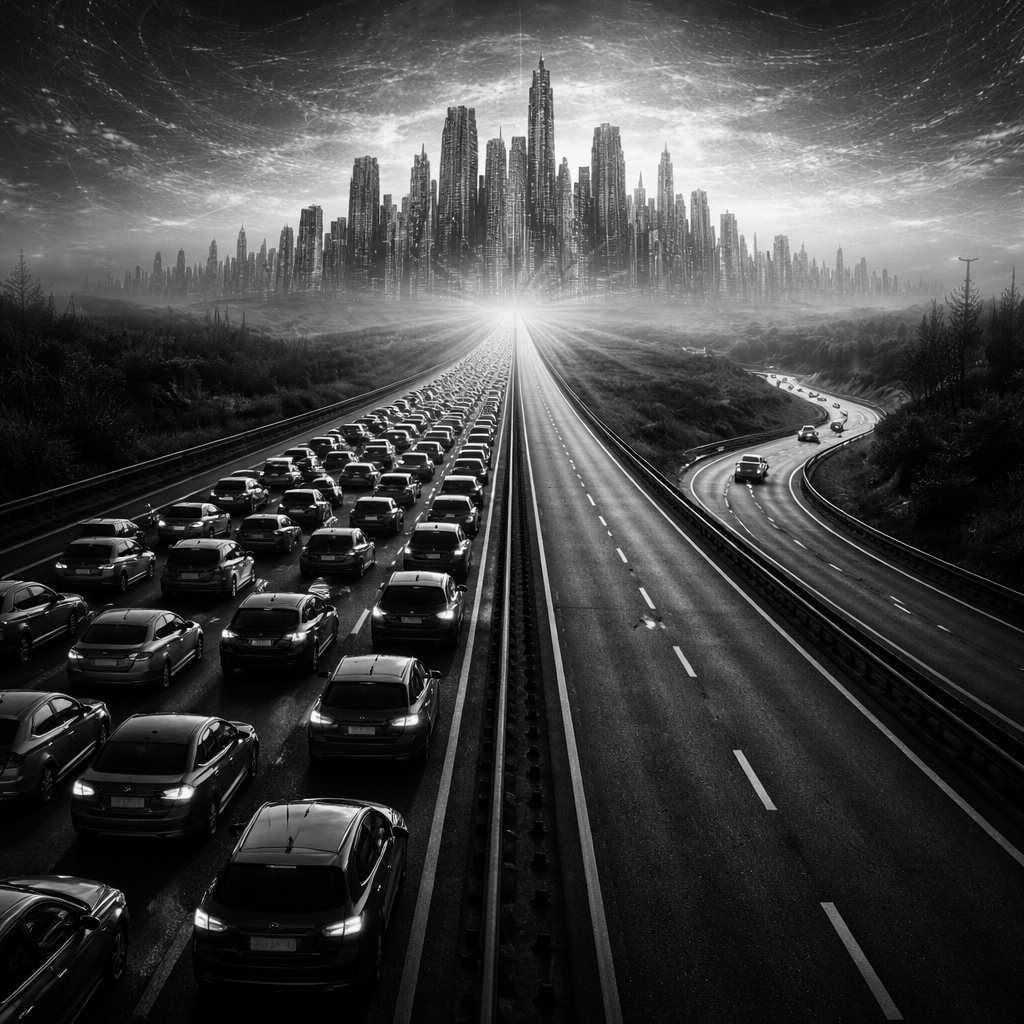
There is this beautiful thing that happens on the motorway: one brakes, the one behind brakes harder, the one behind almost stops, and after half an hour you have created a queue of 10 kilometres. When you finally get to the point of the hypothetical accident, you discover there’s nothing there. Just air. A phantom traffic jam, generated by our collective inability to react to nothing. The AI economy works exactly like that. Only instead of braking with cars, we brake with prices.
Compression: the reverse Jimi Hendrix
Brynjolfsson calls it ‘value compression’. I call it ‘playing Hendrix backwards hoping Mozart will come out’.
It works like this:
– AI produces more and more
– Prices fall more and more
– Wages as well (surprise!)
– Everyone applauds efficiency
– No one realises that we are applauding our economic funeral
It’s like the time the Grateful Dead decided to give away concerts: a great idea, too bad they still had to pay rent.
Remember when Facebook was about ‘connecting people’? The by-product was data. Today, data ARE the product, and people are the by-product.
With AI, the same happens, but worse:
– Declared product: Increasing productivity
– Real by-product: Structural deflation
– By-product by-product: An economy where everything costs zero but nobody has money to buy it
It is the economic version of Russell’s barber paradox: in a world where AI can do everything, who pays AI to do everything?
The Horizon of Events (the one after which we all become unemployed philosophers)
Economists speak of an economic ‘event horizon’: the moment when AI will be able to design, build and replicate itself.
Beautiful. Poetic. Too bad no one thought of one thing: when the marginal cost of production approaches zero, so does the value of money. It is like winning the lottery in Zimbabwe during hyperinflation: technically you are a billionaire, you practically don’t even buy yourself a coffee.
The Crazy Proposal (which is not crazy)
Linda Gonzalez of the University of Miami explains and suggests taxing consumption instead of income says it ‘can help stabilise price levels’.
Translation: because we can’t tax robots that don’t have bank accounts, we tax humans who buy things made by robots. Brilliant. It’s like saying ‘because the Titanic is sinking, let’s raise the price of life preservers’.
But wait, it gets better: the proposal envisages a ‘dynamic’ tax that adjusts in real time. If prices go down by 3%, VAT goes up by 2%. It’s the tax version of cruise control: keep your speed steady as you plummet into the ravine.
The Quantum Consumer Paradox
nda: after blockchain it is now impossible to write an article without quoting Schrödinger
Here we come to the sore point: in a world of artificial abundance, the consumer becomes like Schrödinger’s cat. It is simultaneously:
– Rich (everything costs less)
– Poor (has no job)
– Alive (consume)
– Dead (economically)
Until you open your wallet, you are all these things together. The moment you open it, you collapse into a state: broke.
The Parasitic Economy of Emotions (the real product is you doubting)
You know what the real genius is? It’s not the data. It’s the MEZI spaces given.
AI does not read what you click. It reads:
– The 3 seconds of hesitation before the click
– The nervous scroll when looking for something you don’t know what it is
– The mouse movement that betrays indecision
– The pause of 0.7 seconds meaning ‘I am not convinced’.
It is the economy of monetised doubt. Your every uncertainty is worth gold. It’s as if Pink Floyd had put a meter on the silences of ‘Comfortably Numb’ – you don’t pay for the music, you pay for the emptiness between the notes.
The Custom Bot: The Abolition of the Consumer
And now comes the coup de grace: custom bots that will do the shopping for you.
Follow the perverse reasoning:
– Step 1: Amazon suggests what to buy (you still click)
– Step 2: The AI predicts what you will buy (but you still pretend to decide)
– Step 3: The bot buys for you (game over, you are officially useless)
It is capitalism eating itself: we have created artificial consumers to buy artificial products in an artificial economy. The only real thing left? Your emptying bank account.
It is as if Kraftwerk had foreseen everything: ‘We are the robots’ was not a song, it was a business plan.
Emotional CT in Real Time
While you’re thinking about shopping, the AI is taking an MRI scan of your emotions:
– Excitement = +5% price
– Anxiety = reassuring cross-selling product
– Boredom = immediate dopamine content
– Frustration = tactical discount to close the sale
It’s not Big Brother watching you. It is Big Therapist who psychoanalyses you and sends you the bill. Freud is turning in his grave, but he too would probably have bought the premium subscription. We slip into a loop where machines sell to machines and no longer to people. A dystopian masterpiece:
– Producer: AI optimising production
– Marketing: AI targeting emotions
– Seller: Bot negotiating price
– Buyer: Your custom bot that ‘knows what you need’
– You: The organic ATM financing this comedy
It is the cheap motorway where all cars are self-driving, but someone still has to pay the toll. Guess who?
The Beatles Were Right (as always)
‘Can’t Buy Me Love’ was not just a song, it was an economic prophecy. In a world where AI produces everything, we find that the only things that matter are those that cannot be produced:
– Genuine human attention
– Lived time
– Creative errors
– Suffering that brings growth
Ironic, isn’t it? We built perfect machines only to discover that perfection has no market value.
The Final Cadence of Deception
In music, the cadence of deception is when you seem to be moving towards resolution and instead… turn elsewhere. The AI economy is a giant cadence of deception: it promises abundance, it delivers deflation. It promises leisure, it delivers existential anxiety. Promises efficiency, delivers insignificance.
The solution? It is not in the consumption tax (sorry, my dear Linda). It is not in universal income. It’s not even in Luddism 2.0. The solution is to accept that we have created a system that works perfectly for everything but us. It’s like having built the perfect motorway and then discovering that nobody needs to go anywhere any more.
The Rock Finale
Summers says that any proposal for national taxation ‘must face political opposition from both the left and the right’.
Sure Larry, because the problem is politics. Not the fact that we are trying to apply 19th century rules to 21st century problems using 20th century tools.
It’s like trying to play Zeppelin with a ukulele: technically possible, existentially wrong.
The phantom traffic jam of the economy is not solved by speeding up or braking. It is solved by getting off the motorway. But to do so, we would have to admit that the destination we had in mind may no longer exist.
And that, my friends, is the real compression: not of prices, not of wages, but of the very sense of what ‘economy’ means in a post-scarcity world that still pretends to be scarce.
As Jerry Garcia used to say: “Somebody has to do something, and it’s just incredibly pathetic that it has to be us.”
But hey, at least the concerts were free.
And as I write this, somewhere an algorithm is calculating how long it took you to read each paragraph, where you slowed down, where you laughed, where you sighed. The real phantom traffic jam is not in the traffic or the economy. It is in the fact that while we think we consume content, it is the content that consumes us.
Indecision is the new oil. Doubt is the new currency. And we are the wells that do not know they are being drilled.